Slow Feeder Dog Bowls: Vet-Explained Benefits & Risks

In this article
Our dogs love mealtime, no question! But do you suspect your dog might enjoy her food a little too much? Does she wolf down her food like it’s her last meal? Your dog might benefit from eating her meals from a slow feeder bowl. These bowls are rather unusual looking, but their purpose is to add an extra challenge and slow your dog down while she’s eating.

When Dogs Eat Too Fast
Unfortunately, there are complications that can arise if your dog eats too fast, particularly if she’s a large or giant breed. When gulping down food, they tend to also gulp down a lot of air, leading to bloat or stomach dilatation, once dilated, the stomach can twist over its own axis, turning the dilation into a medical emergency (the medical term is gastric dilatation and volvulus, also called GDV) that can quickly become fatal if not attended via surgery.
While that is the most extreme case, dogs that eat too fast can also encounter gastrointestinal issues like vomiting, and are at increased risk of choking.

Why Is Your Dog Eating So Fast?
Before you do anything else, it’s a good idea for you to try to determine why your dog gulps her food down like there’s no tomorrow.
- If you have other dogs, your dog might be inhaling her food out of a sense of competition. You can feed each of your dogs in separate rooms to help prevent this.
- Is your dog hungry? How often do you feed her? If you’re giving her one meal a day, try giving her two to four smaller meals spaced out throughout the day.
- Similarly, if your dog’s meals consist of very high nutrient and caloric food, this can limit how much your dog can eat at mealtime. Your dog might slow down while eating if you switch to a high fiber and lower calorie dog food, which also means giving her more food volume for each meal.
If these ideas and scenarios aren’t relevant, and your dog seems to be overly hungry most of the time, you should consider taking her to the vet. The veterinarian will run tests to rule out any common issues that might cause your dog’s hunger.
However, if you are quite convinced that your dog wolfing her food down is a behavioral trait, that’s when the slow feeder bowls can come in handy. Behavioral causes are also something that should be consulted with a veterinarian.
What Exactly Is a Slow Feeder Bowl?
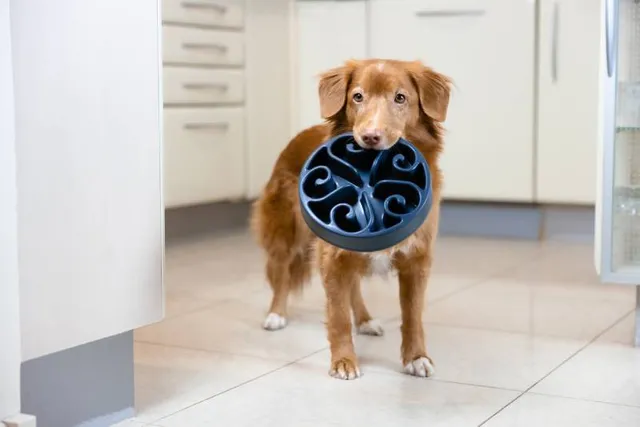
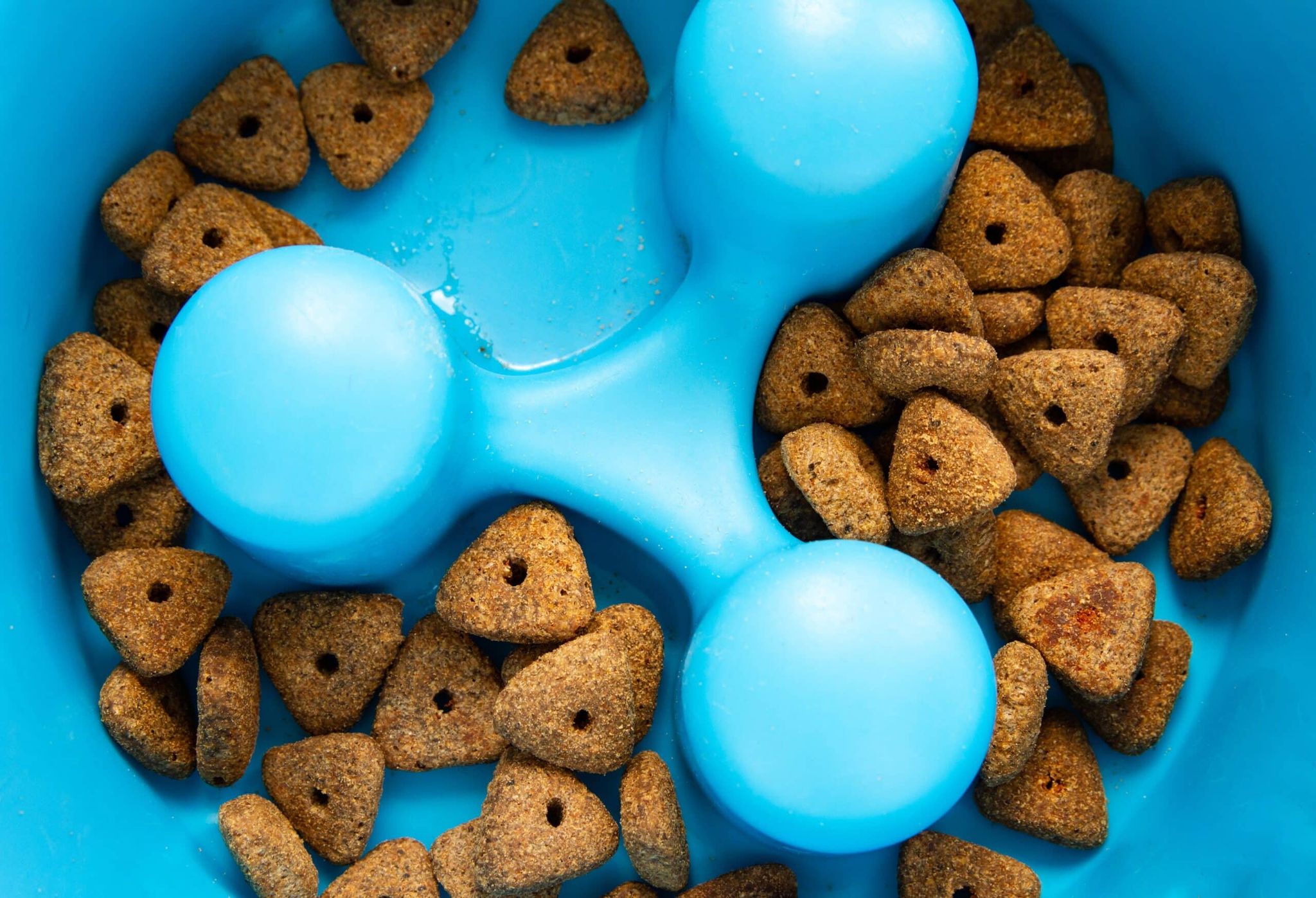
Slow-feeder bowls are dog food bowls that have a bunch of obstructions built into them. These slow feeders come in a variety of different materials; brightly colored plastic to stainless steel and offer a number of obstacles for your dog to figure out in order to get to the food.
They use ridges and other lumps and bumps that your dog needs to negotiate around so he can eat. Some look like mini labyrinths, and others even look like games or puzzles, but these bowls can help prevent serious medical conditions.
Benefits of Slow Feeder Bowls
One of the primary benefits should be pretty obvious: slow feeders slow your dog down while eating. Regular bowls work very well for dogs that don’t inhale their food. The obstructions in a slow feeder make eating more of a challenge, so it takes longer for your dog to eat; this also means she won’t be gulping down all of that air and being at risk of GDV.
But there are other advantages:
So, the benefits range from the physical to the mental well-being of your pup but are there any disadvantages?
Drawbacks of Slow Feeder Bowls
We’ve established that there are many benefits to the slow feeder bowls, which makes it rather difficult to believe that there could be any disadvantages. But there are.
- Damage to the Teeth: If your dog is particularly enthusiastic while eating, there is a risk that she might damage her teeth. Some dogs might become frustrated trying to get at the food, and if the bowl is made from a durable material, this is a possibility. But the chances of this occurring are not very high.
- Plastic: If you purchase a plastic bowl that is cheap and made with softer material, there’s a chance that your dog might end up eating small parts of the bowl. Certain plastics are less than ideal and might contain toxic chemicals that can leach into a pet’s food.
- Cleaning: Washing these bowls is definitely more of a challenge, thanks to all of the nooks and crannies. The more the bowl is a puzzle and harder for the dog to eat from, the more difficult it will be to clean.
- Mess: Dogs are more prone to making a mess while eating from these bowls, especially while trying to get at the food. Some dogs might even knock them over in their eagerness to get at the food. If you have a strong dog and believe this might be an issue, be sure to invest in a bowl that is stable and heavy.
If you find the right bowl for your dog, these problems more than likely won’t be a problem.
A Few Notes
Just a few notes on finding the right bowl for your dog. Slow feeders won’t work for any dogs that are picky eaters and aren’t necessarily motivated by food. Your dog could go hungry and really should only eat from regular bowls.
If you have a large dog, opt for the large and sturdy bowls and the smaller bowls for the smaller dogs. The more enthusiastic the eater, the sturdier the bowl should be.
Also, if your dog initially struggles with the new bowl, particularly if it’s a challenging puzzle slow feeder, take some time to show her how it works. Be ready to reinforce her getting the food with other higher-value treats or simply words of praise and cuddles. Be patient, and she’ll pick it up eventually.

Conclusion
It’s good to have options when your dog loves to gobble down her food. You can also make your own version of a slow feeder if you can’t afford a new dog bowl. Filling up some muffin tins can help slow a dog down. Or just try scattering small amounts of food in different places, if you don’t mind the mess. And if you give your dog canned food, try smashing it up against the sides and into the corners of her bowl. It will take more work for her to lick it out.
We hope we’ve helped you and your literal chowhound with this problem. We all know what it’s like to be so hungry that you could eat almost anything, but we want your dogs to live long and healthy lives, and they need to, well, not eat everything in sight. All at once.
See Also:
Featured Image Credit: Longfin Media, Shutterstock
Expert dog care, straight to your inbox
Vet-reviewed advice, training tips, and the best of Dogster. Free, and you can unsubscribe anytime.
By signing up, you agree to our Terms & Conditions and Privacy & Cookies Policy.
Kathryn was a librarian in a previous lifetime and is currently a writer about all things pets. When she was a kid, she hoped to work in a zoo or with wildlife in some way, thanks to her love for animals. Unfortunately, she's not strong in the sciences, so she fills her days with researching and writing about all kinds of animals and spends time playing with her adorable but terribly naughty tabby cat, Bella. Kathryn is hoping to add to her family in the near future – maybe another cat or two and a dog.
Join the conversation
Ask a question, share your story, or send private feedback.