Bomb Sniffing Dogs: What They Do & How They Are Trained

In this article
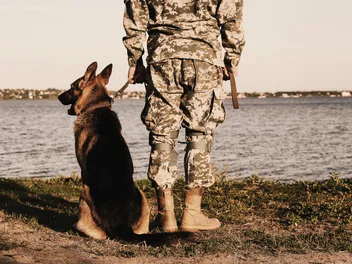
For thousands of years, canines have been helping humans stalk prey, fight off predators, and protect livestock. Service dogs, in turn, aid people with disabilities, while circus animals perform tricks. And then there are bomb-sniffing dogs: fast, witty, and fearless canines that help fellow servicemen and servicewomen detect explosions and prevent disasters. But what exactly does an explosive detection dog (EDD) do?
How are these dogs trained? Which breeds are most suited for this duty? These are just some of the topics that we’ll cover in this guide. Stay tuned!

What Is a Bomb Sniffing Dog? What Does It Do?
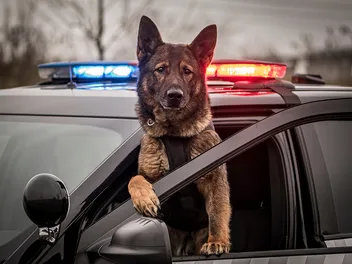
As the name suggests, these dogs are specifically trained to detect a bomb (or, rather, its scent) and report back to their handlers. The candidates go through tough training and get to wear their own badge once they’re accepted into the team. After the events of 9/11, the demand for explosive-detecting canines went through the roof, not only for the police but also in special force units, the military, and private contractors. Bomb-sniffing dogs are trained to be indifferent to other dogs and cats.
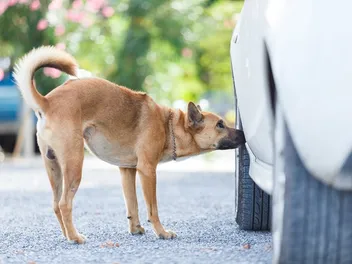
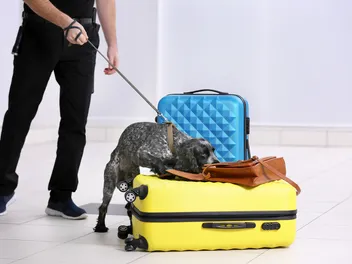
This allows them to stay focused on the mission. They are often used in stadiums, airports, and other crowded places to make sure there are no explosives in the area posing a threat to human lives. K-9s are the first ones to interact with a potential hazard and that’s what makes their work dangerous. Bomb dogs mostly scan humans, baggage, crates, planes, and cars and can work for 35–50 minutes without a break.

Explosive Detection Dogs: How Effective Are They?
This might come as a surprise to a person that’s never been around an EDD, but these animals are incredibly effective at their job. In fact, as the National Institute of Health puts it,1 they are the most efficient, adaptive, and reliable means of detecting bombs. True, modern-day robots/tech devices do a very decent job, but they’re still not nearly as smart as the doggos. That’s why K-9s are the best option on the table for real-time detection.
And one more thing: humans mostly rely on sight to “read” their surroundings; dogs, in contrast, concentrate on their sense of smell. Canines have 100+ million sensors in their noses while we only have 6 million. Veterinarians even claim that the part of a dog’s brain that processes scents is 40 times bigger than that of a human. Thus, our four-legged buds can smell 1,000–10,000 times better than we do. Plus, they search areas up to four times faster than human specialists.
Here’s a list of all the explosive materials that these dogs can sniff out:

What Are the Different Types of Bomb Sniffing Dogs?
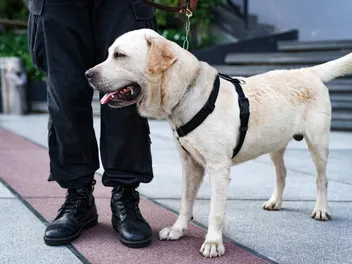
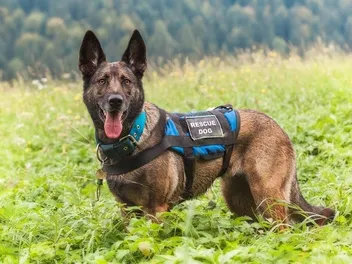
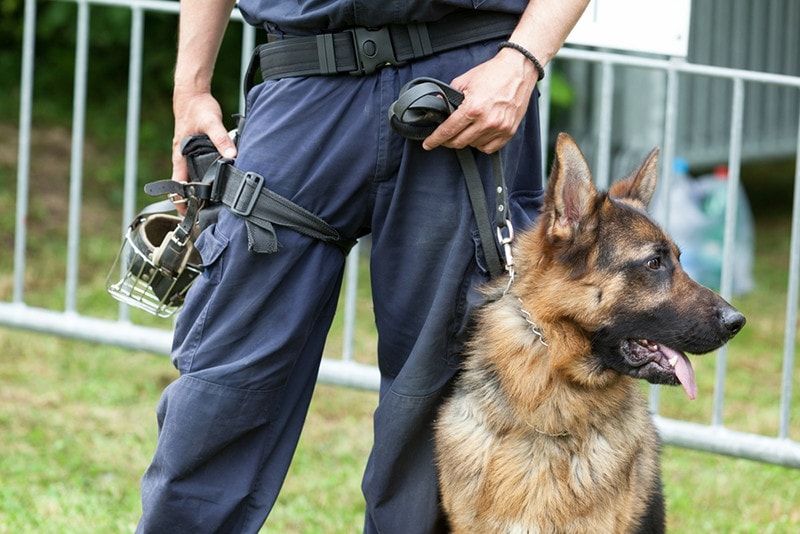
According to the American Kennel Club, sporting breeds are the most common choice when it comes to bomb detection dogs. The list includes Labrador Retrievers, German Shorthaired Pointers, and various Shepherd breeds, to name a few (including German, Dutch, and Belgian Shepherd dogs). These canines are naturally more equipped for this kind of work. On top of that, they are highly intelligent, enduring, and quick to follow commands.
So, while you could say that just about any dog can be turned into an EDD, some breeds do a better job of sniffing explosive materials. Age matters as well, of course. Certain training programs only pick puppies for the job; others start as soon as the doggo turns 10–12 months. But what most programs have in common is that they don’t usually work with dogs that are over 3 years old. The reason: the younger the pup, the easier it will be to “shape” it into a K-9.

To sum up, here are the best breeds for EDD duty:
What’s the Average Service Life for a Bomb Detection Dog?
This greatly depends on how effective the dog is. Some canines stay laser-sharp for many years, while others lose their touch after 6–12 months. Health conditions matter as well, of course, along with the dog’s desire to work. In the US, the average service life for an EDD is 5–7 years. It’s up to their handlers and in-house veterinarians to check them regularly and evaluate the dog’s ability to serve. A pooch that’s not very smart, obedient, or motivated won’t even be accepted.

Where Are They Used?
Explosive detection dogs are among the smartest canines on duty. When properly trained, they can detect explosives of all shapes and sizes in the blink of an eye. These K-9s can identify dangerous chemicals, biological weapons, nuclear compounds, radiological materials, and other hazards. To put things into perspective, human detection dogs only track missing people, while narcotics detection dogs focus solely on sniffing out controlled substances.
That’s why the bomb-sniffing dogs are so highly valued in the industry. Airports, hotels, shopping malls, vehicles—a bomb can be planted pretty much anywhere. And, even if it turns out to be a hoax, the dogs still risk their lives to investigate the scene. So, the range of uses for a well-trained canine is quite wide. And if it’s got years of experience behind its back, that K-9 has the chance of becoming THE most valuable member of the team.
The best EDDs can detect explosives, residue, and blast evidence to help with an investigation. Again, if we talk about detector dogs in general, they are always trained for one specific task/odor type to reach maximum efficiency. Here’s a quick look at common scents that they’re taught to identify and detect:

What Language Do K-9 Handlers Use?
If the dogs were brought up in the US, the UK, or any other English-speaking country, then the commands will be in English. However, with canines that were trained in Germany, the Czech Republic, or the Netherlands, handlers are recommended to learn the commands in the native language of the country they were trained in. It’s always easier to memorize 15–20 commands in a foreign tongue than to make the dogs learn new ones.
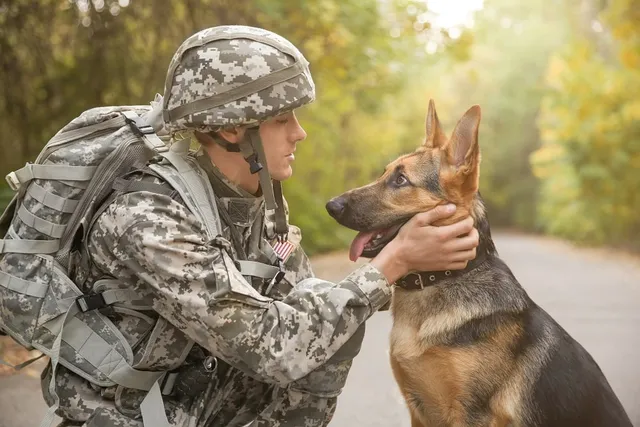
Oh, and by the way, the dogs stay with their handlers. This gives the human and the dog a chance to bond.

How Are Bomb Sniffing Dogs Trained?
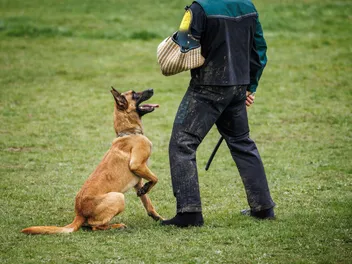
Every single dog training program has one job: to teach the dog how to use its nose in various environments. It starts with instructing the dog to find their favorite toy, followed by a food/praise reward. Next, the handlers introduce future bomb sniffers to the five most prevalent explosive groups, including chemicals that are used in 19K bomb formulas. By being exposed to such a wide range of scents, the canines gain the ability to “isolate” explosive odors when they arrive at the scene.
Commercial bombs aren’t the only threat: there are tons of makeshift explosives out there. And the only way for an EDD to detect them is to have in-depth knowledge of the aforementioned explosive groups. Here’s how the Bureau of Alcohol, Tobacco, Firearms and Explosives (ATF) does it: first, they treat K-9s for a job well done to encourage them. After that, dogs are required to detect up to 20 different bomb scents without making a single mistake. And two of those odors are brand-new for the dogs. Only then are the dogs truly ready for deployment.

How Long Does the Training Take?
Depending on the program, the dog might have to go through up to two months of training before it’s handed over to a handler. For example, dogs at the TSA Canine Training Center spend 6–8 weeks getting ready. After that, they are paired with a handler for a total of 24–32 weeks of training and work in real-life situations like mock terminals, hotels, aircraft units, and other scenarios to get the EDD ready for action.
The ATF, in turn, has a 10-week entry-level program that determines whether the pooch is good enough to continue training. It’s not exactly a walk in the park for the canines. The standards for becoming an explosive detection dog are very high. If the candidate doesn’t meet mission-specific requirements, it won’t ever be deployed. Dogs that lack physical and mental abilities are disqualified from training after 2–3 weeks of being at the camps.
Handlers evaluate their physiological, structural, and, of course, behavioral patterns and characteristics. For this reason, EDDs are mostly recruited from dog families/populations that have been bred for specific tasks. We’re talking about herding, hunting, and security (watchdogs and guard dogs). In many ways, it all comes down to the dog’s drive to follow and the handler’s ability to work with the leash and give the K-9 freedom when it’s needed.

The good news is roughly 90% of all teams do graduate from the courses. This is interesting. While bomb-sniffing dogs are at home waiting for a call, they still do things to stay in shape, including:
Frequently Asked Questions
How many detection dogs are in the States?
As of 2022, there were approximately 5,100 trained dogs in the States working for the government. They were all employed through various federal programs to find bombs, sniff out narcotics, and detect diseases. On top of that, as many as 400 dogs serve as contractors. These working dogs mostly come from Europe: up to 85% of canines obtained by the US Air Force are bred in the EU, mainly Germany and the Netherlands.
The Department of Defense, in turn, relies on the Air Force to provide it with the K-9s. And if we talk about specific breeds, they’re good for different tasks. For decades, the military has been using Shepherds (Dutch, German, and the Belgian Malinois) for duty. Labrador Retrievers excel at detecting scents (mostly drugs, marijuana, and cocaine). Lastly, Jack Russell Terriers are often employed in agriculture.

How much do these dogs cost to train?
On average, the government spends anywhere from $65,000 to $85,000 to turn a pup into a K-9. Police dogs come in at $8,000–$12,000, yet the training costs a lot. That’s right: handlers put tons of effort into training such a dog. They need to be strong, agile, run fast, and be able to overcome obstacles. Plus, they often work in rough climatic conditions and have to navigate through some rubble. And if we’re talking about their sense of smell, it takes years to perfect it.
It’s not that easy for a canine to “pinpoint” the right scent when it’s surrounded by dozens, if not hundreds, of odors. Besides, they’re often required to wear dog-specific armor that weighs a lot and limits their movements to a certain degree. And what about the handlers—how much money do they make? In the US, a professional handler earns $54,000. That’s the median average, of course: the starting salary is $43,000.

Are K-9 dogs sterilized, or not?
Females are almost always spayed, but that doesn’t apply to the males. If it’s dictated by a medical condition, then, of course, the boys are neutered. However, once the doggo grows older than 1.5 years (18 months), sterilization doesn’t prevent it from performing its duties. We’re talking about both boys and girls here. Who pays for the surgery, then? Mostly, it’s the government, but it’s not rare for non-profit organizations to make a donation.
Conclusion
Bomb-sniffing dogs deserve all the praise in the world. They are willing to put themselves at risk to make our lives safer. And it takes months, if not years, of vigorous training to turn a regular doggo into a K-9. Thanks to their inherent ability to track scents from miles away, they are highly regarded by the police, TSA, and Homeland Security.
Dogs can detect bombs, firearms, drugs, and hazardous chemicals. Sadly, there’s a shortage of properly trained sniffing dogs in the US, which makes every single doggo worth its weight in gold. So, next time you see an EDD Shepherd or Retriever in an airport or the park, do your best to make it feel appreciated!
Sources
Featured Image Credit: wellphoto, Shutterstock
Expert dog care, straight to your inbox
News, insights, expert advice, and everything dog.

No spam — unsubscribe anytime.
By signing up, you agree to our Terms & Conditions and Privacy & Cookies Policy.
How useful was this post?
Click a star to rate. You can leave written feedback afterwards. (We read all feedback.)
Nicole has loved animals of all sizes her whole life so it's no wonder she has dedicated her career to helping them through what she loves best: learning, writing, and sharing knowledge with others. She’s the proud mom of two dogs, a cat, and a human. With a degree in Education and 15+ years of writing experience, Nicole wants to help pet parents and pets around the planet to live happy, safe, and healthy lives.