How Do Search & Rescue Dogs Find Missing People? Vet-Verified Answer


In this article
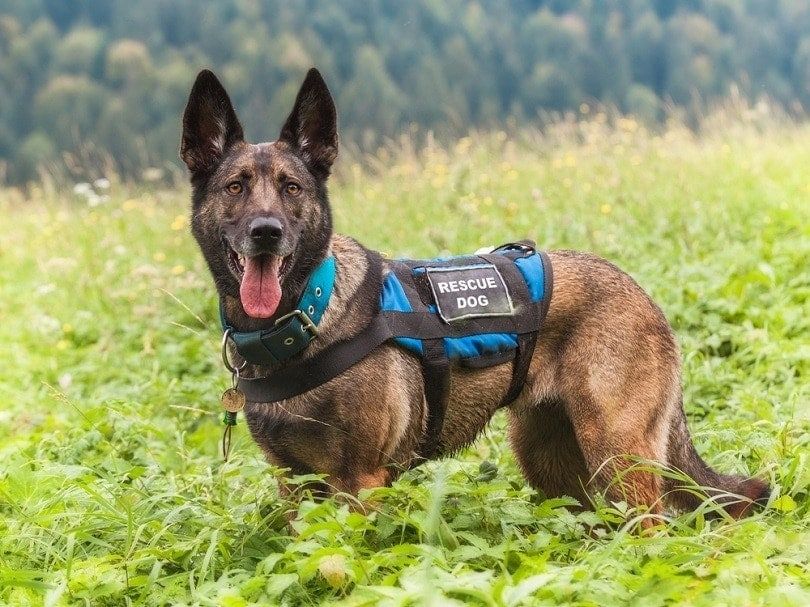
Dogs play many roles in our everyday lives. Some are companions, others are used for farm work, and many are employed as service dogs for the police or military. But one of the most important jobs for dogs is in search and rescue.
These highly trained dogs are used to find people who have been lost in precarious situations when time is crucial. Along with people, these dogs manage their heroic work using one of the strongest natural abilities: scent.

What Are Search-and-Rescue Dogs?
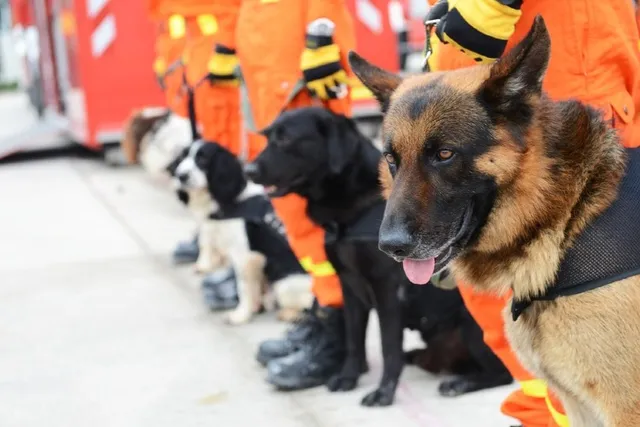
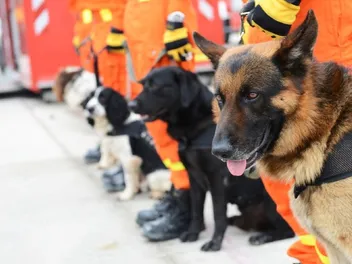
Search-and-rescue (SAR) dogs are working dogs that are used to help find humans that have been lost in various circumstances. They may find people who have been lost hiking in the wilderness or displaced after a natural disaster, such as buried in debris following an earthquake. They may also be used to find missing long-term-care residents with dementia if they wander away from their facility.
In all these situations, the longer someone is missing, the more danger they’re exposed to. This is especially true following natural disasters, which may leave missing people seriously injured and in need of medical attention.

The Power of a Dog’s Sense of Smell
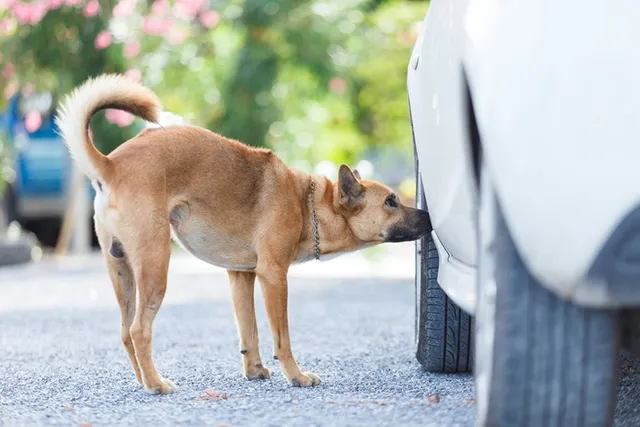
The major advantage dogs have in search-and-rescue is their sense of smell. Dogs have incredible olfactory senses, far stronger than humans. They have over 220-300 million sensory receptor sites in the nasal cavity, compared to about 5-6 million for humans.
The part of the brain responsible for detecting olfactory senses is about 40 times larger than ours, and it’s estimated that they can smell anywhere from 10,000 to 100,000 times better than humans, giving them a distinctive edge in search-and-rescue work.
Part of this is Jacobson’s organ, which is a special organ in the nasal cavity that opens into the roof of the mouth behind the incisors. These nerves lead to the brain and respond to a range of substances that don’t have an odor we can detect.
Basically, just like dogs can hear sounds that are inaudible to humans, they can also smell “undetectable” odors, which helps them locate missing people.

Types of Rescue Dogs
Search-and-rescue dogs all share the role of finding missing people based on scent, but they’re divided into two types: air-scenting and trailing dogs.
Air-Scenting Dogs
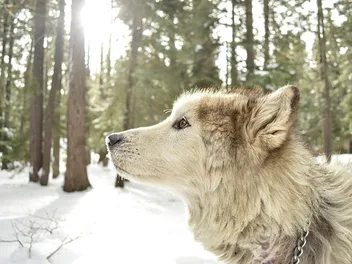
Air-scenting dogs detect human scent that lingers in the air. They may work off-lead to explore a large area of land in a search party. These dogs are not scent-discriminating, however, which means they’ll pick up the scent from any human in the area, not a specific person. These dogs follow airborne scents, whether diffused or carried by the wind, until they determine where the scent came from. Once they find it, they alert their handlers by barking or another trained indicator.
One of the disadvantages of air-scenting dogs is that they rely on airborne scent particles, so their accuracy and ability can be hampered by weather conditions. Wind speed and direction, humidity, temperature, and other factors can have a significant effect.
Still, these dogs have powerful scenting abilities—even in poor weather conditions—and can cover areas ranging from a few hundred square feet to 150 acres. They can detect a scent as far as a quarter mile away.
Common breeds used for air scenting are herding or sporting types, including Border Collies, German Shepherds, Springer Spaniels, Labrador Retrievers, and Golden Retrievers.

Trailing Dogs
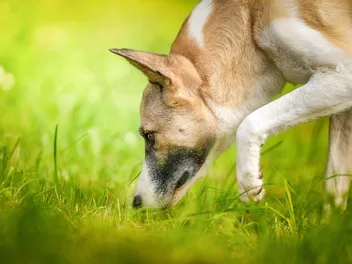
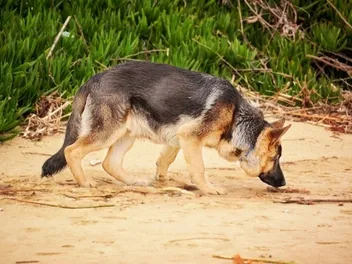
When most people think of search dogs, they think of trailing dogs intently following a scent with their noses to the ground.
Trailing dogs are used to track missing people by scent. They can differentiate between the scent of a specific person, usually by smelling clothing or the person’s belongings, and follow that scent.
These dogs are so sensitive to smell, in fact, that they can follow turns or places where a lost person doubled back over the same area. They can zero in on just one person’s scent as well, which is helpful in high-traffic areas.
Trailing dogs may work on- or off-lead as needed, but they work slowly. Their handlers usually stay close, following the dog as it tracks instead of leading the way.
The obvious breeds used for trailing include scent hounds like Bloodhounds, but other working and herding dogs can perform well with the right training. It’s important for these dogs to not only have an acute sense of smell but also the stamina and temperament to adapt to extreme terrains and rough weather conditions.
Search-and-Rescue Dogs in Disasters
When natural disasters strike, such as tornadoes, earthquakes, and floods, air-scenting and trailing dogs may be used in tandem to find a missing person. The air-scenting dog can be used for a large search area while the trailing dog tracks the missing person’s scent.
These tracking dogs begin at the person’s last known point (LKP) and move outward. If there isn’t an LKP, these dogs are deployed in areas where the person could have most likely gone.
In some cases, air-scenting and trailing dogs can be trained as cadaver dogs to aid in the location of deceased people after natural disasters or localized crime scenes. This isn’t done often, however, because it can create confusion in evidence used for criminal cases that can be exploited in court.

How Are Search-and-Rescue Dogs Trained?
Most dogs have an exceptional sense of smell, and the scent hounds typically excel, but there’s more to being a search-and-rescue dog than scenting. These dogs must be highly trained to operate in an environment with a lot of distractions, such as wildlife and other people, and must maintain their focus on the task at hand.
In addition, these dogs must not be blindly obedient. They need to be “intelligently disobedient” because they can’t possibly be trained for every possible circumstance that may come up in the field. They have to be able to think for themselves.
For example, if a handler directs the dog to a different area, but the dog has located the scent source nearby, it must deliberately ignore the handler’s commands. This is done using an indicator that the handler is headed in the wrong direction to change course.
Typically, search-and-rescue dogs are trained as young as eight to 10 weeks old and are ready to work in the field around a year or a year and a half old. Because the work is taxing, both physically and mentally, these dogs are usually retired with their handlers around 7 to 10 years old.
Final Thoughts
Search-and-rescue dogs are incredible canines that can help save lives and locate missing people. Now that you have read about these dogs' skills and training, you can appreciate them even more. They are hardworking, tireless furry heroes!
Featured Image Credit: jasomtomo, Shutterstock
Expert dog care, straight to your inbox
News, insights, expert advice, and everything dog.

No spam — unsubscribe anytime.
By signing up, you agree to our Terms & Conditions and Privacy & Cookies Policy.
How useful was this post?
Click a star to rate. You can leave written feedback afterwards. (We read all feedback.)
Nicole has loved animals of all sizes her whole life so it's no wonder she has dedicated her career to helping them through what she loves best: learning, writing, and sharing knowledge with others. She’s the proud mom of two dogs, a cat, and a human. With a degree in Education and 15+ years of writing experience, Nicole wants to help pet parents and pets around the planet to live happy, safe, and healthy lives.