Male vs. Female Rottweilers: The Difference (With Pictures)


In this article
Rottweilers are large, powerful dogs that appear somewhat intimidating at first glance, but in reality, are generally sweet, loving, and loyal family dogs. Still, having such a powerful dog is a massive responsibility, and these dogs can be dangerous without the proper training and socialization.
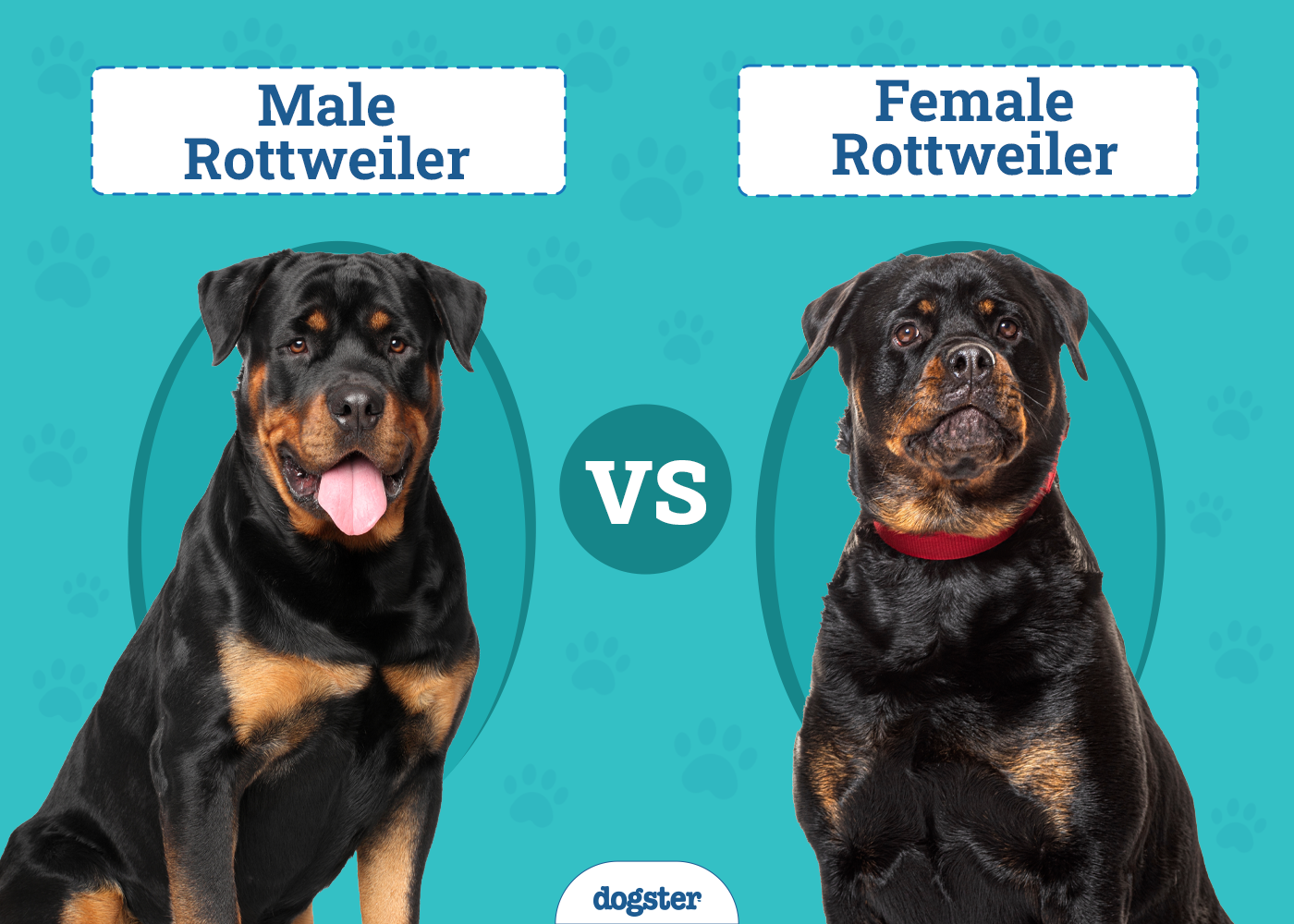
If you’ve decided that a Rottweiler is the right dog for you, you’ll need to decide whether to get a male or female. It’s important to remember that all dogs are unique individuals, and as such, there are few certainties when it comes to the sexes. Still, there are a few differences to be aware of. In the following article, we look at these differences to help you decide which is best for you.

Visual Differences

At a Glance
Rottweiler 101
Rottweilers were initially developed in Germany for driving cattle and pulling carts and were one of the first breeds to be used in the police force and military. Although these dogs have become popular family dogs, they can still make formidable guards and protectors. Playful as youngsters, Rottweilers mature into calm adults, though this can take 2-3 years!
They are highly intelligent dogs that respond well to obedience training and positive reinforcement and are eager to please their owner. Given their size, strength, and protective nature, it is important to set clear boundaries for your Rottie pup from day one so there is no confusion about who is in charge. Both males and females will readily assume a dominant or leadership role if an alternative is not made clear, and they are best handled by a confident and experienced dog owner.
That said, Rottweilers are not inherently aggressive or vicious animals, and if they’re trained properly, they are among the most gentle and loving dogs around, making them ideal family pooches. Like many other powerful breeds that are often used in military or police work, Rottweilers are largely misunderstood dogs that are undeserving of their vicious reputation. These large, powerful dogs are gentle giants overall; they just need direction and consistent training from a gentle and confident owner to guide them.

Male Rottweiler Overview

Personality / Character
In general, male dogs are often assumed to be predisposed to displaying behaviors like marking territory or aggression, but this is not true of all males, and certainly not when it comes to Rottweilers. Male Rotties are highly affectionate dogs and loyal protectors and will only act aggressively when provoked or in defense of their family. They can display dominant behavior at times, though, and may keep testing their boundaries throughout their early years, a trait that you’ll need to keep a close eye on.
Male Rotties are also known for attaching themselves strongly to one member of the family, usually the person who feeds and trains them, although they are still affectionate and loyal to other family members too.
Training 🎾
Since male Rottweilers mature slightly later than females and have more of a tendency toward protective and territorial behavior, training males can be more tricky than females. You’ll need to exercise patience and make training sessions consistent in order to be successful, but with the Rottie’s intelligence and loyalty, they are usually not difficult to train.
Because these dogs grow quite quickly, early socialization is vital for the Rottweiler, and allowing them to play with older dogs that will teach them manners and ‘put them in their place’ is an important part of their development. Rough play with humans must never be tolerated or encouraged, as this can quickly become dangerous when your dog reaches adult size and strength.
Health & Care
When it comes to health and care, there are few differences between male and female Rottweilers, as both can suffer from the same genetic or otherwise lifestyle-related health issues, of which, unfortunately, there are many. Although some Rotties can reach 12 years of age or more, many are affected by cancer, heart disease, and joint problems from a relatively young age.
Common health issues include:
To Neuter or Not To Neuter?
As a general rule, neutering males is highly recommended by most dog experts unless you intend on breeding; it is just a matter of when to neuter that varies between breeds and individual dogs.1 Research has found that for some breeds, delaying neutering (castration) is advised, but there is debate over precisely which age is ideal, and in some cases, whether they should be castrated at all.
Recommendations for the timing of castration for the Rottweiler range from 12 months to over four years, making it challenging for owners to decide on the best option.2 Essentially, the decision needs to be made on an individual basis, considering the health and temperament of the dog, the perceived benefits of castration, and the most current scientific research. This is definitely a subject to discuss with a vet.
Breeding
Males generally reach full sexual maturity at 18–24 months old but are fertile from as young as 6 months old. That said, you should always wait until a male is sexually mature before breeding, and most experts agree that you should wait until your male is at least 2 years old. Given the health problems associated with the Rottweiler, breeding is not recommended without careful consideration and pre-mating health testing to reduce the risk of passing on undesirable traits.3
Pros
- Large size
- Protective
- Playful
Cons
- More prone to aggression
- Territory marking
- Harder to train than females

Female Rottweiler Overview

Phillip van Zyl, Shutterstock
Personality / Character
Female Rotties are generally more aloof than males, with a more independent personality. Females are far less attention-seeking than males but are still affectionate and loving, just in a less needy manner. They are also less likely to get attached to one member of the family, and generally, they show the same level of loyalty and affection toward the whole family.
Training 🎾
Since females mature faster than males, they are also usually easier to train. They have a calm, cool temperament that enables them to focus on training for longer periods than males, and they are not as easily distracted. They are also less inclined toward dominance than males, so they are more likely to follow commands. Females are still perfectly capable police and military dogs, though, and can make wonderful guard dogs too, despite their comparative lack of aggression, dominance, and territorial behavior.
Health & Care
There are few health differences between male and female Rottweilers, but females can be prone to health problems if they are not spayed. They will have hormonal fluctuations that can cause them to be moodier in general, and they will go through the normal heat cycles.
Common health issues include:
To Spay or Not To Spay?
As with male dogs, spaying females is generally highly recommended, as it eliminates the risks of unwanted pregnancies, pyometra, and hormonal fluctuations, as well as significantly reducing the risk of mammary cell cancer. However, just like with the males, there is a lack of consensus over which age is ideal.
Experts cannot agree on whether females ought to be spayed prior to their first season, between their first and second seasons, or after they are 4.5 years old. Once again, the decision about whether or not to spay your Rottweiler, and when, is something you’ll need to discuss with a vet.
Breeding
Female Rottweilers may have their first season anywhere between 8 to 18 months and should not be bred until at least their second season, six months later. This ensures that her reproductive organs have fully developed. Due to the health problems associated with the breed, breeding is not recommended without careful consideration and pre-mating health testing to reduce the risk of passing on undesirable traits.
Pros
- Smaller in size
- Less prone to aggression
- Less territorial
- Not as attention-seeking as males
- Easier to train
Cons
- Hormonal fluctuations may affect behavior
- Can be less affectionate than males


Which Is Right for You?
Both male and female Rottweilers make wonderful companions, for singles or families, provided they are given clear boundaries, strong leadership, and plenty of socialization, training, and love. It’s difficult to make generalizations about male and female dogs, as certain so-called male traits may be present in females and vice versa. With the exception of size and reproductive physiology, most of the differences between the sexes are generalizations and are not necessarily accurate predictors for an individual dog. That said, there are certainly a few differences to consider, especially when it comes to neutering or spaying. If you have a dog at home already, it may be better to go with a Rottweiler of the opposite sex to avoid any territorial behavior.
Is a male or female Rottweiler the right choice for you? That’s a question that only you can answer, and hopefully, we’ve provided you with enough information to help you make your decision. Talk to your vet for their advice and stay on top of current research so you are always armed with the most up-to-date information. Whether you decide to go with a male or female, you’re sure to end up with a wonderful, intelligent, loyal, and playful pooch!
Related reads:
Featured Image Credit: 1 -K L, Pixabay, 2 - Ricantimages, Shutterstock
Expert dog care, straight to your inbox
Vet-reviewed advice, training tips, and the best of Dogster. Free, and you can unsubscribe anytime.
By signing up, you agree to our Terms & Conditions and Privacy & Cookies Policy.
Nicole has loved animals of all sizes her whole life so it's no wonder she has dedicated her career to helping them through what she loves best: learning, writing, and sharing knowledge with others. She’s the proud mom of two dogs, a cat, and a human. With a degree in Education and 15+ years of writing experience, Nicole wants to help pet parents and pets around the planet to live happy, safe, and healthy lives.
Join the conversation
Ask a question, share your story, or send private feedback.