Male vs Female Boxer Dog: Notable Differences (With Info & Pictures)

In this article
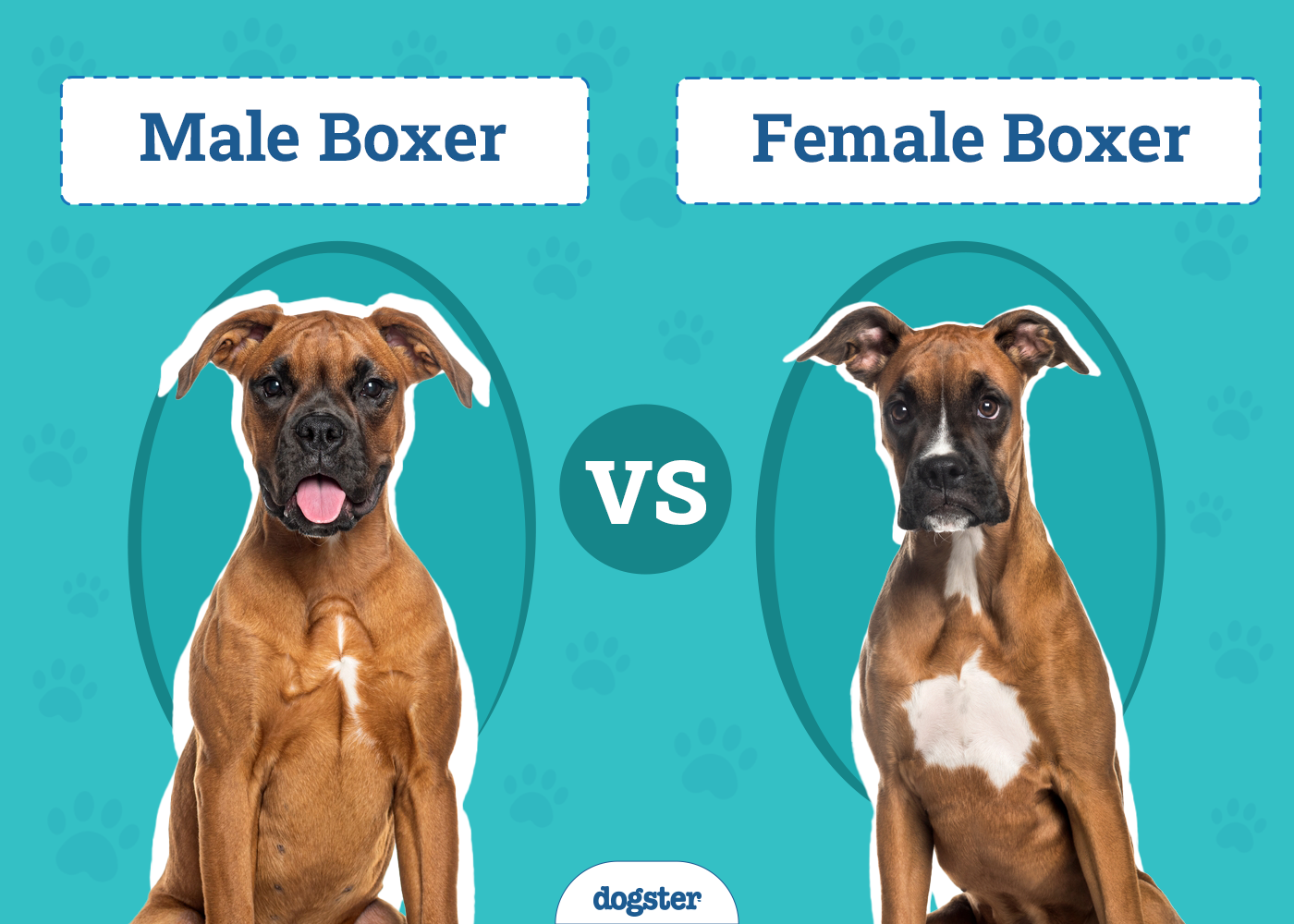
Boxers are energetic, charismatic, and playful pooches that are also sweet, kind, and gentle yet fiercely loyal and protective. Although differences between males and females are small when it comes to Boxers, there are a few key differences to be aware of that may influence your choice.
But how do you know which sex is right for you? While there is no straightforward answer, there are certain aspects that can help your decision. If you’re looking for a playful, energetic, and protective pooch, most agree that a male Boxer is an ideal choice. If you want a pooch that is more independent, calculated, and less impulsive, a female Boxer dog is probably better.
If you’ve decided that a Boxer is the perfect breed for you but are undecided on whether to get a male or female, read on for our in-depth guide.

Male vs Female Boxer Dog: Visual Differences

At a Glance

Boxer Dog 101

Boxers have long been one of America's favorite dog breeds, and for a variety of good reasons. These dogs seemingly have it all: They’re loyal, affectionate, hard-working, intelligent, and adorable, with a ton of personality and character too. These dogs can have an imposing appearance at first glance, but once you spend just a short time with one of these pooches, you quickly see their sweet and gentle side.
Boxers are often known as the “Peter Pan” of the dog world due to their seemingly ever-lasting puppyhood—these dogs are playful and energetic well into their senior years. In fact, Boxers aren’t considered fully mature until they reach 3 years old and, thus, have one of the longest puppyhoods of all dog breeds. This makes them great family pooches and ideal playmates for children, but this long puppyhood can also make training a challenge, especially with male Boxers.
Male Boxer Dog Overview

Personality / Character
Like most dog breeds, male Boxers are more dominant than females in general, and they’ll display this dominance in a variety of different ways, including marking. Males are also more energetic and easily excitable, and since they mature slower than females, they are also more difficult to train. That said, both male and female Boxer dogs are late to mature, so training can be a challenge for both sexes.
Males are more attention-seeking than females and are less happy to be alone. They become more attached to their owners and prefer to be around their human family whenever possible. Lastly, male Boxers are also known to be bolder, more outgoing, and more confident than females, making them excellent family protectors.
Training 🎾
Male Boxers are definitely more of a challenge to train than females, as they tend to act out and get easily distracted, and their dominant nature makes them want to be the leader of the pack. You’ll need to establish yourself as the alpha early on to avoid this dominant behavior, and neutering can help, too.
Male Boxers also have a distinct stubborn streak, which can make training difficult for novice owners or owners who don’t have much experience with the breed. These dogs need a ton of patience, consistency, and a firm but gentle hand for successful training. While males can be more of a challenge, in all fairness, the Boxer breed, in general, is known to be challenging in training.

Health & Care
The Boxer breed overall is known to suffer from various genetic health concerns, most of which can affect both male and female Boxers. Some of the conditions that only males are susceptible to can be prevented by neutering, and this simple procedure may prevent other general health conditions, too.
Common health issues include:
Breeding
Male Boxers reach full sexual maturity at 12–15 months old but are fertile from as young as 6 months old. Most experts agree that it’s best to wait until a male is sexually mature before breeding or, for best results, is at least 2 years old before breeding. Males remain healthy and fertile well into old age in general, but it’s best not to breed a male that’s older than 10–12 years, as they will have decreased quality of sperm. This will most likely not cause any problems, but the mating may not be as successful as with younger Boxers.
Pros
- Affectionate
- Loyal
- Playful
- Protective
- Inexpensive to neuter
Cons
- More difficult to train
- Slower to mature
- Needier than females
Female Boxer Dog Overview

Personality / Character
The most distinguishing factor in female Boxers is their distinct independent nature. Females are far happier to be alone than males and are far more reserved around strangers and in general. Many owners of female Boxer dogs also report that they are quicker to anger than males, although this is anecdotal and not universally the case.
While females are not as dominant as males, they can be territorial at times, especially when another female dog is around. Both male and female Boxers are late to mature, but since females mature quicker than males, they are somewhat easier to train.
Training 🎾
Since female Boxers mature quicker than males, they are easier to train in general, although, like all Boxers, they can be a bit stubborn at times. Females tend to get strongly attached to one member of the family, which can also make training easier. No matter the sex, though, Boxers are a difficult breed to train, and they need a gentle, patient hand in training if you want any kind of success. Harsh training methods simply do not work with these pooches.

Health & Care
Female Boxers are prone to many of the same health issues as males, although they are also susceptible to mammary cancer and uterine infections, both of which can be prevented by spaying. Boxers are the fifth most likely breed to die from cancer, and cancer is one of the leading causes of death in the breed overall.
Common health issues include:
Breeding
Female Boxers can enter their first heat as young as 6 months old but are only sexually mature enough for breeding at 18–24 months. Most experts recommend waiting to breed until your female is around 2 years old or has had at least two heat cycles.
Pros
- Smaller size
- Less prone to dominance and aggression
- Not as attention-seeking as males
- Easier to train
- Quick to mature
- More independent
Cons
- Expensive to spay
- Not as affectionate as males
Male vs Female Boxer Dog: Which Sex Is Right for You?
Both male and female Boxer Dogs are a great choice for your family. These dogs are energetic, affectionate, and loyal regardless of sex, and they are great family protectors. It’s important to remember that all Boxers are different, and while sex will affect certain personality characteristics, a dog’s temperament and personality are far more affected by their upbringing and training than their sex.
You may have a female who challenges your authority during training or a male who is incredibly independent, so these dogs do not always adhere to stereotypical Boxer traits. These traits should be viewed as guidelines only and are not set in stone. With that in mind, though, how do you choose between a male and a female?
The best way to choose is to meet the puppy in person and decide from there. You may be set on a male Boxer, only to meet the puppies, and a female captures your heart! Either is a great choice, and it comes down to personal preference. No matter what you decide, your Boxer will need plenty of dedicated training, socialization, and exercise. They are a big responsibility, but one that will bring you a ton of joy and love.
See also:
Expert dog care, straight to your inbox
News, insights, expert advice, and everything dog.

No spam — unsubscribe anytime.
By signing up, you agree to our Terms & Conditions and Privacy & Cookies Policy.
How useful was this post?
Click a star to rate. You can leave written feedback afterwards. (We read all feedback.)
Nicole has loved animals of all sizes her whole life so it's no wonder she has dedicated her career to helping them through what she loves best: learning, writing, and sharing knowledge with others. She’s the proud mom of two dogs, a cat, and a human. With a degree in Education and 15+ years of writing experience, Nicole wants to help pet parents and pets around the planet to live happy, safe, and healthy lives.