Dogster is reader-supported. When you buy via links on our site, we may earn a commission at no cost to you. Learn more.

Dog Training

Are Dog Whistles Harmful to Dogs? Vet-Verified Facts & FAQ

Jessica Kim
By Jessica Kim · Reviewed & fact-checked by Dr. Paola CuevasVet Approved
Dr. Paola Cuevas
Reviewed & Fact-Checked byDr. Paola CuevasVeterinarian
Dr. Paola Cuevas is our Senior In-House Veterinarian at Dogster and Pangolia. She has over 19 years of experience working with an array of species and loves sharing her knowledge and experience with our readers and aims to provide assistance with any issue presented by your non-human family members. She received her degree from the University of Guadalajara, Mexico.View authorThe information is current and up-to-date in accordance with the latest veterinarian research. Learn more
Updated on June 17, 2026
Share
Dog whistle training

There are various ways to train dogs and helpful tools that make communication with dogs easier. One common training tool that people use is a dog whistle. Some dog owners may be concerned that dog whistles are harmful to dogs because they emit a high-pitched frequency. However, dog whistles are safe training tools as long as you use them properly.

So, before you use a dog whistle, make sure you know the basics and the most effective way to use them. We’ll go over the essential information to help you to use dog whistles properly.

Dogster_Website dividers_v1_Jan 18 2025-01-TEST

Are Dog Whistles Harmful to Dogs?

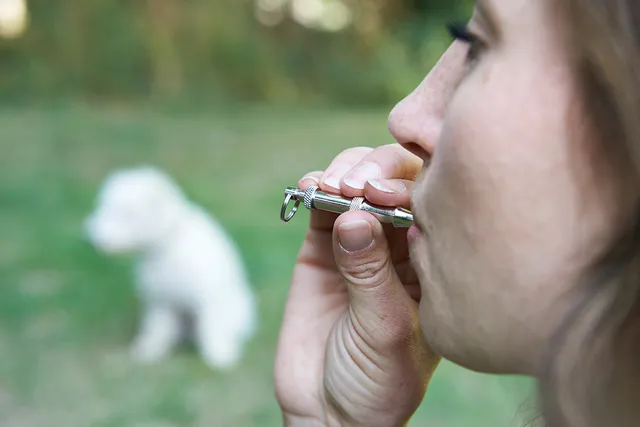
Generally, dog whistles aren’t harmful to dogs. When you use them properly, they don’t hurt your dog’s ears or cause any pain. You can view them like regular whistles. When you blow a whistle, the loud sound doesn’t hurt your ears if you’re a safe distance away. However, if someone blows a whistle right next to your ear, it can be painful and damage the ear.

Dogs also won’t feel pain when they hear the dog whistle. However, it should never be blown right next to their ears or with too much force or used repeatedly at high intensity.

Photo credit: Miriam Doerr Martin Frommherz, Shutterstock

How Do Dog Whistles Work?

Dog whistles emit high-pitch frequencies that may be difficult or impossible to detect by human ears. As dogs have more sensitive and broader-range hearing, they can hear a wider range of frequencies than humans. Other animals with strong hearing, like cats, can hear dog whistles.

The average adult can hear frequencies between approximately 20 Hertz (Hz) and 20 kilohertz (kHz). Dogs can hear up to approximately 45 kHz, and cats can hear even higher pitches at approximately 64 kHz. Dog whistles typically emit frequencies between 23 and 54 kHz. So, when you blow a dog whistle, you’ll usually just hear a hiss or nothing at all, while a dog will hear a high-pitched sound.

How Dog Whistles Are Used to Train Dogs

The most common ways people use dog whistles are to regain a dog’s attention or as a marker during positive reinforcement. Similar to clicker training, dog whistle training often starts with attaching a reward to the sound of the whistle. Each time a dog does something correctly, the trainer will blow the whistle and follow it with a reward, like a treat or praise.

As the dog starts associating the whistle with a reward, the whistle becomes a positive reinforcement that helps dogs understand when they’re displaying the correct behavior. When a dog gets used to dog whistles, it may be able to learn commands and tricks more quickly.

Since dog whistles carry farther than other training tools, like clickers, they’re often used for active herding and hunting dogs. Once a dog is trained to be responsive to a dog whistle, trainers can move forward to more advanced training and start associating different whistle patterns with commands.

For example, a trainer can blow a short sound when they want a dog to sit and a longer sound if they want a dog to return if they’re a long distance away.

Photo credit: Natalliaskn, Shutterstock
Dogster_Website dividers_v1_Jan 18 2025-03

Conclusion

Dog whistles can be a helpful and harmless tool used to train dogs. Many dogs will react to them when they are first blown, but they can become habituated to the sound and stop responding if a reward isn’t attached to the sound.

So, if you’re interested in training a dog with a dog whistle, make sure to securely establish a positive association with the whistle by consistently pairing it with a reward. This will help your dog understand and have the incentive to pay attention whenever you blow the whistle.


Featured Image Credit: GUNDAM_Ai, Shutterstock

Want content like this delivered to you?

Sign Up For Our Newsletter

News, insights, expert advice, and everything dog

* By submitting, you agree to our Terms & Conditions and Privacy & Cookies Policy.

Jessica Kim
Authored by

Jessica Kim

How Do Dog Whistles Work? Vet-Approved Guide & Explanation

How Do Dog Whistles Work? Vet-Approved Guide & Explanation

Whistles have been used as a dog training tool for generations. You've probably seen dog whistles in pet stores or even witnessed someone using one at a dog pa…

Chantelle Fowler
By Chantelle Fowler · 3 weeks ago
How to Select the Right Dog Whistle for Training: Expert Advice

How to Select the Right Dog Whistle for Training: Expert Advice

A crucial aspect of being a dog parent is training your furry friend and helping them learn how to socialize and obey when needed. As training is required for…

Visnja Radosavljevic
By Visnja Radosavljevic · 3 weeks ago
Do Dog Whistle Apps Actually Work? Myths & Facts Revealed

Do Dog Whistle Apps Actually Work? Myths & Facts Revealed

As dog owners, we love our pets more than anything, but occasionally, they can be a bit annoying. Take barking, for example. Pups that love barking at anything…

Misty Layne
By Misty Layne · 3 weeks ago
How to Use a Dog Whistle: 8 Vet-Approved Tips for Training & FAQ

How to Use a Dog Whistle: 8 Vet-Approved Tips for Training & FAQ

Training any dog can be challenging, especially if yours never seems to listen to you. While it’s true some dogs are easily distracted, it is also true that so…

Matt Jackson
By Matt Jackson · 3 weeks ago
June 17, 2026

Ultrasonic Dog Repellers & Deterrents: Are They Ethical? Vet-Reviewed Facts

Ultrasonic dog repellers and deterrents are designed to be a training tool to prevent your dog from excessive barking. While barking is a natural behavior for…

Chantelle Fowler
By Chantelle Fowler
Ultrasonic Dog Repellers & Deterrents: Are They Ethical? Vet-Reviewed Facts
July 3, 2026

Is Clicker Training Bad? Our Vet Explains the Science, Methods & Controversies

Clicker training was developed in the 1940s by scientist B.F. Skinner during his experiments on pigeon behavior. It was an accidental discovery and led to rese…

Grant Piper
By Grant Piper
Is Clicker Training Bad? Our Vet Explains the Science, Methods & Controversies
June 27, 2026

Are Prong Collars Humane? Vet-Verified Safety Facts

Prong collars have supporters and critics. Some believe that they can be effective in training, while others believe that they are cruel. In this post, we expl…

Cassidy Sutton
By Cassidy Sutton
Are Prong Collars Humane? Vet-Verified Safety Facts
June 16, 2026

How to Train a Deaf Dog: 9 Vet-Approved Tips for Success

Training a dog that cannot hear may seem like a daunting task, but it can be done quite successfully. Rather than relying on verbal commands, you can use hand…

Kathryn Copeland
By Kathryn Copeland
How to Train a Deaf Dog: 9 Vet-Approved Tips for Success
June 16, 2026

How to Teach a Dog to Howl: 5 Vet-Approved Tips & Tricks

While some pet owners prefer their dogs not to howl, many think it’s fun to teach their pets, and sometimes they’ll howl right along with them. Also, many expe…

Nicole Cosgrove
By Nicole Cosgrove
How to Teach a Dog to Howl: 5 Vet-Approved Tips & Tricks
June 27, 2026

Positive Reinforcement Training for Dogs: Vet-Verified Behavioral Science & Tips

Well-trained dogs make good canine citizens who respond quickly and consistently to commands. Training has several benefits; it ensures that dogs remain well-m…

Lorre Luther
By Lorre Luther
Positive Reinforcement Training for Dogs: Vet-Verified Behavioral Science & Tips
June 16, 2026

Dog Training Techniques: 7 Vet-Verified Methods & Their Differences

Part of the responsibility of being a dog owner is making certain your dog is well mannered around others. A dog owner is also responsible for the safety of hi…

Nicole Cosgrove
By Nicole Cosgrove
Dog Training Techniques: 7 Vet-Verified Methods & Their Differences
June 17, 2026

How to Clicker Train Your Dog: Basics & Vet-Verified Guide

“Training is quicker with a clicker!” While that may only be partially true depending on the situation, clickers have proven their worth for many owners and pr…

Nicole Cosgrove
By Nicole Cosgrove
How to Clicker Train Your Dog: Basics & Vet-Verified Guide

Love Dogs? So Do We! Join the Dogster Community

Stay informed with expert pet care insights delivered straight to your inbox! Discover professional guidance on animal behavior, feeding tips, trusted product picks, and much more.

You may opt-out at any time. View our Privacy Policy for more information.

The Dogster app on a phone