5 Sounds Only Dogs Can Hear: Vet-Analyzed Canine Hearing Range


In this article
We’ve heard people talk about ‘sounds that only a dog can hear’, and we all know that our dogs can hear the rustling of a chip packet from a mile away, but what are the real facts about a dog’s sense of hearing?
Although the superior intellect and brain capacity of humans have allowed us to reach the lofty position of owner and leader, when you take a look at how we measure up against our canine companions in most other respects, we are woefully outmatched. They are far better athletes, have an almost unparalleled sense of smell, and their sense of loyalty is far greater than our own. In addition to all this, dogs can also hear a wider range of sounds from much farther distances.
Let’s break this down so we can understand the canine hearing range and find out what they can hear but we can’t.

Sound Frequency
Have you ever heard the riddle about the tree falling in the forest? If no one is around to hear it, does it really make a sound? The answer is yes, but also, no.
A sound is created when something creates a vibration (sound waves) that moves molecules through the air (or water) that are received by an auditory receptor, like the eardrum of mammals. So, if there is no receptor, is it still a sound? We could argue this one back and forth, but instead, let’s talk about how sound is measured and how dogs measure up to other animal species.
Sounds are measured in two ways:
Different animal species can hear sounds that fall in specific frequency ranges; some may also be able to hear sounds at much lower decibels than others. As a general rule, smaller animals are usually able to detect sounds at a lower volume than larger animals, even if they can hear sounds of the same frequency.
Dogs and humans are very similar in their ability to hear low-frequency sounds, but dogs can hear frequencies up to twice as high as we can.
The average human hearing range is around 64 - 23,000 Hz, and sounds with a frequency higher than 20,000 Hz (20 kHz) are referred to as ‘ultrasonic’ - ie. sounds that are higher than can be readily detected by the human ear. By comparison, the sound frequencies detected by dogs are around 67 - 45,000 Hz. Let’s take a look at how that stacks up against other animal species:
| Species: | Approximate Range (Hz) : | Species: | Approximate Range (Hz): |
| Human | 64-23,000 | Chinchilla | 90-22,800 |
| Dog | 67-45,000 | Bat | 2,000-110,000 |
| Cat | 45-64,000 | Beluga Whale | 1,000-123,000 |
| Cow | 23-35,000 | Elephant | 16-12,000 |
| Horse | 55-33,500 | Porpoise | 75-150,000 |
| Sheep | 100-30,000 | Goldfish | 20-3,000 |
| Rabbit | 360-42,000 | Catfish | 50-4,000 |
| Rat | 200-76,000 | Tuna | 50-1,100 |
| Mouse | 1,000-91,000 | Bullfrog | 100-3,000 |
| Gerbil | 100-60,000 | Tree Frog | 50-4,000 |
| Guinea Pig | 54-50,000 | Canary | 250-8,000 |
| Hedgehog | 250-45,000 | Parakeet | 200-8,500 |
| Raccoon | 100-40,000 | Cockatiel | 250-8,000 |
| Ferret | 16-44,000 | Owl | 200-12,000 |
| Opossum | 500-64,000 | Chicken | 125-2,000 |
Source: LSU
We humans might be impressed by the hearing range of our canine friends, but it’s nothing compared to that of the porpoise!

What Sounds Can Dogs Hear That We Can’t?
So, we know that dogs can hear sounds in the ultrasonic range up to around 45,000 Hz (45 kHz), but what does that entail?
1. Electronics and Machines
The most common high-frequency sounds that your dog may be aware of are those that come from machinery. Some humans are more sensitive to the high-pitched sounds that are emitted from electrical equipment, and dogs will be even more aware of these.
Interestingly, these sorts of high-frequency sounds can actually be damaging to the human ear, especially when dialed up to high decibels, as the high-frequency vibrations can lead to a build-up of pressure within the ear. So it is the sounds we can’t hear that we need to be most careful with! In fact, there are international standards that regulate the maximum decibels that can be emitted by ultrasonic equipment.1

2. ‘Silent’ Whistles
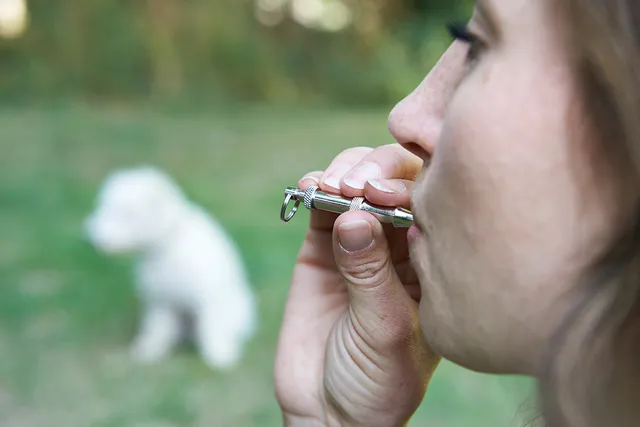
Ultrasonic dog whistles are a popular training tool as they are less intrusive than a lower frequency type, and the higher frequency sound is able to travel much further distances, often over a mile.
The term ‘silent’ whistle is a bit misleading, as they tend to emit a sound that is just on the upper edge of the human hearing range, so some people can hear them better than others.
3. Ultrasonic Pest Repellers
These small devices emit sounds at a frequency of around 15 to 75 kHz, with most devices allowing you to select the frequency range. While dogs can technically hear these sounds, the pest-repelling devices are designed to work at lower decibel levels that can be detected by smaller animals like rats, mice, and insects, but are not loud enough to bother household pets. However, if you have any exotic animals like rodents, reptiles, insects, or arachnids, you might want to think twice before using one of these devices!

4. Quiet Sounds
Smaller animals are able to hear sounds at lower decibels than we can, which is why children can often hear quiet noises better than adults, and dogs can hear the fridge opening from upstairs or your car coming down the road.
5. Distant Sounds
The higher the sound frequency, the greater the distance that sound can travel, which is why dogs can also detect sounds more clearly from farther away than we can.

What Gives Dogs Their Superior Hearing?
There are a number of features of the canine ear that make them able to hear sounds at higher frequencies than humans:
- The deeper ear canal of the dog enhances its ability to direct sound waves toward the eardrum.
- The cartilaginous pinnae (ear flaps) are able to move independently of one another to help locate and direct sound waves into the ear canal. Even dogs with floppy ears have and use this ability, but dogs with upright ears do have something of an advantage.
- The anatomy of the canine inner ear appears to be better geared to sound magnification than in humans.
Hearing Problems in Dogs
Just like in humans, dogs often suffer from hearing reduction and loss as they age. This is mostly due to the gradual degeneration of specific cells within the ear, the nerves in the brain that carry and interpret sounds, and the thickening of the tubes and inner structures within the middle and inner ear. This tends to be gradual, and we can take steps to ensure that we are still able to communicate effectively with a dog with hearing loss.
Certain breeds, including the Australian Shepherd, Dalmatian, Bull Terrier, and Jack Russell Terrier, are known to be predisposed to congenital deafness, and this is something that responsible breeders (and owners) should be testing for.
If you are concerned about the health and well-being of your pet, seek veterinary advice for the best course of action.
Dogs can also suffer hearing loss as a result of trauma, infection, wax build-up, and even as a side effect of certain medications.
Too much of a good thing?
Sounds You Can Play For Your Dog
This video has ultrasonic frequencies that you can try out at home to gauge your dog’s reaction. Just make sure not to play it too loud - you don’t want to damage your own ears, and it doesn't need to be very loud for them to hear the sounds. If your dog seems distressed, turn it off immediately.

Final Thoughts
The canine ability to detect high-frequency sounds is far greater than our own. This ability no doubt evolved in their ancestor to help them become more proficient hunters, as well as allow them to stay in contact over great distances. For our pets, this heightened hearing is rarely employed for hunting purposes, but it no doubt allows them to keep tabs on who and what is in their neighborhood, and most importantly, when someone is opening a food bag.
With the amount of sound pollution from electronic devices in the home, as well as sirens and machinery, our dogs may sometimes feel overwhelmed, which is something we should be mindful of. Their superior hearing evolved in open plains and quiet forests, so our noisy world may be a lot for some dogs to cope with.
If you are worried about your dog’s ears or hearing, be sure to speak to your vet, even if you think it’s probably just due to their age.
You might be interested in: Sound Oasis Pet Sound Therapy System Review
Sources
Featured Image Credit: Anze Furlan, Shutterstock
Expert dog care, straight to your inbox
News, insights, expert advice, and everything dog.

No spam — unsubscribe anytime.
By signing up, you agree to our Terms & Conditions and Privacy & Cookies Policy.
How useful was this post?
Click a star to rate. You can leave written feedback afterwards. (We read all feedback.)
Dr. Karyn Kanowski, BVSc MRCVS (Vet)
Dr. Karyn is originally from Queensland, Australia, and has resided in the UK for the past 10 years. She graduated from The University of Queensland School of Veterinary Science in 2010, and also holds a Bachelor’s degree in Zoology. Karyn is passionate about using experience, evidence, and working with pet owners to provide the best solutions for pets. She also believes in making reliable information about animal health accessible to everyone. 5 cats and 4 dogs let her share their home with her and her husband, and when she is not practising as a veterinary surgeon, she spends her time writing, gardening, and cleaning up pet hair!