Why Does My Golden Retriever Lick Me So Much? 4 Common Reasons

In this article
You might be a dog lover, but are you a fan of all the kisses you get? Some people don't mind a bit, while others find it pretty irritating. If you have a Golden Retriever, you already have a dog that is typically very social and human-oriented. One way that your dog might communicate with you is by licking.
So we'll go over why your dog might be licking you and even themselves. You probably have guessed some of these already, but we're going to additionally address when licking might even signal a problem. As an owner, knowing what to look out for is always excellent. So here we go!

The 4 Common Reasons for Licking
You can probably guess most of the reasons why your dog might be licking you. But hopefully, this helps you put your finger up once and for all!
1. Attention-Seeking Behavior
Your Golden might be trying to score some attention. After all, you're probably not giving them enough for their liking, and they may respond by licking or engaging in other attention-seeking behaviors. If that's the case, they might approach you, lick you, and do just about anything to grab your attention.
We all know that some golden retrievers can be big-time attention hogs. You might notice your Golden Retriever licking you a lot more if they have another canine or feline around that's hogging attention.
Yes, this can reflect normal social competition for owner attention. If it is an issue, you can try behavioral tactics to calm the situation.

2. Affiliative Behavior
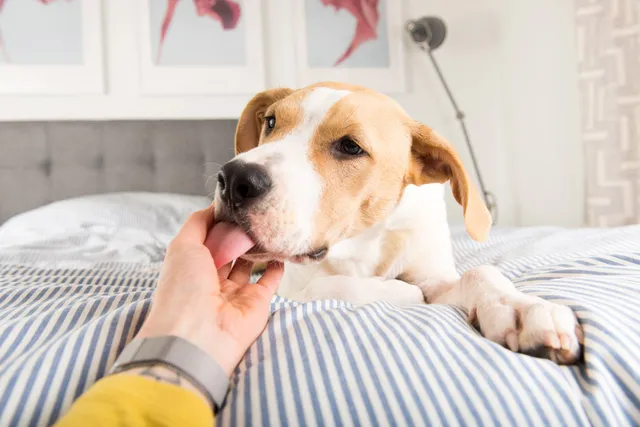
Licking is one of the ways dogs may express social bonding or affiliative behavior. If your Golden Retriever is giving you lots of kisses, they're probably trying to show you some affection. And, if they're licking you more than anybody else, you can smile and know you were the favorite.
Often, this is somewhat comparable to social bonding behaviors. They're trying to engage with you in a way that has been reinforced over time.
3. Taste and Olfactory Exploration
Did you know that our bodies excrete many chemical compounds (such as salts and other substances) that dogs can smell and detect more sensitively than humans? Our dogs learn several things about us based on smell alone.
Taste and smell are two ways your dog picks up on the cues around them, learning more about their environment. If your dog is licking you, they might enjoy the salt on your skin or simply the smells you produce. Maybe that's gross to us, but they totally welcome it.

4. Social Behavior
If you’ve ever noticed how dogs behave in social groups, then you’ll know that they may lick each other as part of social and affiliative behaviors, although dogs do not rely on licking as a primary grooming method. This behavior can occur between a mother and her pups and among familiar dogs as part of social bonding. The same extends to your canine companion.
They might be licking you as a form of social bonding, strengthening their connection to you.
When Is Licking a Concern?
Licking is usually nothing to worry about. It's a normal dog behavior; some do it much more than others. It really just depends on the individual. But if the behavior is sudden or it seems like one of several additional clinical signs, an underlying factor could be more serious.

Anxiety/Stress
Usually, licking is a very ordinary dog behavior, so how do you know if it's a problem? Some Golden Retrievers can be a bit more prone to anxiety-related behaviors than others. If your dog has high anxiety or stress, licking might be a coping mechanism or a repetitive or compulsive behavior. Usually, this kind of anxiety can come with other clinical or behavioral signs as well.
Here are a few signs of canine anxiety:
Health Conditions 🏥
Another reason that your dog might be having issues is that there could be an underlying medical condition. Excessive licking is often a sign of pain or discomfort. And if something medical is the underlying reason causing frequent licking, it might be time to schedule a vet appointment to see if your vet can look them over.
So if you noticed that your dog is licking itself incessantly, it might be time to make a vet appointment to get down to the bottom of it. It could be something as simple as allergies or something as serious as a chronic health condition.
If you are worried about your dog's behavior or if there's any sudden change in the way that they act, it's time for a veterinary visit. The earlier you catch any underlying health issue, the more likely you are to solve it.
If your dog shows signs of the clinical signs above or you suspect they might be suffering from underlying health issues, you should contact your vet.
Teaching Your Dog Not to Lick
Teaching your dog not to lick can be really challenging. After all, this is a very typical form of communication for them. But there are some cases where it can be pretty excessive and invasive. It's understandable to want to ward off these kinds of kisses.
After all, your dog's mouth can contain many microorganisms, some of which may be opportunistic pathogens, and you don't want them in sensitive areas like your eyes, nose, ears, or mouth. Rather than any negative association, like yelling or spanking, you can simply redirect your dog's attention or teach them basic commands using positive reinforcement-based training methods.
Working with your Golden Retriever may take consistency and repetition for them to learn appropriate behaviors. There is a time and place for everything, and this particular dog breed can learn appropriate boundaries with consistent, reward-based training.

Conclusion
So now you know several reasons your Golden Retriever might be licking you. One of the most common reasons is social bonding or affiliative behavior, but it can really stem from a variety of factors, including social interaction, environmental cues, or underlying medical or behavioral causes. It might be gross to think that when you've been out sweating all day, your Golden Retriever wants to lick the salty residue from your skin, but they agree to disagree. You can redirect the behavior with basic command training if the licking is a problem. If you notice that this behavior may be associated with an underlying health condition, make sure to make an appointment with your veterinarian for further evaluation.
Featured Photo Credit: archimede, Shutterstock
Expert dog care, straight to your inbox
Vet-reviewed advice, training tips, and the best of Dogster. Free, and you can unsubscribe anytime.
By signing up, you agree to our Terms & Conditions and Privacy & Cookies Policy.
Ashley Bates is a freelance dog writer and pet enthusiast who is currently studying the art of animal therapy. A mother to four human children— and 23 furry and feathery kids, too – Ashley volunteers at local shelters, advocates for animal well-being, and rescues every creature in need. Her mission is to create awareness, education, and entertainment about pets to prevent homelessness. Her specialties are dogs and cats.
Join the conversation
Ask a question, share your story, or send private feedback.