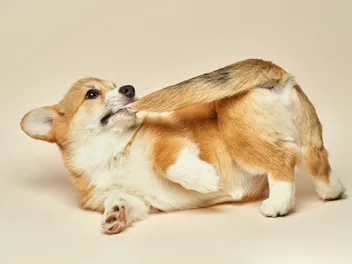
What Does It Mean When a Dog Wags Its Tail? Vet-Reviewed Explanation


In this article
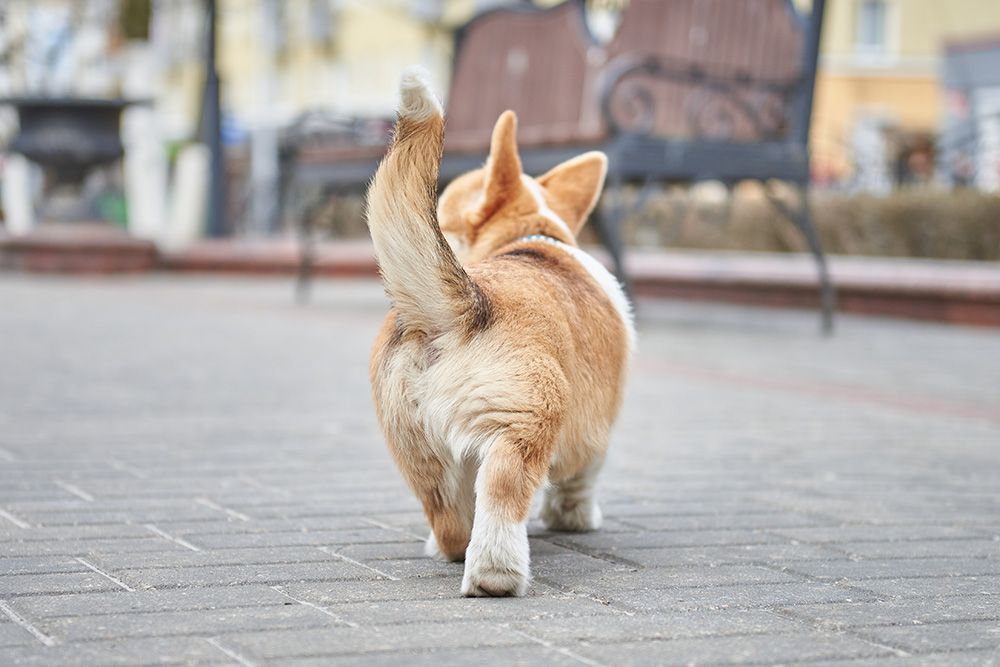
When your precious pup wags their tail when you come home, it just means they’re incredibly happy to see you, right? But is this really the case?
We often believe that a wagging tail is synonymous with joy and happiness among our canine companions. However, their body language may be more nuanced than that. Understanding these subtleties should help you interpret what your dog is really trying to communicate.
Ultimately, we don’t know exactly what it means when dogs wag their tails, but let’s take a look at what science has told us so far. It could mean they are concerned or happy; context and body language will go a long way toward understanding.

What Research Says About Waggy Tails
The 2007 and 2013 Current Biology Studies
In a 2007 study published in the journal Current Biology, Italian researchers examined 30 dogs and their tail-wagging responses to various visual cues.1 The dogs were presented with stimuli, including their owners, unfamiliar people, unfamiliar dominant dogs, and a cat. The results revealed that the dogs tended to wag their tails vigorously to the right when they saw their owners, and while they had a similar bias to the right when shown an unfamiliar person, the amplitude of the wagging was reduced. Their tails wagged with a bias to the left when confronted with unfamiliar dominant dogs. When faced with a cat, dogs showed reduced tail-wagging movements, but there was still a slight preference for the right side.
A follow-up study in 2013, also published in Current Biology, involved observing 43 dogs exposed to a video of a dog wagging their tail.2 The dogs remained calm when the tail wagged to the right but showed signs of anxiety when it wagged to the left. The difference in these responses suggests a link between the direction of tail movement and the hemispheric specialization of the brain.
The left hemisphere, associated with positive responses and social interactions, is activated when a dog wags their tail to the right. Conversely, a movement to the left indicates activation of the right hemisphere, which is more linked to negative responses, fear and anxiety.
These results suggest that dogs can pick up on differences in how other dogs wag their tails, and this supports the hypothesis that there's a connection between brain asymmetry and social behavior.
That said, more research is needed before drawing any concrete conclusions.

The 2022 iScience Study
In a study published in iScience in 2022, scientists created a system using advanced motion tracking to analyze how a dog's tail moves during interactions with humans.3 They found that over the course of 3 days of interaction, the dogs tilted their tails more to the right side, indicating a possible strengthening of the human-dog bond.
Much like the results of the Italian researchers' studies, these findings suggest that tail wagging in dogs is an indicator of social bonding. Additionally, their results show that dogs exhibit different tail-wagging patterns in response to various social cues. However, more research is needed to fully understand how these social cues affect tail wagging and the underlying reasons for these behaviors.

The 2024 Biology Letters Study
In a 2024 article published in Biology Letters, researchers reviewed several studies on tail wagging.4 Among other things, they sought to understand why dogs wag their tails more often than other closely related canids, such as wolves.
They proposed two hypotheses to explain why dogs wag their tails more frequently and in diverse contexts: either as a byproduct of selection for other traits during domestication, such as docility, or as a direct result of human influence due to our preference for “rhythmic stimuli.”
The studies have indeed shown that hand-reared dog puppies wag their tails more than hand-reared wolf puppies. Additionally, dogs tend to wag their tails to the right in response to positive experiences, such as seeing their owners, and to the left when feeling threatened, anxious, or aggressive (which is consistent with previous research findings).
One theory does suggest that tail wagging may have increased during domestication solely due to its rhythmic nature, which humans find “attractive.” But other canine experts believe that tail wagging serves as a social signal between individuals, perhaps evolving in dogs to adapt to human preferences.
So, while the exact reason that dogs wag their tails remains unclear, it appears that they do it to communicate emotions, including ones far more complex than previously believed they were capable of expressing.

Tips for Understanding Your Dog’s Body Language Better
A wagging tail does not necessarily mean positive emotions, but you can pay attention to other signs to better read your dog's body language:
- Pay attention to the speed and height of the wag. A fast and high wag can signify excitement but also aggression, while a slow, low wag can indicate a relaxed state.
- Look at the rest of the body. A relaxed posture indicates contentment, while tense muscles and raised hackles can signal aggression or anxiety.
- Consider the context. Tail wagging during play is different from wagging during a confrontation.
- Watch for other signs of communication. Pay attention to vocalizations, facial expressions, and body movements.
- Get to know your dog's individual cues and personality. Every pup is unique, so learn what tail wagging means for your furry companion specifically.
Final Thoughts
Contrary to popular belief, dog tail wagging is a complex behavior that scientists do not yet fully understand. Exploring it further could help us understand how dogs evolved and how humans influenced them. In the meantime, pay close attention to your dog's entire body language when interacting with them, as this will help you gain insight into what they’re trying to communicate.
Featured Image Credit: E Kis, Shutterstock
Expert dog care, straight to your inbox
News, insights, expert advice, and everything dog.

No spam — unsubscribe anytime.
By signing up, you agree to our Terms & Conditions and Privacy & Cookies Policy.
How useful was this post?
Click a star to rate. You can leave written feedback afterwards. (We read all feedback.)
A biologist and science writer, Genevieve has a special fondness for capuchin monkeys, pumas, and kangaroos, which has inspired her to volunteer and work at wildlife rehabilitation centers in countries like Bolivia, Guatemala, Canada, and Australia. Now living as a Canadian expat in Argentina, she enjoys the sight of horses and cows outside her home office window every morning. Genevieve is the proud owner of three rescue dogs—Lemmy, Nala, and Pochi—and a lively kitten named Furiosa. She finds happiness and fulfillment in sharing her passion and extensive knowledge of animals with others.