Dogster is reader-supported. When you buy via links on our site, we may earn a commission at no cost to you. Learn more.

Dog Training

How to Train a Dog to Herd: 5 Vet-Approved Tips

Kit Copson
By Kit Copson · Reviewed & fact-checked by Dr. Paola CuevasVet Approved
Dr. Paola Cuevas
Reviewed & Fact-Checked byDr. Paola CuevasVeterinarian
Dr. Paola Cuevas is our Senior In-House Veterinarian at Dogster and Pangolia. She has over 19 years of experience working with an array of species and loves sharing her knowledge and experience with our readers and aims to provide assistance with any issue presented by your non-human family members. She received her degree from the University of Guadalajara, Mexico.View authorThe information is current and up-to-date in accordance with the latest veterinarian research. Learn more
Updated on June 17, 2026
Share
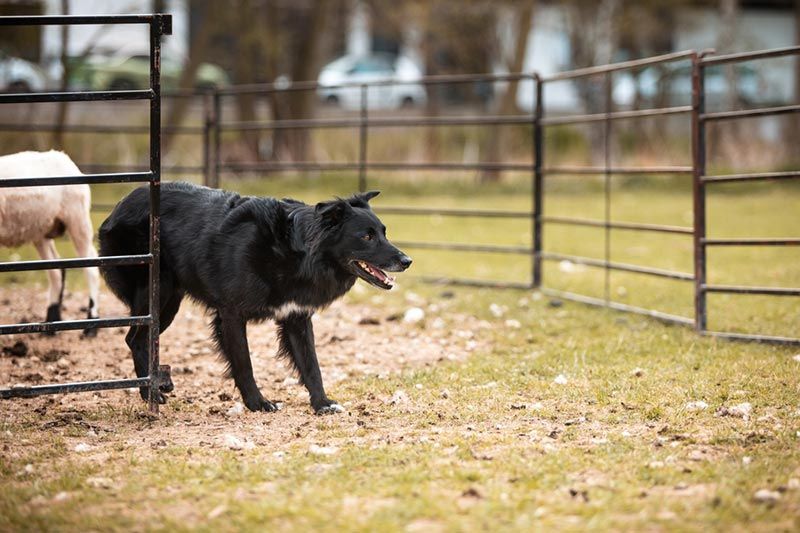
black australian shepherd dog herding sheeps

If you’re planning to train your dog to herd but are a complete beginner, it can be hard to know where to begin. The most important thing is to start slowly, work on the basics, and build your dog’s confidence when they’re just getting started.

This guide shares some tips on ensuring your pooch is a happy, confident, and capable herder.

Dogster divider_v2_NEW_MAY_24_

Before You Start

What you’ll need:

  • Treats
  • A long leash (20–30 feet)
  • A shorter leash
  • A ball (optional)
  • A whistle (optional)
  • Small livestock or well dog-broke, calm, and healthy stock to start with
Image By: Wikimedia Commons
Dogster divider_v2_NEW_MAY_24_

How to Train a Dog to Herd

1. Start with Basic Commands

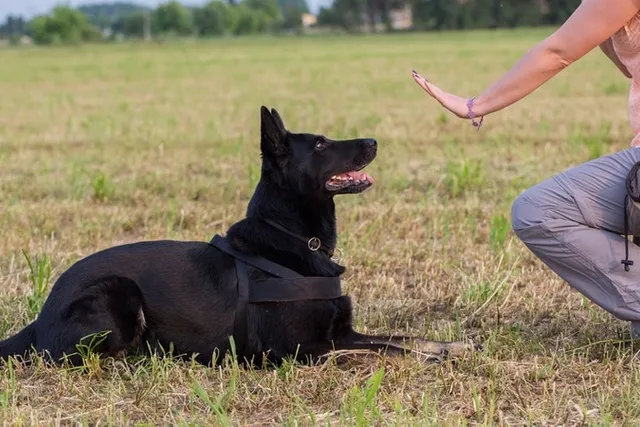
Before you get into herding training, it’s essential that your dog knows how to respond to some basic commands, like “sit”, “stay”, “come”, “lie down”, and “leave it”. These commands give you more control over situations and help keep both your dog and your livestock safe. When you start herding training, you’ll be able to focus more on commands like “come bye”, “away”, and “walk up”, which help direct the dog’s movement and control their instinct to gather and move livestock.


2. Start With Small Animals

The initial stages of herding training are all about increasing your dog’s confidence. If you start out with large animals, animals that can run faster than the dog, or animals that won’t pay attention to the dog, this could lead to your dog feeling discouraged very quickly and may increase the risk of injury or stress for both the dog and the livestock.

It’s ideal to start with smaller animals like chickens or ducks, or livestock that are already well dog-broke (animals that have experience being herded and will move calmly and predictably when they see a dog, even an inexperienced one). Later on, you can build up to larger or more challenging livestock as your dog gains skill and control.

Image By: sw_photo, Shutterstock

3. Let Your Dog Get Used to the Animals

So, you’ve got your herd of small animals and are ready to roll with training. A good way to start is to put your chickens or ducks in a training pen (ideally, the most relaxed chickens at first) and let your dog sit outside the pen to get used to their presence. Reward your dog when they remain calm and focused around the animals. If you’re going to start with larger animals instead, read on to find out how to approach this.


4. Teach Herding Commands

When your dog is accustomed to being around chickens or ducks, keep your dog on a leash and walk them towards the animals while saying the words “walk up.” Stop about 6-10 feet away and reward your dog for staying calm.

Your dog should be able to walk up to the animals calmly, and you can later add in commands like “lay down” as you go toward the animals to practice getting your dog to stop at any time you tell them to.

Progress to moving around the animals in circles, saying “come bye” to go in a clockwise direction and “away” to go in an anti-clockwise direction. Continue to reward your dog with a treat when they start to get it. You can remove the leash when your dog responds reliably to cues and the birds show no signs of stress, and keep practicing the above commands.

Image By: Natalliaskn, Shutterstock

5. Working With Larger Animals

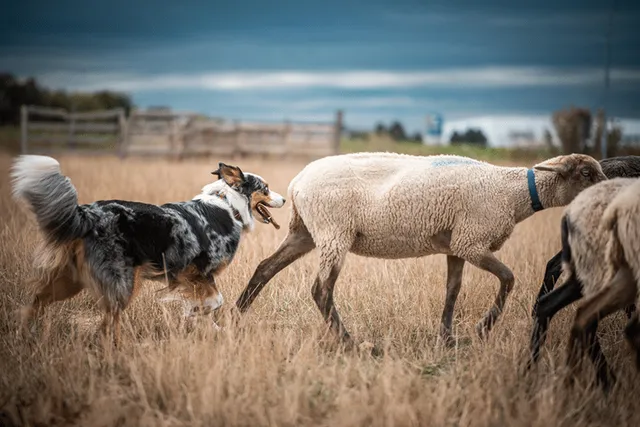
If you’re starting with larger animals or have been practicing with smaller ones and are ready to move on, start with a small herd to avoid intimidating the dog and to reduce stress and injury risk for both the dog and the livestock. Put your dog on a long leash and walk up to the herd while saying “walk up.” As with the smaller animals, give your dog time to feel relaxed around the herd, rewarding them every time they are calm and the livestock remain settled.

Then, place your dog on a short leash and practice walking around the herd anti-clockwise (“away”) and clockwise (“come bye”), saying the appropriate commands as you go and rewarding your dog for their successes.

When your dog has things well established and is responding reliably with the short leash, switch to the long leash and move backward by around 20 feet. Continue practicing the commands at this distance until your dog is able to herd calmly and under control. When your dog is at the point, you can remove the leash only if the dog maintains reliable responses and the livestock are not showing signs of distress, and practice without it.

Dogster divider_v2_NEW_MAY_24_

Additional Tips

  • Give your dog time to rest between sessions and keep training sessions short to prevent your dog from getting bored, overstimulated, or exhausted.
  • Avoid shouting at your dog for mistakes—this will diminish their confidence.
  • Teach commands like “break” or “to me” to get your dog to stop herding and come back to you when you need them to, and “wait” to get your dog to wait until you tell them to start herding. You can practice this with a ball at first.
  • Teach a “get back” or “get out” command to use if the dog is getting too close to the livestock and stressing them out. The goal is to get the dog to move backward to give the animals more room.
  • Consider whistle-training your dog by using different numbers of blows for different commands. For example, one blow for “come bye”, and two blows for “away”. You can do this by first using verbal commands in conjunction with the whistle blows.
  • Be patient with your dog—it may take some dogs longer than others to develop confidence and the physical conditioning, impulse control, and coordination needed to work livestock smoothly.
Dogster divider_v2_NEW_MAY_24_

Conclusion

Though the prospect of training a dog to herd can be intimidating, you can make it work with lots of practice and by boosting your dog’s confidence at every opportunity.

It’s also important to remember that you and your dog are a team. Getting used to reading each other’s body language and predicting what the other’s next move will be is a skill that you will develop with time and experience working livestock together, and start to do naturally.

Sources

Featured Image Credit: marketalangova, Shutterstock

Want content like this delivered to you?

Sign Up For Our Newsletter

News, insights, expert advice, and everything dog

* By submitting, you agree to our Terms & Conditions and Privacy & Cookies Policy.

Kit Copson
Authored by

Kit Copson

How to Train a Border Collie to Herd: 14 Vet-Approved Tips & Tricks

How to Train a Border Collie to Herd: 14 Vet-Approved Tips & Tricks

Border Collies are famous for their intelligence and work ethic (not to mention their cuteness!). They excel in herding sheep, cattle, and other animals. Herdi…

Nicole Cosgrove
By Nicole Cosgrove · 3 weeks ago
15 Vet-Verified Herding Dog Commands: Facts & Guide

15 Vet-Verified Herding Dog Commands: Facts & Guide

Herding dogs have strong instincts and thus have fantastic herding abilities. While they are excellent working dogs, many people also keep them as companions.…

Patricia Dickson
By Patricia Dickson · 3 weeks ago
Australian Shepherd Herding: A Complete Guide

Australian Shepherd Herding: A Complete Guide

What is the Australian Shepherd temperament? Australian Shepherds are loyal, dependable and easygoing. When it comes to play, they never really outgrow the pup…

Rachael Gerkensmeyer
By Rachael Gerkensmeyer · 3 weeks ago
How to Train an Australian Shepherd: 8 Vet-Approved Tips

How to Train an Australian Shepherd: 8 Vet-Approved Tips

Training any dog can be challenging, so what can you expect when training an Australian Shepherd (Aussie)? It’s a good idea to be familiar with the dog breed b…

Kathryn Copeland
By Kathryn Copeland · 3 weeks ago
June 17, 2026

How to Train a Working Dog: 9 Vet-Approved Tips

Dogs can do incredible things. You can find dogs working in jobs all over the world. Dogs can be search and rescue animals, helping find people trapped in rubb…

Grant Piper
By Grant Piper
How to Train a Working Dog: 9 Vet-Approved Tips
June 17, 2026

How to Train a Border Collie: 15 Vet-Approved Tips & Tricks

We’re all pretty familiar with the Border Collie. They're gorgeous and highly intelligent, and they make incredible working dogs and companions. If you’ve been…

Kathryn Copeland
By Kathryn Copeland
How to Train a Border Collie: 15 Vet-Approved Tips & Tricks
June 17, 2026

How to Stop a Herding Dog From Nipping: 7 Vet-Approved Tips

If you’ve ever owned a herding dog, you know how intelligent they are, how easy they are to train, and that they usually have a pretty even temperament. Howeve…

Patricia Dickson
By Patricia Dickson
How to Stop a Herding Dog From Nipping: 7 Vet-Approved Tips
June 17, 2026

How to Train a Guard Dog: 5 Vet-Approved Steps & Breed Selection Tips

Dogs are truly man’s best friend, and any dog owner knows what a rewarding experience it is to have a dog by your side. Dogs provide us with love, friendship,…

Lindsey Lawson
By Lindsey Lawson
How to Train a Guard Dog: 5 Vet-Approved Steps & Breed Selection Tips
June 17, 2026

How to Entertain a Herding Dog: 15 Vet-Approved Ideas

Herding dogs are intelligent and easy to train, which makes them great pets. They are also usually friendly, affectionate, and protective, but they are also qu…

Ed Malaker
By Ed Malaker
How to Entertain a Herding Dog: 15 Vet-Approved Ideas
June 17, 2026

How to Obedience Train a Dog: Vet-Verified Steps & Tips

If you've only just brought a dog home, the prospect of obedience training can feel intimidating, especially if you've never done it before. The good news is t…

Kit Copson
By Kit Copson
How to Obedience Train a Dog: Vet-Verified Steps & Tips
June 17, 2026

How to Teach the "Come" Command to Your Dog in 8 Vet-Approved Steps

While every obedience command has its purpose, “come” is arguably the most crucial cue you can train. A solid recall and trust between you and your pet opens u…

Nicole Cosgrove
By Nicole Cosgrove
How to Teach the "Come" Command to Your Dog in 8 Vet-Approved Steps
June 17, 2026

How to Teach Your Dog Recall: A Vet-Approved Training Guide

A reliable recall is among the most crucial skills a dog can learn and one of the most liberating commands their owner can teach. Having your dog return on cue…

Nicole Cosgrove
By Nicole Cosgrove
How to Teach Your Dog Recall: A Vet-Approved Training Guide

Love Dogs? So Do We! Join the Dogster Community

Stay informed with expert pet care insights delivered straight to your inbox! Discover professional guidance on animal behavior, feeding tips, trusted product picks, and much more.

You may opt-out at any time. View our Privacy Policy for more information.

The Dogster app on a phone