Get

In Your Inbox

Dogster is reader-supported. When you buy via links on our site, we may earn an affiliate commission at no cost to you. Learn more.

How to Obedience Train a Dog: Vet-Verified Steps & Tips

Share

dog obedience training at home

If you’ve only just brought a dog home, the prospect of obedience training can feel intimidating, especially if you’ve never done it before. The good news is that you do not need any prior experience to mold your pup into a model canine citizen. What matters most is being consistent and maintaining a positive attitude throughout the training period, along with having a dose of good humor. In this guide, we share simple steps and tips to get you started with basic obedience training. dogster face divider

Obedience Training Steps & Tips

What you'll need:
  • Harness
  • Leash
  • Long leash
  • Treats or other motivators (toys, etc.)
Dogster_Website dividers_v1_Jan 18 2024-01-TEST

How to Obedience Train a Dog

1. Enroll in Obedience Classes

Even before you bring your new dog home, it would be ideal to get in contact with an obedience class group to get your pup signed up early and ask any questions you may have. This is strongly recommended because it offers you an extra support system while you’re training your dog at home. It’s also a good way to socialize your dog with other dogs in a secure environment.


2. Identify the Motivator

Rewarding your dog is key to motivating them during training. Dogs are motivated by different rewards; while some like treats, others like toys, play sessions, or even just a nice scratch behind the ear. Watch out for what your dog gets most excited about and use that as your training motivator.

Dogster_The Four Quadrants of Operant Conditioning Training_Infographic_v2-2 FINAL_Mar 20 2024
You are free to use this image but we do require you to link back to Dogster.com for credit

3. Start With Basic Commands

Basic commands are essential because they give you more control in a variety of situations. For example, if your dog is about to eat something they shouldn’t, a command like “leave it” could make all the difference. It’s best to start teaching basic commands at home in a distraction-free environment. Here are a few of the most basic commands (not an exhaustive list) and simple tips for how to use rewards to train your dog to do them:

  • Sit

Hold a treat in front of your dog, and move it upward over their head in a curve. This encourages your dog to naturally go into the sitting position.

  • Come

While your dog is at a distance from you, crouch down, and make sure they can see the treat or toy in your hand. Say “Come” in a happy voice and reward your dog. When out in public, like in the dog park, attaching a long leash can be useful for training your dog to come back to you from a farther distance.

  • Stay

Have your dog sit, then show them the treat, and give the “Stop” signal with your palm facing up. Wait a second or two and then reward them. Gradually increase the length of time your dog must “Stay” before they get the treat.

  • Leave

Hold a treat in your closed fist, and let your dog nudge and lick at your hand to try and take it. When they back away for a second or two, reward them with the treat. Keep doing this until your dog backs off from the treat all the time, then you can start to work on the verbal cue, “Leave it,” and advance to having your dog leave alone a treat on your open palm.

  • Down

Have your dog sit and show them a treat. Move the treat toward the ground to encourage your dog to follow it into a lie-down position. When they lie down, give them the treat.

  • Watch Me

Show your dog a treat, and then hold it up between your eyes. Say, “Watch me,” and reward if your dog can watch you for a few seconds. Gradually increase the time they have to focus on you to get the treat.

You are free to use this image but we do require you to link back to Dogster.com for credit

4. Work on Leash Behaviors

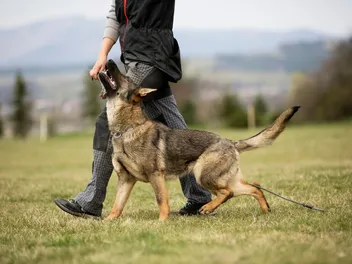
You can also work on good leash behavior both inside and outside the house. Teaching your dog to “heel” (walk at your side) is an important leash behavior because it is more comfortable than being pulled and gives you greater control. There are various ways to teach “heel,” but a common way is to start by calling your dog to your side and rewarding them when they do. You can then advance to showing them the treat and having them follow it as they walk alongside you. Gradually increase the length of time they have to wait to get the treat, from a few steps to several steps.


5. Keep Practicing

Although some dogs learn quickly, training is not an overnight job, and it’s never something that’s “done and dusted.” Training needs to be consistent. Even if your dog has started to get really good at a specific command, keep instilling it every day. If your dog takes a while to pick something up, that’s fine—give them time. Keep practicing, keep being consistent, and you’ll soon start to see the rewards.

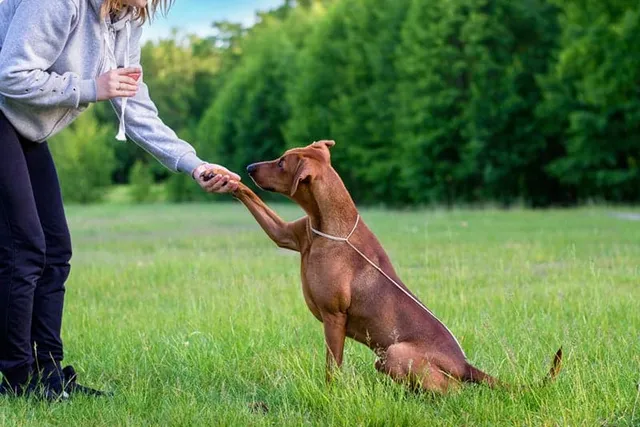
woman training a Brown Pitbull mix dog
Image By: Victoria Rak, Shutterstock

6. Stick to Short Sessions

Avoid overwhelming your dog with lengthy training sessions: 10–15 minutes per session is just enough to work on a command or routine. It’s better to do several short sessions than big, long ones, as dogs can only stay focused for so long.


7. Reach Out for Help If Necessary

If training is not going as you expected, there’s absolutely no shame in reaching out to a professional dog trainer for help. It doesn’t mean you’re doing a bad job; it just means your dog may respond better to a different method of training that you haven’t considered. If you’re finding things a challenge, drafting in a professional that uses positive reinforcement techniques is always a good idea.

If you need to speak with a vet but can't get to one, head over to PangoVet. It's our online service where you can talk to a vet online and get the advice you need for your pet — all at an affordable price!

PangoVet_Mention-in-Content Savings V1

Dogster_Website dividers_v1_Jan 18 2024-01-TEST

Final Thoughts

How you approach training your dog can make all the difference. Patience, consistency, and positive reinforcement will help keep your bond with your pup strong and build up that all-important respect. Conversely, harshness, punishments, and an inconsistent approach will only teach your dog to lack respect for you or even fear you, which is devastating for training and socialization efforts.

See also: 


Featured Image Credit: Westend61, Getty Images

Want content like this delivered to you?

Sign Up For Our Newsletter

News, insights, expert advice, and everything dog

* By submitting, you agree to our Terms & Conditions and Privacy & Cookies Policy.


How useful was this post?

Click on a star to rate (you can leave written feedback after clicking submit)

Help us improve Dogster for pet parents!

Your feedback really matters.

What did you like about this post? Also how can we improve it?

Join the conversation

4 Responses

  1. I hope this is where I need to be. My sister drove over 400 miles to rescue a dog that was wandering the streets. She has spoiled him and today he bit a woman first time. He is 1 yo. I need help training him. Do not have the money for professional training up to me. What should I do next?
    Thank you

    1. Hello Peggy,

      Thank you for your message. We're sorry to hear about the difficult situation with your sister's dog. It's great that she rescued him, but a dog biting someone is a very serious issue, and we understand why you are concerned.

      For a serious behavioral issue like a dog bite, the safest and most effective approach is to consult with a professional veterinarian or a certified dog trainer. They can help you identify the root cause of the behavior and create a tailored training plan. You can book a 20-minute video-call appointment with one of the veterinarians from our telehealth service at www.PangoVet.com to get a professional opinion and helpful suggestions from the comfort of your home. Our vets will be happy to answer all your questions.

      We hope this helps.

    1. Hi Cindy, thanks for getting in touch. You've started in the right place, so I hope you were able to gain some knowledge from our article above. A Border Collie cross Australian Kelpie is a fantastic mix; both breeds are highly intelligent, energetic, and eager to work. You would've read some great advice already, so I'll just highlight a few key points below.

      We believe in positive reinforcement training here at Dogster so be sure to use treats, praise, and toys to reward good behavior. This will encourage them to repeat those behaviors. Be consistent with your rewards, and ensure the reward is something the dog really loves—this will keep them motivated. Having a strong recall response is a great building block for other areas of training. Start with a leash on during training to help reinforce the behavior if needed. Eventually, you can practice in environments with more distractions as they get more reliable. Consistent, short sessions (even just 15 minutes a day) can make a big difference. With patience, your Border Collie-Kelpie mix will be a happy, healthy, and eager learner who enjoys working alongside you. Enjoy the journey!

Leave a Reply

You’re very welcome to leave a comment or question. Please know that all comments must meet our community guidelines, and your email address will NOT be published. Let’s have a positive and constructive conversation.


Talk With A Vet Online

Peace of mind,
anywhere, anytime

Affordable vet advice

The Crate Setup Most Dog Owners Get Wrong (And How To Fix It!)

Most people assume that if their dog hates the crate, the crate is the problem. So they try a bigger one, a different...

1,500 Beagles Rescued from Wisconsin Lab Farm – Here’s Where They’re Going

You may remember that a few weeks ago, we reported on a tense situation at Ridglan Farms, Wisconsin, a facility infamous for housing...

Dogster’s Weekly Photo Contest Winners: Window Watchers (May 11, 2026)

Every week our team gets the privilege of sorting through our readers photos to choose what dogs will win this weeks contest! See...

Can a Relationship Work When One Person Doesn’t Like Dogs? Tips & When to Walk Away

For dog owners, a partner who doesn’t like dogs isn’t a minor quirk to overlook. Dogs aren’t a hobby you can scale back...

More related

International Dogsitting 101: How to Get Started & Helpful Tips

If you are the kind of person who has been looking for a reason to get your passport, dogs might just give you...

Dog Breeder vs Rescue Shelter: Vet-Verified Pros, Cons & Considerations

There are two primary ways to obtain a new dog. You can adopt one from a local shelter, or you can find a...

AKC Agility Invitational: What It Is & How to Compete

Bringing together a vast assortment of dog breeds, large and small, the AKC Agility Invitational is the perfect event to close out the...

Coon Dog Day 2026: What It Is, Events & Ways to Celebrate

A Coon Dog is an American English Coonhound, and they make a fantastic pet with plenty of energy, but they also like to...

Keep reading

Can Dogs Eat Crackers? Vet-Reviewed Facts & FAQ

How great are crackers? Slathered with dip, layered with cheese, or eaten just on their own, they are simple yet delicious snacks. But is that the case for dogs? Most of us are probably aware that our dogs will happily...

Can Dogs Eat Crackers

10 Best Dog Foods for Wheaten Terriers in 2026 – Reviews & Top Picks

Wheaten terriers are a devoted, friendly breed. Their medium size and happy temperament make them excellent family pets. The dogs need the right food to stay healthy and keep their gorgeous coats shiny. However, finding the best dog food for...

Soft-coated Wheaten Terrier dog sitting in grassy ground and looking at camera

My Puppy Is Overweight: 5 Vet-Approved Tips on What to Do

If you have an overweight puppy, we recommend consulting a veterinarian before implementing any suggestions in this post, as it may be related to diet or health, and making sudden changes to your puppy’s diet may bring on medical issues....

Husky puppy on a weighing scale

Victor Dog Food vs Diamond: Pros, Cons & What to Choose in 2026

As a dog owner, you should ensure that you’re providing your furry friend with the best possible food. But the options seem endless! There are so many brands, options, ingredients, and discussions surrounding pet food that it can be hard...

Dogster_Dog Food Victor VS Diamond

11 Best Dog Foods for Chow Chows in 2026 – Reviews & Top Picks

Who doesn’t love the adorable Chow Chow dog breed? Chow Chows are medium-sized and sturdy, with thick bearish fur and short pointed ears. This dog breed is believed to have come from Siberia or China and has a close DNA...

chow-chow-dog-lying-on-the-floor

My Dog Eats Too Fast: 6 Vet-Reviewed Tips on How to Slow Them Down

Some dogs eat their food very quickly. But how fast is too fast? It might just seem like your dog is hungry or enjoys their food, but eating too fast can be harmful for your dog. Fast eating is a...

labrador retriever dog eating dry kibble

10 Frozen Dog Treat Recipes: Great Summer Options for Your Pup

Dogs love treats in all shapes and forms, and there are so many commercial options to choose from. But when it’s a hot summer day, a frozen treat tends to hit the spot much better than a commercial or homemade...

Frozen Dog Treat Recipes

What Do Rottweilers Eat? Vet-Approved Feeding Guide

Rottweilers are big dogs with big appetites to match, so it’s essential to feed them appropriately to ensure they’re getting the nutrients they need to thrive. However, the number of dog food products available can make choosing the right diet...

rottweiler dog sitting next to an empty bowl

Love Dogs? So Do We! Join the Dogster Community

Stay informed with expert pet care insights delivered straight to your inbox! Discover professional guidance on animal behavior, feeding tips, trusted product picks, and much more.


Sign up for the Dogster Email Newsletter