
Dog Weight-Pulling – Enrichment or Exploitation


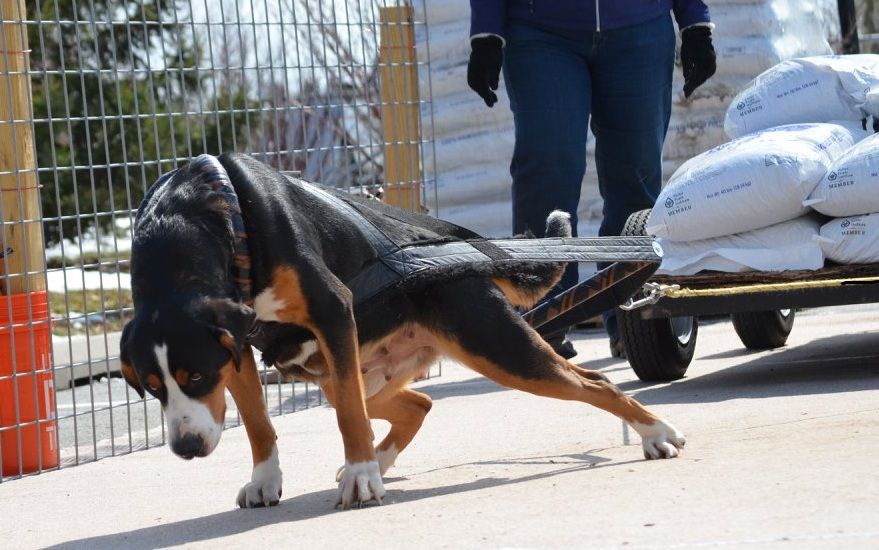
At first glimpse, the sport of dog weight-pulling might look pretty brutal.
Strapping heavy weights to a dog harness to see who can pull the heaviest load seems both unnecessary and borderline cruel, with some individuals and animal welfare organizations calling for it to be banned.1 But, if you look a little closer, is this challenging sport really any different from the myriad other competitive canine events that millions of dog owners take part in?
There’s no doubt that weight-pulling is far more physically demanding than dog agility, surfing, or even a simple game of fetch, as the image above of Swiss Mountain Dog, Dezzy, suggests, but her face earlier in the competition tells a different story. So is dog weight-pulling a healthy way for active dogs to let off steam, or just another example of exploitation by humans in the name of competition?

From Functional to Fun
Like many canine – and human – sports, dog weight-pulling evolved from more functional origins. While the competitive sport of today has been around for at least half a century, the activity itself dates back to the end of the 19th century, when dogs were used to pull heavy loads over challenging terrain during the Klondike Gold Rush.2 Much like competitive dog sledding, weight-pulling has evolved from an activity of utility to one of spectacle, with competitions and demonstrations taking place around the world.
What Are The Rules?
The International Weight Pull Association (IWPA) was founded in 1984 in order to standardize the procedure and safety of weight-pulling events. This non-profit organization has 18 regions that encompass the United States and Canada, and although not all weight-pulling competitions fall under their jurisdiction, their goal is to keep the sport fun, family-friendly, and above all, safe.
The objective of a competition is to see which dogs can pull the most weight over a distance of 16 feet within one minute, with any ties broken by who pulls the fastest. Dogs compete within nine weight classes, and competition is open to all dogs, mixed breed or pedigree.

The competition starts with sleds or trailers (depending on whether it’s a dry land or snow event) loaded with minimal weight, increasing incrementally until the winner is revealed. Dog owners cannot touch their dog during the competition and can only give visual and vocal encouragement from behind the finish line.
In order to ensure the safety of participating dogs, the IWPA has implemented strict rules, including:
- All dog pull events within IWPA jurisdiction must apply for authorization.
- Dogs must be fitted properly with a freight or weight pull type harness to minimize the risk of injury.
- Dogs must be well controlled, and be wearing a good collar – prong collars are not allowed.
- Dogs may not be more than 12 years of age at the beginning of the season to compete in any IWPA event.
- The physical condition of the dog should always be taken into consideration, and the Chief Judge may disqualify any dog they feel will be in danger of injury.
- All dogs must be currently immunized against any contagious canine diseases with vaccinations recognized by the state/ province in which the dog is pulling.
- The use of performance-altering drugs is strictly prohibited.
- Abusive or inhumane treatment of a dog shall be strictly prohibited and shall be cause for disqualification.
- Pregnant or lactating bitches cannot compete, and no bitches in season will be allowed on the competition premises.
- Any person found to be participating in a dog-fighting competition shall be suspended for the maximum amount, pending possible expulsion, due to the abusive or inhumane treatment of dogs.
The Risks of Dog Weight-Pulling

According to the IWPA, no dog has been injured at one of their weight-pulling events since its creation in 1984; however, it would be impossible to determine whether, and to what extent, dogs experience discomfort, pain, stress, or long-term injuries as a result of participation. Of course, not all weight-pulling competitions around the world are going to fall under IWPA (or similar governing body) authority, and while some of these events look like good, clean fun, there is plenty of footage on the internet showing dogs pulling insane amounts of weight that are clearly at risk of tendon injury, joint damage, or intervertebral disc prolapse, with loads of over 4000 lbs not unusual for wheeled pulling events.
As soon as you turn any physical activity into a competition, the risks go up; it’s inevitable. The desire to push a bit further, a little harder, just a few seconds longer to take home the trophy, can mean the difference between healthy exercise and a debilitating injury. And when that need to win is coupled with a creature that will do just about anything to please their human, including masking any signs of pain, you’ve got a recipe for disaster. Competition shifts the focus away from enrichment and onto winning, and that’s where things can get dangerous for our dogs.
Are There Any Benefits For Participating Dogs?

As is the case with most organized canine events, the most significant potential benefit for dogs competing in weight-pulling events is enrichment. All dogs need mental and physical stimulation, particularly those that were selectively bred for work. Sledding breeds like Huskies, Malamutes, or Greenland Dogs, or those bred for strength like Mastiffs and Molossers, can often become frustrated by the relatively slow pace of domestic bliss, and finding an activity that challenges them both physically and mentally is not always easy.
Another challenge for dog owners is finding activities and exercises that can improve strength and fitness, without putting excessive strain on their joints.
Weight-pulling enthusiast and member of the IWPA Board of Directors, W. Clay Fonvielle, is passionate about the role this sport plays in keeping his dogs happy and healthy. Clay’s dog AIDEW (which stands for All I Do Es Win) is a 15-time National Weight Pull Champion, pulling loads of over six thousand pounds!

“I work under the guidance of an orthopedic vet, and I utilize x-rays, supplements, etc, in doing the best for my dogs. Weight pull dragging is actually a common practice in rehabbing dogs after TPLO, total hip replacements, and more.”
With more vets and dog owners becoming aware of the high risk of joint injury from repetitive, high-speed activities like chasing a frisbee or ball, particularly when a ball-thrower is involved, there may be some value to incorporating a low-impact activity that improves fitness and muscle mass. But is weight-pulling that activity? After all, no sport is without risk.
The Goal Must Always Be Happy, Healthy Dogs – No Contest

Ultimately, all dog sports, particularly those of a competitive nature, involve training, encouraging, or even forcing dogs to participate in an activity they may not necessarily wish to engage in. Whether it be through positive reinforcement or by strapping them into a harness, we are effectively asking them to do something at a time or in a manner they would not ordinarily do it.
So where do we draw the line?
Do we put an end to all competitive dog sports, or only the ones deemed to be cruel?
And who makes that decision? After all, it wasn’t all that long ago that dog fighting — thankfully now banned and recognized as inhumane — wasn’t just legal, but a popular spectator sport!
As our understanding of animal behavior and welfare evolves, so too does our definition of what constitutes enrichment and what is perceived as exploitation.
What is clear, however, is that when it comes to competitive canine sport, rules and regulations are an essential ingredient to keeping dogs safe. If you’re looking to get involved in an activity like dog weight-pulling, whether as a participant or spectator, be sure to look for events that are operated by an organization like the IWPA that works to ensure the safety of the dogs involved.
What are your thoughts on competitive sports for dogs like Dog Weight-Pulling? We’d love to hear from you.
All images are courtesy of International Weight Pull Association
Expert dog care, straight to your inbox
News, insights, expert advice, and everything dog.

No spam — unsubscribe anytime.
By signing up, you agree to our Terms & Conditions and Privacy & Cookies Policy.
How useful was this post?
Click a star to rate. You can leave written feedback afterwards. (We read all feedback.)

Dr. Karyn Kanowski, BVSc MRCVS (Vet)
Dr. Karyn is originally from Queensland, Australia, and has resided in the UK for the past 10 years. She graduated from The University of Queensland School of Veterinary Science in 2010, and also holds a Bachelor’s degree in Zoology. Karyn is passionate about using experience, evidence, and working with pet owners to provide the best solutions for pets. She also believes in making reliable information about animal health accessible to everyone. 5 cats and 4 dogs let her share their home with her and her husband, and when she is not practising as a veterinary surgeon, she spends her time writing, gardening, and cleaning up pet hair!