How Old Is a Puppy When Their Balls Drop? Our Vet Explains


In this article
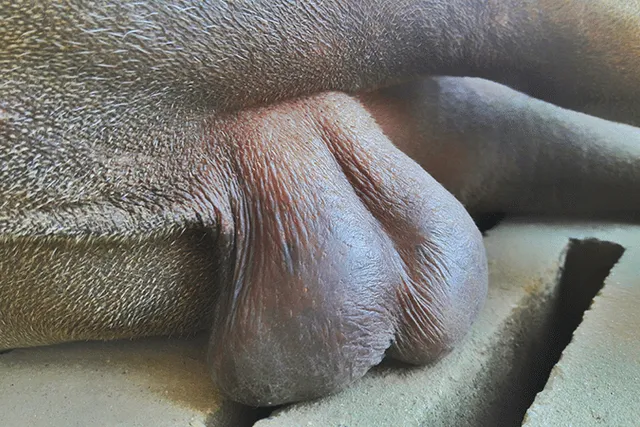
The testes develop behind the kidneys in the abdomen while a puppy is still in the womb. In most puppies, the testes descend or “drop” by 2 months of age. Each testicle is attached to a ligament called the gubernaculum.1 The end of this ligament is attached to the scrotum. As the ligament shrinks, it pulls the testicle through the inguinal canal into the scrotum. In some breeds of dogs, the testes may descend later than 2 months, but rarely after the age of 6 months.
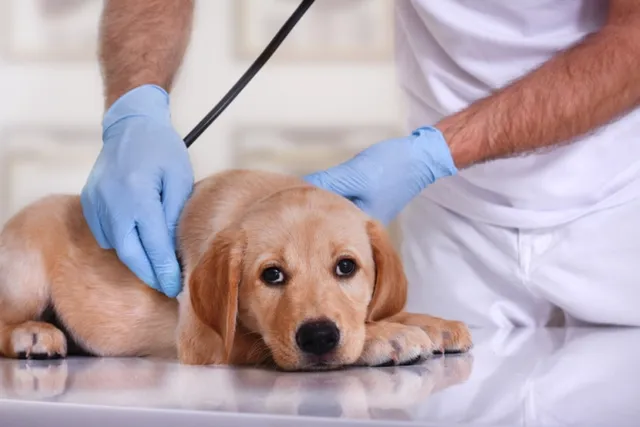
At your puppy’s first check-up, your veterinarian will examine the scrotum to see if his testes have descended. If your puppy’s testes have not yet “dropped”, your vet will check again at a future visit.
If one or both testicles fail to descend into the scrotum by about 4 months of age, the puppy is presumed to have a condition known as cryptorchidism.

The Signs of Cryptorchidism
Puppies with cryptorchidism usually don’t show symptoms other than a lack of one or both testes in the scrotum. The condition is not painful and does not make a dog feel sick unless complications arise. There are two complications associated with cryptorchid testicles—spermatic cord torsion and testicular cancer.
In spermatic cord torsion, the spermatic cord twists on itself, cutting off blood supply to the testicle. This causes severe abdominal pain. The only treatment is emergency surgery to neuter the dog. Spermatic cord torsion is rare in dogs.
Older dogs with cryptorchidism are at risk for developing testicular cancer.
Cryptorchid dogs are estimated to be 13 times more likely to develop cancer than normal dogs. Some dogs don’t show obvious symptoms of testicular cancer, but if they do, the symptoms depend on the type of cancer present. Testicular tumors of the retained testicle are typically diagnosed post-surgery when sections of the tumor are sent to the lab for histopathology, where a veterinary pathologist examines the tissue under a microscope.
If your dog is showing any of these signs and you are seeking the best possible treatment for your pup, we recommend speaking with a vet.
Lowering the Chances of Testicular Cancer
The best way to prevent testicular cancer from occurring in a cryptorchid dog is to neuter the dog while it is still young.
The undescended testicle is not able to produce sperm due to the higher temperature inside the body. It is also usually smaller than the scrotal testicle. If both testicles are retained, the dog will be sterile, while dogs with one cryptorchid testicle are still fertile with the testicle in the scrotum producing sperm.

See also: Common Infectious Diseases in Dogs
What Causes a Dog to Develop Cryptorchidism?
Cryptorchidism is inherited. It is therefore important not to breed males with this condition. Although any breed of dog can have cryptorchidism, some breeds are at greater risk.
According to VCA Hospitals, the toy breeds, including Toy Poodles, Pomeranians, and Yorkshire Terriers, are more likely to have undescended testicles.

What Is the Treatment for Cryptorchidism?
Castration (also known as neutering) is the only treatment for this condition. Castration involves surgically removing both testicles while the dog is under general anesthetic. In most cases of cryptorchidism, the retained testicle is located in the abdomen or the inguinal canal. It is also possible for the testicle to be located under the skin in the groin area.
Cryptorchid dogs should be neutered early to avoid life-threatening conditions such as testicular cancer and spermatic cord torsion from developing.
The prognosis for cryptorchidism is excellent provided dogs are neutered early before problems develop in the retained testicle.
Final Thoughts
Understanding when a puppy's testicles should descend is important for monitoring their health and identifying potential health issues like cryptorchidism. While most puppies experience normal testicular descent by 2 months of age, some can take up to 6 months. If one or both testicles remain undescended by this type, it’s essential to consult a veterinarian to avoid complications.
Cryptorchidism itself may not cause immediate discomfort, but it significantly increases the risk of health conditions such as testicular cancer and spermatic cord torsion. The best course of action is neutering your puppy, which eliminates these risks and prevents passing on this hereditary condition to future generations.
Related Reads:
Featured Image Credit: mamillaria, Shutterstock
Expert dog care, straight to your inbox
News, insights, expert advice, and everything dog.

No spam — unsubscribe anytime.
By signing up, you agree to our Terms & Conditions and Privacy & Cookies Policy.
How useful was this post?
Click a star to rate. You can leave written feedback afterwards. (We read all feedback.)
Dr. Lindsay Bisset BVSc (Veterinarian)
Lindsay is a veterinarian living in the vibrant city of Cape Town, South Africa with her husband and their rescue animals, Blizzard and Harrison. Lindsay received her bachelor's degree in veterinary science from the University of Pretoria and currently works in small animal practice. When she’s not working, you can find her enjoying time outdoors in nature hiking with Blizzard, or writing.