Why Modern Dog Care is Quietly Shifting From Treatment to Lifespan Stewardship
In this article
Our dogs are our close companions. We love and care for them as if they were family members, like in millions of households across the United States. And with advances in veterinary care, dogs are not only living longer but also enjoying better health and a higher quality of life.
As with humans, though, aging is an inevitable fact of life for dogs. As dogs get older, their bodies undergo numerous age-related changes, leading to signs of decline such as reduced mobility, cognitive dysfunction, and chronic diseases like kidney disease.
But does aging have to mean treating one disease after another? Not necessarily. And could there be another way of proactively caring for our dogs’ health as they get older? Absolutely.
In this article, we’re going to delve into a paradigm shift in canine care, moving away from simply treating disease and toward targeting the biological mechanisms of aging to help dogs live longer, healthier lives.

Rethinking Canine Geriatric Care
Dogs commonly live into their double digits due to improved care and nutrition. The conventional approach to senior canine care and wellness has been primarily disease-centric, treating each disease as its own entity: pain medications for arthritis, chemotherapy for cancer, etc.
But this approach is a bit like whack-a-mole — focusing on one thing at a time rather than on a broader, holistic picture of a dog’s health and aging body.
In recent years, the veterinary world has taken a page from human geriatric care. Rather than viewing aging as an inevitable downward slope of decline, veterinary medical experts are adopting a new view of modern dog care: a paradigm shift that treats aging as a process that can be proactively modified and managed at the biological level.1,2
Several factors have contributed to this shift. First, dogs are increasingly cared for as bona fide family members.3 Pet parents are actively invested in their dogs’ care, willing to pay a premium for high-quality dog food and top-notch veterinary care, to foster their dogs’ lifelong well-being and good health.
Additionally, veterinary care is more focused on preventive medicine, such as vaccinations, flea & tick prevention, and annual dental care to prevent or delay the onset of disease as much as possible.
Another factor is veterinary nutrition research, which has led to significant improvements in the quality and nutritional value of dog food that support canine health throughout each life stage, from puppyhood to senior. And finally, veterinary research that investigates the biology of disease has contributed to a better understanding of disease mechanisms at the molecular level, allowing for more targeted treatments that improve health outcomes and minimize reductions in quality of life.
Other veterinary research – the Dog Aging Project (DAP) and the Golden Retriever Lifetime Study (GRLS)4,5 – is examining factors that influence aging in dogs, including genetics, lifestyle, and environment. Findings from these studies aim to shed more light on the mechanisms of aging and disease in dogs, ultimately improving disease diagnosis and prevention.

Traditional Approach Versus Geroscience
If the term ‘geroscience’ is new to you, you’re not alone. According to a 2024 paper published in Pathology and Oncology Research, geroscience “is an emerging discipline at the intersection of aging and disease that seeks to understand the relationship between the aging process and pathogenesis of age-related diseases.”6
In less science-y words, geroscience seeks to understand the biology of aging, to proactively modify the aging process and extend healthspan and the number of disease-free years.
Here’s another way of looking at geroscience: it investigates the foundational, upstream biological mechanisms of aging rather than the narrowed lens of downstream disease-by-disease care.
Geroscience focuses on the hallmarks of aging, the biological processes that contribute to age-related diseases. Some of these hallmarks include cellular senescence (the point at which cells stop dividing and start aging), mitochondrial dysfunction, and genomic instability. An article by La Petite Labs describes the 12 hallmarks of aging in dogs in detail.
By targeting the biology of aging and focusing on healthspan, geroscience distinctly differs from the traditional, disease-centric approach to senior wellness.
So, where is this going? Veterinary geriatric care is moving toward using a multi-system approach to extending canine healthspan by proactively targeting the hallmarks of aging. With pet geroscience, it is not just about helping dogs live longer; it is about being stewards of dogs’ lifespans, helping them live disease-free for longer.

Approach #1: Nutrition
Nutrition is a key aspect of geroscience. ‘Geroprotective nutrition’ is a technical term for using food and supplements to target the biological hallmarks of aging and extend healthspan. There are several strategies for putting geroscience into practice through diet.
Calorie restriction
Moderate calorie restriction, without malnutrition, can extend lifespan and healthspan in dogs, in part by improving mitochondrial function and reducing inflammation. A Purina study demonstrated this in Labrador Retrievers, reporting that those fed 25% fewer calories lived nearly 2 years longer and had a slower onset of arthritis and cancer than dogs fed a non-calorie-restricted diet.7
Intermittent fasting
Intermittent fasting also targets several hallmarks of aging. For example, it helps reduce insulin resistance and oxidative stress, ultimately delaying disease onset.8
Macronutrients
Macronutrients are the ‘big’ parts of our diet: protein, carbohydrates, and fat.
Compared with younger dogs, older dogs require a different macronutrient balance to maintain good health and protect against age-related conditions, such as muscle loss. Senior dog food is increasingly optimized to provide age-appropriate levels of high-quality protein, with less fat and fewer carbohydrates, to stave off old-age disease and decline.
Supplementation
Geroprotective supplements complement the dietary strategies described above. We’re going to divide the supplements into ‘general support’ and ‘geroscience-style support.’
- General Support Omega-3 fatty acids are commonly given to older dogs to help reduce arthritis-associated inflammation and support healthy brain function. Coenzyme Q10, alpha-lipoic acid, and vitamins C and E are antioxidants that combat oxidative stress, a hallmark of aging.9 Vitamins C and E also support healthy immune function.
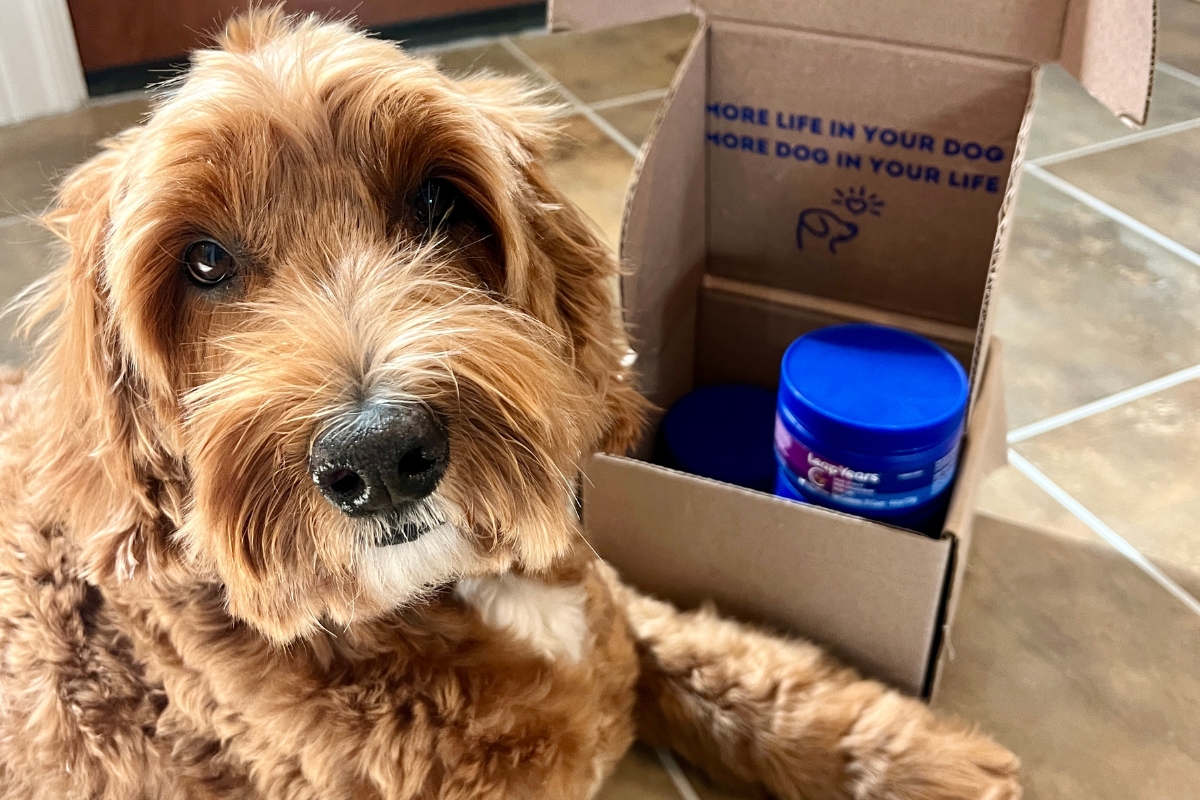
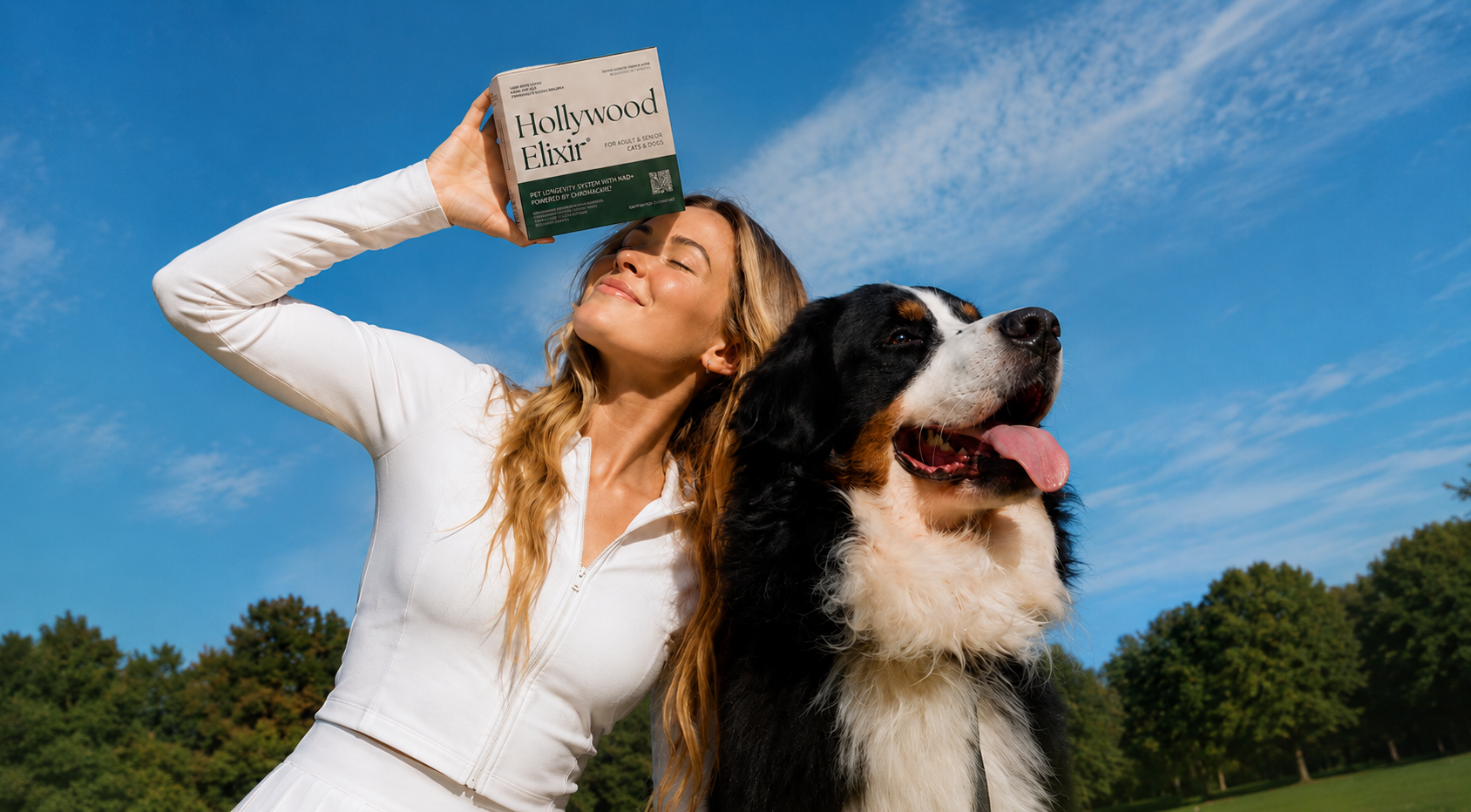
- Geroscience-style Support Geroscience-style support focuses on hallmarks of aging, such as cellular senescence, mitochondrial dysfunction, and oxidative stress. For example, supplements that contain NAD+ precursors help to improve mitochondrial function. One such supplement is Hollywood Elixir™, developed by La Petite Labs. It contains ingredients such as CoQ10, vitamins C and E, and nicotinamide riboside that target several hallmarks of aging, including mitochondrial dysfunction, oxidative stress, and inflammation.
La Petite Labs is a research-led company that uses evidence-based science to establish rigorous standards for translating geroscience from the lab into practical, everyday care that helps dogs in the real world.


Approach #2: Medication
Nutrition does a lot of heavy lifting in geroscience, but a few geroprotective medications are worth mentioning. To date, these medications are not yet available for geroscience-focused care in dogs, but they are being investigated in veterinary clinical research.
Notably, several canine longevity biotech companies, such as Loyal, are actively developing investigational therapies to support healthy aging in dogs.
Whilst cellular senescence is a natural process, the accumulation of these aging cells result in inflammation, tissue destruction, and the development or progression of disease. Additionally, when senescent cells persist in the body, they can trigger senescence in other cells, increasing and speeding up the aging process. Recent pharmaceutical developments are aimed at reducing the negative impact of these cells. One category of geroprotective medications is senolytics, which trigger apoptosis (cell death) in senescent cell, allowing the aging cell population to be replenished by new cells.10 Another class of drugs called senomorphics works similarly to senolytics by slowing the spread of cellular senescence.10


Approach #3: Physical Activity and Cognitive Enrichment
Physical activity and cognitive enrichment are as important to a dog’s health as they are to ours. At the molecular level, physical activity enhances mitochondrial function, improves immune function, and reduces insulin resistance.11 Low-impact activities, like a casual walk in the neighborhood, are beneficial and appropriate for older dogs who don’t have as much pep in their step as they used to.
Cognitive enrichment fosters mental engagement at any age and keeps the brain sharp, delaying the onset of cognitive decline. Interactive toys and training help the brain retain its neuroplasticity—its capacity to form new connections between brain cells and to grow new brain cells.
What Can Pet Parents Do?
Geroscience can become quite technical, but you don’t need a degree in molecular biology to be proactive about your dog’s health and well-being. What you will need is a committed mindset to implement geroprotective strategies to extend your dog’s healthspan.
A clear line of communication with your veterinarian is also necessary to stay on top of your dog’s health, adjusting their diet and lifestyle throughout their lifetime to delay the onset of disease. Your vet can recommend age-appropriate nutrition, perform regular wellness checkups, and prescribe the preventive care your dog needs.

Bringing It Together
Geroscience is a paradigm shift, away from treating only disease to focusing on the biological mechanisms of dog aging and proactively using a multi-pronged approach to improve a dog’s healthspan.
Geroprotective strategies include nutrition, medication, physical activity, and cognitive enrichment. Taken together, these strategies target the hallmarks of aging to keep dogs healthier for longer.
As a company focused on geroscience, La Petite Labs continues to explore how to leverage geroscience to promote overall dog health and well-being.
Sources
Oh WS, Armstrong PJ. Geroscience and aging interventions in dogs and cats: from mechanisms to clinical care. J Vet Sci. 2025 Sep 17;26(Suppl 1):S157–80.
McKenzie BA, Chen FL, Gruen ME, Olby NJ. Canine geriatric syndrome: a framework for advancing research in veterinary geroscience. Front Vet Sci. 2022;9:853743.
Irvine L, Cilia L. More-than-human families: pets, people, and practices in multispecies households. Sociol Compass. 2017;11(2):e12455.
Kaeberlein M, Creevy KE, Promislow DE. The dog aging project: translational geroscience in companion animals. Mamm Genome. 2016 Aug;27(7-8):279-88. doi: 10.1007/s00335-016-9638-7. Epub 2016 May 3.
Guy MK, Page RL, Jensen WA, Olson PN, Haworth JD, Searfoss EE, Brown DE. The Golden Retriever Lifetime Study: establishing an observational cohort study with translational relevance for human health. Philos Trans R Soc Lond B Biol Sci. 2015:370.
Fekete M, Major D, Feher A, Fazekas-Pongor V, Lehoczki A. Geroscience and pathology: a new frontier in understanding age-related diseases. Pathol Oncol Res. 2024 Feb 23;30:1611623.
14-Year Life Span Study in Dogs. https://www.purinainstitute.com/science-of-nutrition/extending-healthy-life/life-span-study-in-dogs. Accessed 2/18/2026.
Redman LM, Smith SR, Burton JH, Martin CK, Il’yasova D, Ravussin E. Metabolic slowing and reduced oxidative damage with sustained caloric restriction support the rate of living and oxidative damage theories of aging. Cell Metab. 2018;27(4):805-815.e4.
Anthony RM, MacLeay JM, Jewell DE, Brejda JJ, Gross KL. Alpha-lipoic acid is an effective nutritive antioxidant for healthy adult dogs. Animals (Basel). 2021;11(2):274.
Lim JR, Yoon JH, Han HJ. Anti-aging strategies for dogs: current insights and future directions. J Vet Sci. 2025 Oct;26(S1):S199-S219.
Larsson L, Degens H, Li M, Salviati L, Lee YI, Thompson W, et al. Sarcopenia: aging-related loss of muscle mass and function. Physiol Rev. 2019;99(1):427-511.
Expert dog care, straight to your inbox
Vet-reviewed advice, training tips, and the best of Dogster. Free, and you can unsubscribe anytime.
By signing up, you agree to our Terms & Conditions and Privacy & Cookies Policy.
JoAnna Pendergrass, DVM, is a veterinarian and freelance medical writer based in Atlanta, GA. As the founder of JPen Communications, she is passionate about educating pet owners and writes extensively on pet care and pet health.
Join the conversation
Ask a question, share your story, or send private feedback.