Nuclear Sclerosis in Dogs: Our Vet Explains the Signs, Diagnosis & Treatment

In this article
As our pets age, one common ocular change seen in senior and geriatric dogs is a condition called nuclear sclerosis, or lenticular sclerosis. Nuclear sclerosis can change the appearance of your pet’s eye, but you also might be wondering how exactly it impacts their vision. Fortunately, nuclear sclerosis minimally, if at all, influences vision and doesn’t require veterinary intervention. Continue reading more below to learn about this incredibly common condition.

What Is Nuclear Sclerosis?
Before getting into the details of nuclear sclerosis, it is a good idea to review basic ocular anatomy.
The cornea is the outer layer of the eye that appears clear and rounded. Within the cornea is a clear fluid called the aqueous humor. The colorful part of the eye is the iris, and this is the part of the eye that constricts and dilates to adjust to light. The pupil is the dark portion located within the center of the iris, and the lens lives behind the iris. The lens helps control the shape of light as it enters the back of the eye and interacts with the retina. Meanwhile, the back of the eye is where vessels and the optic nerve are housed.
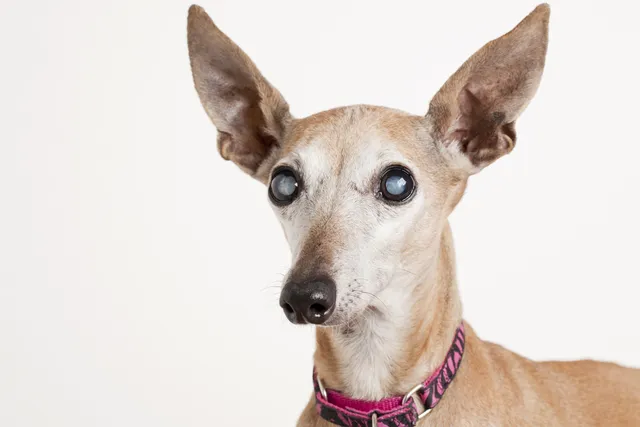
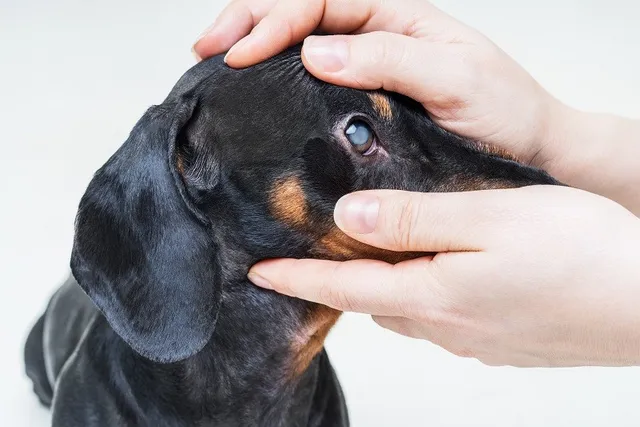
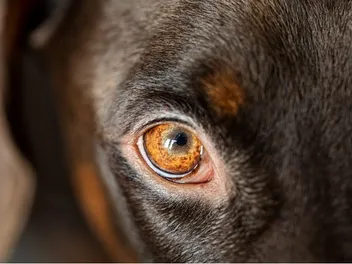
So, what happens to our pet’s eyes with nuclear sclerosis? With nuclear sclerosis, the lens which is typically clear becomes uniformly cloudy or hazy. This causes the center of the eye to appear blue or grey. Fortunately, this doesn’t seem to significantly impact a patient’s ability to see and is a common age-related change.

What Are the Signs of Nuclear Sclerosis?
A gray or hazy appearance to the eye is suggestive of possible nuclear sclerosis. This change is most commonly noted bilaterally. Additionally, your pet may have a harder time with depth perception. However, nuclear sclerosis is thought to only minimally affect vision, if at all.
If your dog is showing these signs, we suggest you speak to a vet.
What Causes Nuclear Sclerosis?
The exact cause of nuclear sclerosis is not known currently. A theory is that as more lens material is replaced in the aging dog, the lens itself doesn’t grow. As a result, the lens becomes thicker giving a darker appearance to the eye.
How Is Nuclear Sclerosis Diagnosed?
Nuclear sclerosis can be differentiated from cataracts through an ophthalmic examination. During the ophthalmic examination, a light is shined into the eye. The lens is evaluated with an ophthalmoscope, and through the lens, the retina is examined. A lens impacted with nuclear sclerosis will still be transparent and the retina can be fully visualized.
A Note on Cataracts
Cataracts are another very common eye change associated with older age. The lens in a dog with a cataract appears different from the lens of a dog with nuclear sclerosis. In cataracts, the lens will develop opacities and light cannot pass through to the retina. Cataracts do not impact the entire lens all at once; often, there will be a small cataract present, and with time, that cataract can become larger until the entire lens is involved.
During evaluation using an ophthalmoscope, the retina may be partially or fully obscured as a result of the opacities within the lens. Cataracts will require veterinary care, as they can lead to complete blindness and have secondary complications, like uveitis.

How Is Nuclear Sclerosis Treated?
Due to the lack of impact nuclear sclerosis has on vision, treatment is not needed. Again, this is considered a normal part of the aging process. Care should be taken, however, to monitor for the development of a cataract. Cataracts can sometimes be missed until vision is impaired unless regular ophthalmic exams are performed.
How Do I Care for a Dog With Nuclear Sclerosis?
Caring for a dog with nuclear sclerosis doesn’t require any special care. It is a good idea to have a wellness exam performed by a veterinarian every 6 months in senior dogs, and at least annually in younger dogs. This will allow for ocular changes to be timely addressed.

Frequently Asked Questions (FAQ)
Now That My Dog Has Nuclear Sclerosis, Will They Develop Cataracts?
No, not necessarily. It is important to note that nuclear sclerosis and cataracts are the two most common eye conditions in adult and senior dogs. There is a high chance that a senior dog will develop one or both conditions in their lifetime.

What Can I Do to Prevent the Formation of Nuclear Sclerosis?
Fortunately, nuclear sclerosis does significantly impact vision. As a result, there is nothing that needs to be done to address this condition. Furthermore, there is no treatment present to prevent this from occurring either.
In Summary
Although the appearance of a sclerotic lens may be concerning, it is actually a benign process that doesn’t interfere with vision. Nuclear sclerosis is a common age-related change that doesn’t require medical intervention or treatment. Care must be taken to routinely have the eyes evaluated as cataracts can develop in dogs with or without nuclear sclerosis, and a thorough eye examination will allow differentiation between the two conditions.
Sources
Featured Image Credit: Zontica, Shutterstock
Expert dog care, straight to your inbox
News, insights, expert advice, and everything dog.

No spam — unsubscribe anytime.
By signing up, you agree to our Terms & Conditions and Privacy & Cookies Policy.
How useful was this post?
Click a star to rate. You can leave written feedback afterwards. (We read all feedback.)
Dr. Marti Dudley DVM (Veterinarian)
Dr. Marti Dudley is a small animal veterinarian with a strong interest in preventative medicine and pet parent education. She enjoys being a resource for pet owners as she believes that having a team approach leads to the best possible care of pets. Dr. Dudley enjoys writing and has been able to use this skill as another avenue to educate pet owners outside of the traditional office setting.
Dr. Dudley has been practicing veterinary medicine since 2014. She has an interest in preventative care and emphasizes the importance of pet owner education. Dr. Dudley’s experience in veterinary medicine is broad, as she has worked as a general practitioner, which has allowed her to see and treat many different types of conditions.
Dr. Dudley received her bachelor’s degree in biology from Longwood University in Virginia. She earned her Doctor of Veterinary Medicine (DVM) degree from Ross University.