Weimaraner vs. Great Dane – The Differences (With Pictures)

In this article
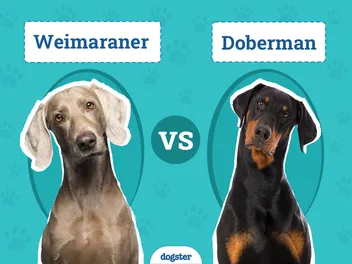
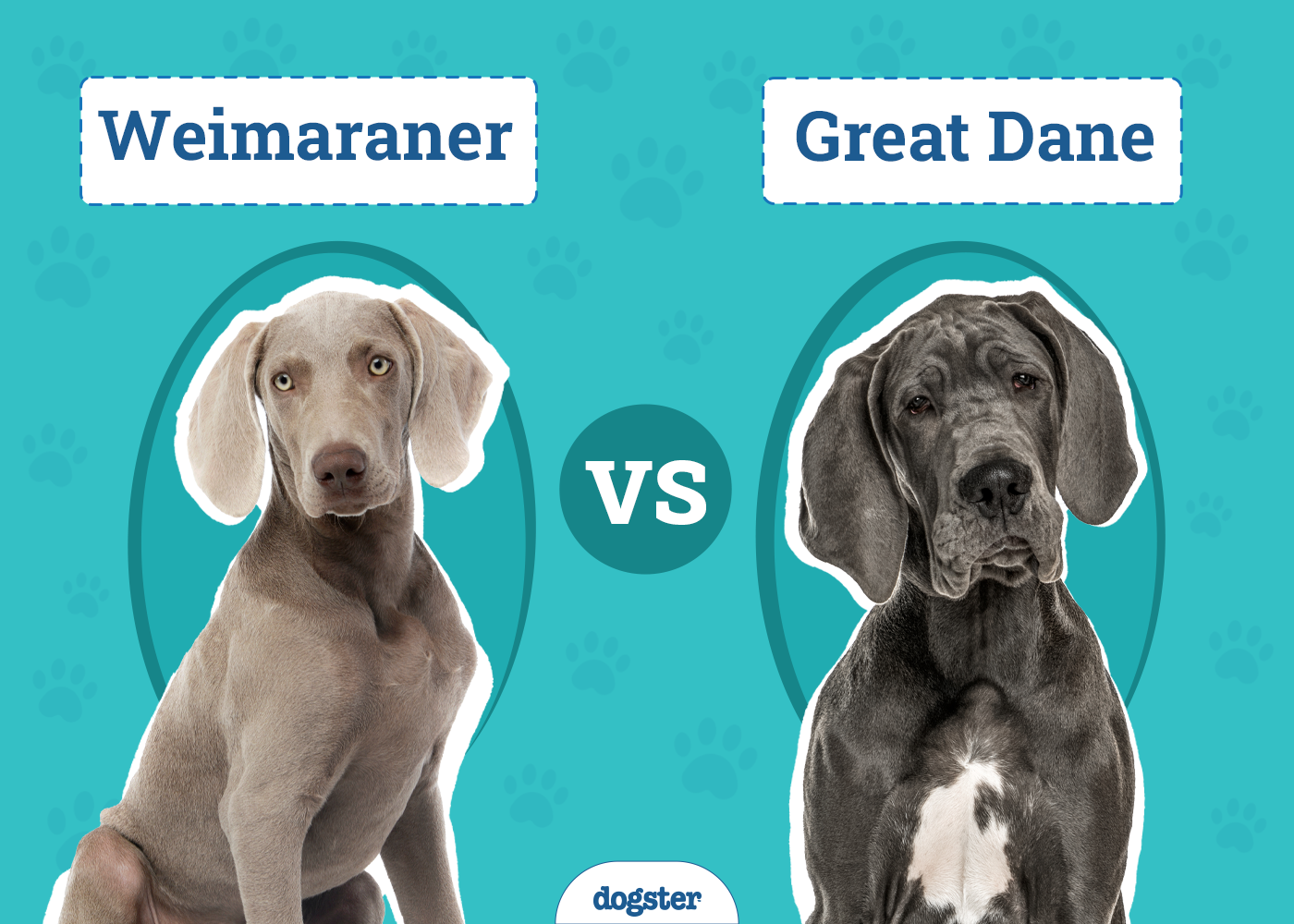
Weimaraners and Great Danes look similar, but they have quite a few obvious differences. For instance, Weimaraners are much smaller than Great Danes, even if they are often considered large dogs. The Great Dane is the biggest of all breeds, so there is an obvious size difference between these two dogs. They also have different personalities, making them more suitable for different lifestyles. Weimaraners tend to live longer than Great Danes—up to 13 years compared to the Great Dane’s max of 10. Let’s dive into other important differences to consider when choosing one of these breeds.

Visual Differences

At a Glance

Weimaraner Overview

Care
Weimaraners do not require extensive maintenance. They don’t have a double coat, which means that they shed minimally. Usually, these dogs also do not need a bath unless they’ve rolled in something particularly smelly. Their coat is largely dirt-proof, which means that most dust just rolls off of them.
You will need to trim their nails regularly, though, as they can be rather fast–growing.
Exercise 🐕
This dog is a high-energy breed. Therefore, you can expect to exercise them a lot. Unlike many other breeds, they don’t tend to settle down much when they become older. You should plan on exercising them for at least 1.5–2 hours each day for their whole life.
For this reason, these dogs are best for active families.

Health
These dogs have quite a long lifespan. They tend to live up to 13 or 14 years. However, some may die younger depending on their overall health. These dogs are rather healthy in general, but they may be prone to certain genetic eye disorders. Bloat and gastric torsion may also occur, so be sure to watch for the signs.
In many cases, adopting from a qualified breeder can lower the risk of many health problems. For instance, many of the eye problems that occur in the breed are genetic. Good breeders avoid these issues when possible.
Price
The price of a Weimaraner varies considerably. You can find puppies for around $700. However, these are usually companion-only dogs. Since the price of this breed is rising, you may find pups for nearly $3,000. Of course, these more expensive dogs are typically destined for the show ring (which is why they are so expensive).
Your location will play a large role in how much a Weimaraner costs near you.
Suitable For:
These dogs are suitable for all owners, though we only recommend them to those who are fairly active. Otherwise, they can be a handful. They require hours of exercise a day, which isn’t typically something that most dog owners have time for. However, if you already exercise yourself, you may find it easy to include a Weimaraner in your routine.
Great Dane Overview

Care
The Great Dane has a short, smooth coat. They don’t have an undercoat, which helps keep shedding to a minimum. However, they do still shed a bit—about as much as a Weimaraner. Since they are so large, this can translate to quite a bit of hair.
We do recommend brushing these dogs weekly to help limit the amount of hair that ends up around your house. This brushing session is solely to limit shedding. These dogs will not develop tangles due to their very short hair.
Exercise 🐕
While these dogs are large, their stamina isn’t that high. Therefore, they may only need about 1 hour of exercise a day. However, since they are so large, they do need a decently spacious area to run. Small dogs may be able to meet their exercise needs with an indoor game of fetch, but not a Great Dane.
These dogs are prone to joint issues. Therefore, you should avoid overexercising them. Never force a Great Dane puppy to exercise, and be wary of taking long walks or runs before they turn 2 years old.

Health
Sadly, Great Danes don’t tend to live long. Their maximum lifespan is around 10 years, though many do not make it past 7. To an extent, this is to be expected, and it isn’t because the breed is extremely unhealthy. Instead, large animals just don’t tend to live as long as small animals. An increase in size usually means a decrease in lifespan.
Great Danes are prone to a few health issues. For instance, it isn’t odd for a Great Dane to develop bloat due to their large size. This emergency condition requires fast veterinary care (and usually surgery). Luckily, the signs are often clear, so owners can seek help right away. Great Danes are also prone to cardiac and thyroid problems, many of which are genetic.
Therefore, we recommend purchasing a Great Dane from a qualified breeder only. Doing so can help reduce health problems.
Price
Great Danes vary in cost quite a bit. Some are as cheap as $800. However, if you want a show-quality dog, you’ll likely pay closer to $3,000. Great Danes are large, which means they cost more money to breed and maintain. For this reason, the puppies tend to be more expensive than those of other breeds.
Be sure to be cautious of any dog under this price range. Unethical breeders and puppy mills often breed Great Danes, as they are in demand and go for a lot of money.
Suitable For:
This breed is best for those who want a large, calm dog. While they aren’t that active, they do need quite a bit of room to simply exist. Therefore, we only recommend them for those with larger homes. Fenced-in backyards can be helpful, as they enable these dogs to stretch their legs.
Choosing a qualified breeder is important for this breed. Otherwise, you may end up with an unhealthy puppy.
Which Breed Is Right for You?

An obvious difference between these two breeds is their size. Great Danes are quite large. While Weimaraners aren’t as huge as Great Danes, they are still quite big compared to many other breeds. Still, how much room your house has may be the deciding factor between these two breeds.
That said, you should also consider the exercise requirements. Weimaraners are quite active and thrive most when adopted by an active household. Great Danes have much lower stamina and don’t need tons of exercise every day. Consider your own activity level when considering which dog to purchase.
See Also:
Featured Image Credit: Top - RitaE, Pixabay | Bottom - BIGANDT.COM, Shutterstock
Expert dog care, straight to your inbox
News, insights, expert advice, and everything dog.

No spam — unsubscribe anytime.
By signing up, you agree to our Terms & Conditions and Privacy & Cookies Policy.
How useful was this post?
Click a star to rate. You can leave written feedback afterwards. (We read all feedback.)
Kristin loves to help pet parents create a fulfilling life for their pets by informing them on the latest scientific discoveries and helping them choose the best products for their pets. She currently resides in Tennessee with three cats, four dogs, two fish, and a lizard, though she has dreams of owning chickens one day!