What Were Papillons Bred For? Origin & History


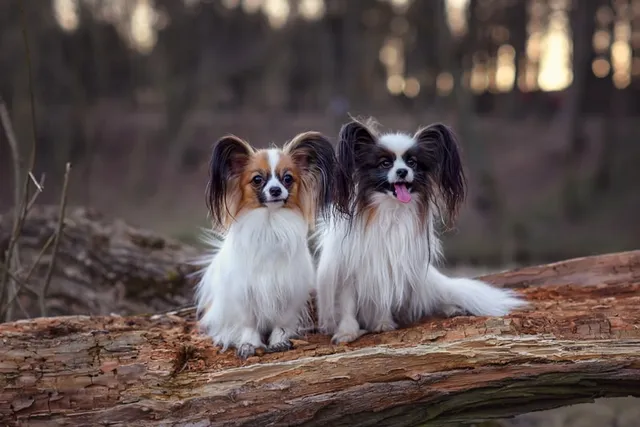
Once you’ve seen one, you never forget the cute face of the Papillon. They have large, fluffy, wing-shaped ears that have you thinking of butterflies, which is pretty perfect when papillon means “butterfly” in French. They’re playful, but while you might think they’re little lapdogs, you’d be wrong. They love to spend time with humans and crave physical and mental stimulation to keep them healthy and happy.
The exact date and place of origin for the Papillon dog breed is unknown, but it’s thought they date back at least 500 years ago and originated in Western Europe.
Ironically, despite all their energy, the adorable dogs were bred as companions for noblewomen. You’ve probably seen the toy spaniel the Papillon descends from, which was frequently portrayed in paintings that go as far back as the 16th century.
Not only were they originally bred to be companions, but also lapdogs and even foot warmers. In this article, we’ll delve into the history of this breed, and how they became the beloved dogs we know and love today.

A Little More About the Papillon
The little dogs are so unique in their appearance, and you might be surprised to find out that they didn’t always look the way they do now. Their ancestors had fluffy ears, but they weren’t erect. Instead, they were laid back as if they were folded.
The earlier versions of Papillon were called Phalene, which is the French word for “moth” and it’s an excellent way to describe how the ears resembled a folded moth’s wing. We don’t have a record of when the ears became erect, because the dog predates breeding records. So, a lot of this breed’s history is based on assumption, rather than proven fact.
It’s thought this change in appearance for the Phalene occurred around the 17th century. Phalene still exists today, and it’s possible in a litter of Papillon puppies to have dogs with erect and dropped ears.

The 16th century
Some researchers believe the Papillon is a modern Continental Toy Spaniel, although we have no proof. Continental Toy Spaniels had the drooping ears and feathery coats familiar in the Phalene, and it’s thought this breed was depicted in Italian paintings as early as the 12th and 13th centuries. This could mean they were originally bred in Italy. However, “Spaniel” also hints they came from Spain, so sadly the true origin of this breed is lost to history.
While Spaniels were bred as hunting dogs, smaller versions were bred for companionship as they became more popular. Around the 1500s, the Italian painter Titan depicted small Spaniels in some of his paintings which resembled what would later be called Phalene, and the dogs became known as Titan Spaniels at the time.
Thanks to their small size, the Spaniels were called Dwarf or Toy Spaniels, and it was thought they could serve no other purpose than companionship for the nobility or those rich enough to care for them. The dogs became companions and lap and feet warmers. Many doctors even recommended that noblemen and women get one to cure whatever illness they had because they believed the dogs had healing properties.
The 17th and 18th Centuries
The popularity of the Toy Spaniel grew over this time, and while not much changed during the 16 and 1700s, more dogs were bred to keep up with the rise in popularity. Because of this, there were changes in their appearance as breeders refined certain aspects of the dog’s appearance. By the reign of King Louis XIV, they started to resemble Phalene dogs that we would recognize today, and this is likely thanks to French breeders.
Marie Antoinette favored the breed, and it’s believed that she and her Papillon Coco were together until the end. She didn’t want to lose her beloved pet, and she held Coco when she was about to be beheaded.
After her death, the dogs were cared for by the house inhabitants where she had lived. This house is known today as “The House of Papillon.” Coco even went on to live a long life. She survived the French Revolution and died at the age of 22.

19th century
After the French Revolution, Toy Spaniels and Phalenes were more common in households, and it wasn’t just the wealthy or nobles who owned them. It was during this century that the Papillon variety appeared. It’s never been proven if the change in appearance was due to a mutation or some other reason. Experts are sure that it didn’t appear because of cross-breeding practices.
In the late 1800s, the Papillon was brought to America, and it didn’t take long for its popularity to spread.
20th century
In the early 1900s, the erect-eared variety of dogs, the Papillon started to be recognized as a separate breed. Both Papillons and Phalenes were recognized in Belgian dog shows. The drop-eared variety was still known as the Continental Toy Spaniel, and it wouldn’t be until around 1955 that the name Phalene was approved.
In 1930, the Papillon Club of America (PCA) was formed, and in 1935, the American Kennel Club (AKC) gave the Papillon recognition as a toy breed. The AKC treats the Papillon and Phalene as a single breed, while some parts of Europe recognize them as separate.
In America, Papillons have maintained their status as one of the most popular dog breeds and were once in the top 50 spots. This popularity has declined in the last 10 years, and out of 200 breeds, Papillons are in the top 30%.
Present Day Papillon
Papillons today are bright, curious, and busy. If you are on the lookout for a dog to curl up on the couch with, this is not the dog for you. They take their duties as guard dogs seriously, but they’re unaware that they weigh only 4 to 9 pounds, and this big-dog attitude can get them into trouble.
Papillons love children, but they can be hurt easily, especially the puppies, and they’re not suitable pets for families with young children. They get along with other pets, but the brave Papillon will usually boss around dogs much bigger than them.
If you adopt a Papillon, know that it will expect to be the center of your universe. They don’t do well in environments where they are ignored or left alone for long periods. They love their families and want to spend all of their time with them.

Final Thoughts
Papillons have a long history that is quite different from their present reality. They are fearless, loving, energetic, and integral to any family who takes them in. While it might be their butterfly ears you think about initially, their intelligence and dynamic personality will win you over.
See Also:
Sources
Featured Image Credit: BIGANDT.COM, Shutterstock
Expert dog care, straight to your inbox
News, insights, expert advice, and everything dog.

No spam — unsubscribe anytime.
By signing up, you agree to our Terms & Conditions and Privacy & Cookies Policy.
How useful was this post?
Click a star to rate. You can leave written feedback afterwards. (We read all feedback.)
Kerry-Ann lives in Scotland and wishes her garden was bigger so she could have her very own Highland cow but thinks her dogs probably wouldn’t like that idea very much. She has a La Chon called Harry who was poorly with a liver shunt when he was a puppy. It wasn't likely he would make it into adulthood, which was difficult to comprehend, but he beat the odds and is a healthy old man now. She also has a Pug called Maddie who is a big foodie. She’s small, sassy, and every day she finds a new way to wind her brother up.
When she isn’t writing you can find Kerry-Ann going for long walks when it isn't raining, reading, or watching cartoons when she should be tidying her house. She would one day like to be a tourist in her own country and travel through the Highlands with her family.