10 Kenya Pet Industry Statistics To Know In 2026: Trends, Market Size & FAQ


In this article
Note: This article’s statistics come from third-party sources and do not represent the opinions of this website.
When people living outside of Africa picture animals on the continent, lions and elephants are probably the most common visions. Although the wild beasts call Africa home, the continent is also home to several domestic animals.
Kenya, one of the most populous nations on the continent, is among the countries with an emerging pet industry. In this article, we'll cover 10 statistics about the Kenyan pet industry, including why the region is expected to continue to play a role in the global pet industry boom.

Top 10 Kenya Pet Industry Statistics
The African pet food market is expected to grow at an annual rate of 12.67%.
In Kenya, pet owners may spend 2,200–3,000 Kenyan shillings (Sh), or roughly $19–$26 on a 5 kg (11 pounds) bag of organic food.
Ten major companies account for 50% of the pet food market share in Africa.
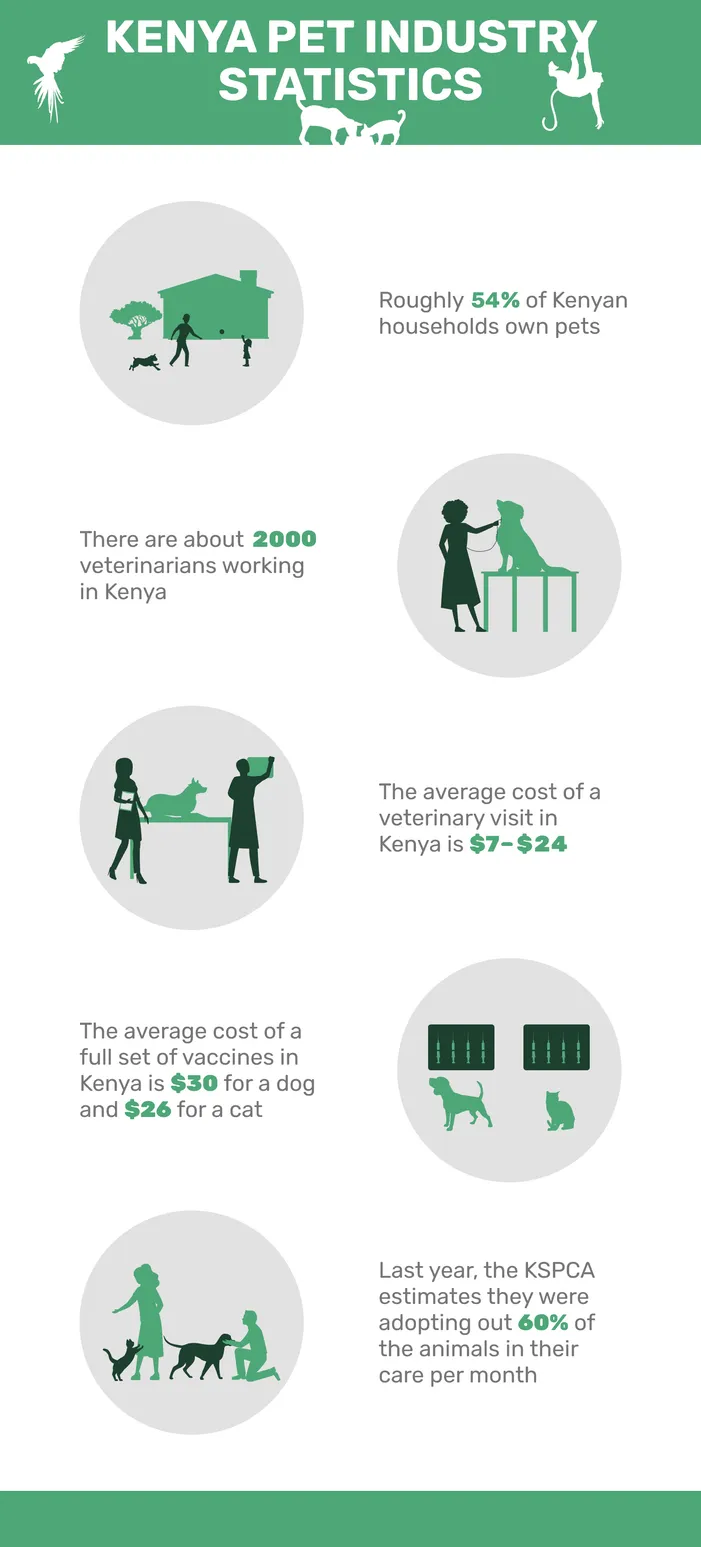
Fewer than 2,000 veterinarians are working in Kenya.
The average consultation fee at a vet’s office in Kenya is Sh1000–3000 (~$7.69–$23.8).
The average cost of a full set of vaccines is about Sh3,500 ($30) for a dog and Sh3,000 ($26) for a cat.
99% of human rabies infection in Kenya comes from dogs.
During the COVID-19 pandemic (2020–2021), the Kenyan Society for the Prevention of Cruelty to Animals (KSPCA) estimates that 60% of the animals in its care were adopted per month.
The most popular working breed in Kenya, the German Shepherd, typically costs around KES 120,000 (~$923.08) from a breeder.
A survey conducted in Kenya in 2023 found that 54% of participants owned animals.
The Pet Food Market in Kenya
1. The African pet food market is expected to grow at an annual rate of 12.67%.
(Statista)
Kenya is one of the most populous countries on the continent. Africa, as a whole, is considered the fastest-urbanizing region in the world. This trend toward city living is one factor contributing to increased rates of pet ownership.
More disposable income and changing attitudes toward the role of pets are other factors. With higher rates of pet ownership has come increased demand for pet food in Africa.

2. In Kenya, pet owners may spend 2,20–3,000 Kenyan shillings (Sh), or roughly $19–$26 on a 5 kg (11 pounds) bag of organic food.
(Daily Business)
Globally, trends indicate increased demand for premium and organic pet products, including food. Kenya is also displaying signs of this phenomenon. Many pet owners, especially younger ones, are transitioning to think of their pets more like children.
Because of this, they don't hesitate to spend more on organic pet food. However, the industry faces some issues based on the number of people who like to feed homemade food to their dogs.
(Market Data Forecast)
The region's number one pet food company is Mars, Inc., home to recognizable brands such as Friskies, Royal Canin, Pedigree, and Iams.
The other nine companies dominating the market include the following:
As you can see, many of the most well-known dog food brands have a presence in Africa and Kenya. The region is viewed as an emerging market.

The Animal Healthcare Industry in Kenya
4. Fewer than 2,000 veterinarians are working in Kenya.
(Kenya Vet Association)
Access to veterinarians varies worldwide, based mainly on the number of vets practicing in the country. For example, you can compare the 2,000 Kenyan vets with the 188,909 working in the EU.
Like most in the developing world, Kenyan vets tend to focus more on livestock than small animals, but urban areas have thriving companion pet practices.
5. The average consultation fee at a vet’s office in Kenya is Sh1000–3000 (~$7.69–$23.8).
(DuckNetVet)
The price of the exam will vary depending on where you are in the country, for example, in a rural or urban area. The figures we listed are from Nairobi, which are probably higher than fees in smaller towns.

6. The average cost of a full set of vaccines is about Sh3,500 ($30) for a dog and Sh3,000 ($26) for a cat.
(DuckNetVet)
This cost includes the major shots, including rabies, cat flu, parvo, and the distemper combination vaccine. Any boosters would cost an additional Sh1,000 ($9) to Sh3,000 ($26). These prices are reflective of those found in the major city of Nairobi. Prices in other areas of the country could fluctuate higher or lower.
7. 99% of human rabies infection in Kenya comes from dogs.
(ILRI)
Vaccinations are more vital for dogs in Kenya than other parts of the world. Each year, about 2,000 people—most of them children—die from the rabies virus. Virtually all of them are infected by a dog bite or scratch.
Eliminating rabies is a human health concern in Kenya, not just a canine one. It's much cheaper to vaccinate dogs against rabies than to give humans the full set of post-exposure shots they need. Various public health campaigns are ongoing in Kenya to vaccinate dogs, with the aim of eliminating the disease by 2030.

Pet Ownership Trends in Kenya
8. During the COVID-19 pandemic (2020–2021), the Kenyan Society for the Prevention of Cruelty to Animals (KSPCA) estimates that 60% of the animals in its care were adopted per month.
(Business Daily)
Before the pandemic, the KSPCA had 20 to 30 adoptions per month. Like much of the world, the lockdowns, working from home, and COVID isolation spurred many Kenyans to adopt a new pet. According to the KSPCA director, more dogs were adopted than cats!
9. The most popular working breed in Kenya, the German Shepherd, typically costs around KES 120,000 (~$923.08) from a breeder.
(BIZNA Kenya, Business Daily Rare Breeds)
Although there is growing acceptance of dogs serving as pets only, for years, most Kenyan canines have been working dogs. As they are in much of the world, the German Shepherd is among the most popular breeds in Kenya.
Recent trends show that Kenyans are willing to pay for imported and rare breeds, such as Siberian Huskies, Teacup Pomeranians, Great Danes, and Chows.

10. A survey conducted in Kenya in 2023 found that 54% of participants owned animals.
(TGM Research)
This survey helps confirm the trend toward adopting animals for companionship rather than work. Around 68% of the participants owned a cat, and 63% owned a dog. It’s also interesting that 36% said they had two pets.
Frequently Asked Questions About the Pet Industry in Kenya
Besides Kenya, What Are the Major Pet-Owning Countries in Africa?
Based on their share of the pet food market, South Africa, Egypt, and Nigeria rule the roost. These three countries account for 70% of the African pet food market. The Africa and Middle East pet food market is predicted to reach KES 838.8 billion ($6.46 billion) by 2028. Many of the dogs imported into Kenya for sale come from Egypt and South Africa as well (Market Data Forecast).

Are There Animal Welfare Laws in Kenya?
Kenya has several laws relating to animal welfare. The country's constitution requires the protection of biodiversity and both wild and domestic animals. A further cruelty prevention act was passed in 2012.
This act is a more traditional animal welfare law that prohibits hurting an animal, overworking them, allowing them to starve, abandoning them, or intentionally poisoning them. Cruel training methods and inhumane slaughter of food animals are also forbidden. (API World Animal Protection)
Can I Adopt a Dog from Kenya?
Theoretically yes. However, because Kenya is considered at high risk for rabies, importing your new pup into the U.S. may be more complicated. Currently, for example, the U.S. is not allowing imports of dogs from high-risk countries due to a noticeable increase in infected animals being denied entry over the past two years.
The CDC considers dog rabies eradicated in the U.S. and is hyper-vigilant against reintroducing the disease. (CDC)
In Conclusion
With the global pet industry booming, new and exciting markets are emerging in previously untapped regions. The Middle East and Africa comprise one of those emerging markets, and Kenya is a key country in that region.
The Kenyan pet industry is growing thanks to a dense population, improving economic indicators, and increasing numbers of people relocating to cities. Although public health concerns surrounding rabies remain, the role of domestic animals, especially dogs, is shifting. This shift in attitude is a key factor driving the rise of the pet industry in Kenya.
Sources
Featured Image Credit: Dean Drobot, Shutterstock
Expert dog care, straight to your inbox
News, insights, expert advice, and everything dog.

No spam — unsubscribe anytime.
By signing up, you agree to our Terms & Conditions and Privacy & Cookies Policy.
How useful was this post?
Click a star to rate. You can leave written feedback afterwards. (We read all feedback.)
Elizabeth Gray is a lifelong lover of all animals great and small. She got her first cat at 5 years old and at 14, she started working for her local veterinarian. Elizabeth spent more than 20 years working as a veterinary nurse before stepping away to become a stay-at-home parent to her daughter. Now, she is excited to share her hard-earned knowledge (literally--she has scars) with the readers. Elizabeth lives in Iowa with her family, including her two furry kids, Linnard, a husky mix and Algernon, the worldʻs most patient cat. When not writing, she enjoys reading, watching all sports but especially soccer, and spending time outdoors with her family.