Male vs. Female Chesapeake Bay Retrievers: What’s the Difference (With Pictures)

In this article
The Chesapeake Bay Retriever is a rare breed that isn’t often seen in the United States. This breed was initially employed to hunt waterfowl. Both males and females were bred for endurance, strength, trainability, and a strong work ethic. However, there are significant differences between male and female Chesapeake Bay Retrievers. Choosing the correct sex is essential if you’re looking for a life-long companion animal.
Do note that neither sex is notably “better” than the other. It’s more of a matter of your needs and preferences.
Here, we go over the most significant differences between male and female Chesapeake Bay Retrievers.

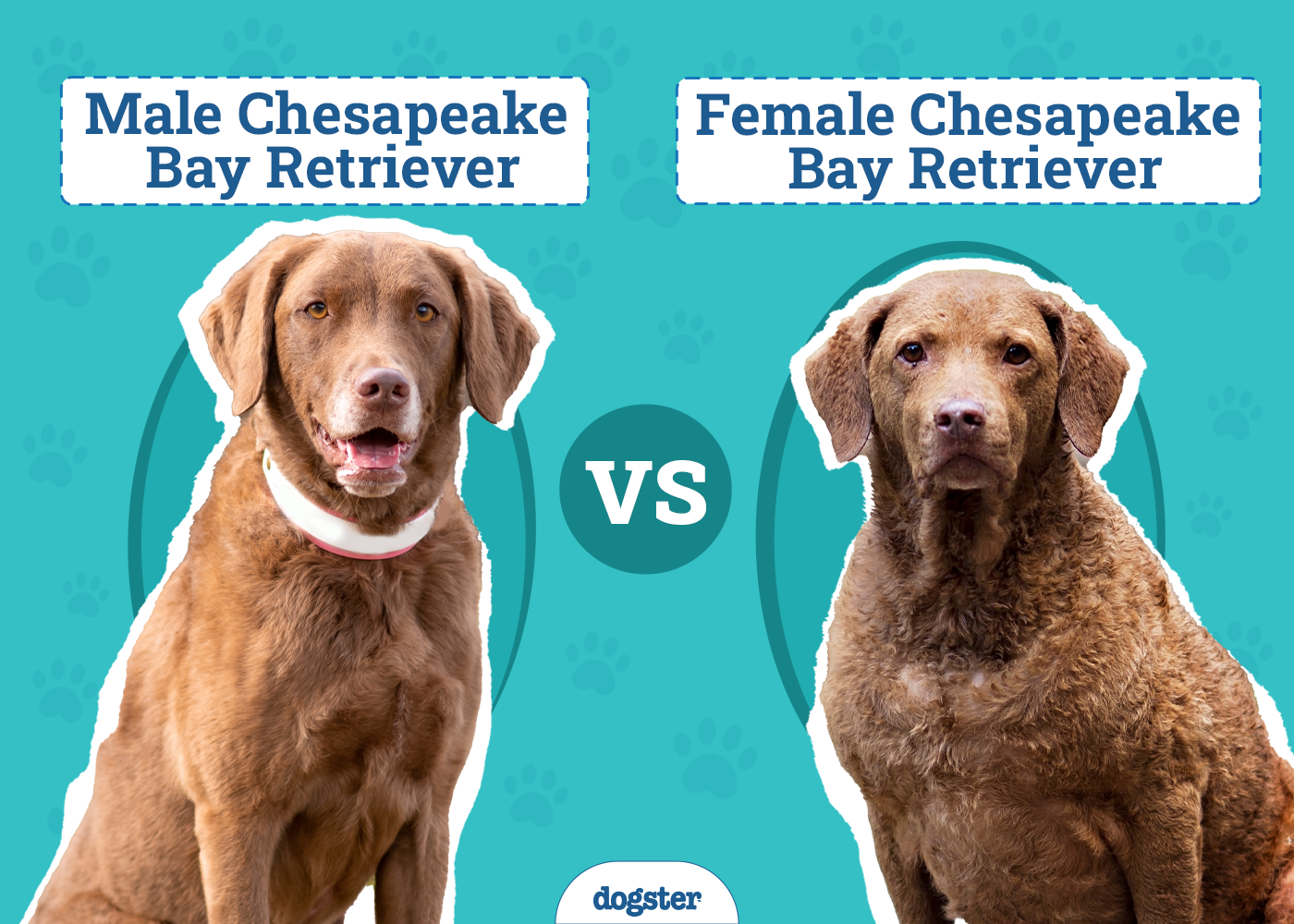
Visual Differences

At a Glance
Chesapeake Bay Retriever 101
The Chesapeake Bay Retriever was bred as a retriever, sporting dog, and gundog. As their name suggests, they were developed in the Chesapeake Bay area around the 19th century. For the most part, they were used to retrieve waterfowl and pull in fishnets. However, they were also utilized as family pets, which is their primary purpose today. They are still known for their hunting abilities and love of water.
Due to their similarities in purpose, this breed is quite similar to the Labrador Retriever. They have a similar, water-proof coat. However, their coat is wavy, while the Labrador Retriever’s coat is smooth.
Often, these dogs are known for their willingness to work and their high intelligence. They are courageous and have been utilized for water rescues. Their intelligence enables them to be used for various purposes, though they are mostly only utilized for retrieving.
Overall, they’re friendly dogs and make solid family companions for more active individuals. However, due to their history as working dogs, they do require quite a bit more work than other canines out there. For this reason, we can’t recommend them for those who simply “want a dog.” They are best for experienced dog owners who want an active, working companion.

Male Chesapeake Bay Retriever Overview
Personality/Character
Most male dogs are more energetic and playful than females. This energetic behavior is more dramatic when the male is younger, but it often sticks around well into their adult years. Males also tend to be worse at focusing on a set task for an extended period of time. They tend to flirt from one thing to the next, which can make training somewhat difficult. They also display fewer cooperative skills. Males are often more aggressive than females. More dog bites are from male dogs, for instance. The most extreme personality differences are more apparent in intact males. Once you fix a male, their hormones level out substantially, and some of these differences may be less present.
Training 🎾
Male Chesapeake Bay Retrievers are often more difficult to train than others. However, they are still quite trainable compared to other breeds. Males simply have a harder time concentrating on the task in front of them, making long training sessions almost impossible. Short, frequent training sessions are key to properly training a male. Once their attention starts to wander, you may want to consider ending the session. Due to their playful attitude, many males can be trained using toys alone. Be sure that the dog is tired before attempting to train. They tend to have quite a bit of energy. If they are not worn out, their ability to concentrate will be even further diminished.
Health and Care
Overall, Chesapeake Bay Retrievers tend to be quite healthy. The U.K. Kennel Club survey listed their lifespan at about 10.75 years, which is higher than average for large dogs. However, males are prone to a few health problems. Firstly, exercise-induced collapse is not uncommon. This condition typically occurs after the dog has exercised too much, along with their exuberant nature. Both sexes are prone to alopecia. Luckily, this condition is not that serious. They are also prone to a variety of eye conditions, including progressive retinal atrophy and cataracts. Both of these conditions tend to appear later, though. They’re most common in senior dogs, not younger ones.

Breeding
Male Chesapeake Bay Retrievers can be bred as soon as they reach sexual maturity, which is typically around 1–1 ½ years. Dogs that are used most often as stud dogs become more proficient and are often more likely to produce a litter. All male stud dogs should be tested for genetically inherited diseases, such as Von Willebrand’s disease and hip dysplasia. You should also have them tested for sexually transmitted diseases, ensuring that nothing is passed onto the female. A healthy diet is essential. Our dogs often are what they eat. If males are fed a low-quality diet, they may not produce top-notch sperm.
Pros
- Higher energy levels
- Play-driven
- No heat cycles
- Cheaper to neuter
Cons
- More aggressive
- More active
- Larger
Female Chesapeake Bay Retriever Overview
Personality/Character
Females are typically more laidback and less aggressive than males. They tend to be less active, though all Chesapeake Bay Retrievers are more active than most other breeds. Females don’t jump around from activity to activity quite as much.
Most of the time, they are better at focusing on the task ahead of them, making training a bit easier.
Females are typically described as more even-tempered than males. They make wonderful family dogs for this reason, though socialization and training are still essential.
That said, females go through more hormonal changes than males, which can affect their overall personality. For instance, females tend to get more affectionate during their heat cycles.

Training 🎾
Females are often easier to train than males. They aren’t quite as active, which means they don’t need as much exercise before a successful training session. They also tend to focus better on specific tasks for longer periods, allowing training sessions to be lengthier. However, they aren’t as play-driven as males. Some will respond to training with toys, but females generally train better with traditional training methods. They do seem to have more cooperative behaviors. In other words, females are more likely to do what you say, making training quite straightforward.
Health and Care
The health and care of a female Chesapeake Bay Retriever aren’t all that different from a male. However, there are a few key differences. Since they are generally less active, females seem less likely to develop exercise-induced collapse. They simply aren’t as likely to exercise to the point of exhaustion. Hip dysplasia and Von Willebrand’s disease are just as common in female dogs as male dogs. These conditions have a genetic predisposition and don’t differentiate based on sex. Eye conditions are also common. Female Chesapeake Bay Retrievers can develop both progressive retinal atrophy and cataracts. Again, these are more common in older dogs.

Breeding
Breeding a female dog is often more complicated than a male. There is simply more that goes into it because the female’s role in the process is longer than the male’s role. You must wait for the female to go into heat and be susceptible to the male before breeding. For first-time breeding, we recommend choosing a more experienced male. Throwing two inexperienced dogs together doesn’t often go well! You should wait until your female is fully grown before breeding her. Since they are larger dogs, Chesapeake Bay Retriever females often continue to grow until they are 1 ½–2 years. Females will often experience hormonal changes after becoming pregnant. Sometimes, these are evident through personality changes. However, you often can’t tell that a female is pregnant until a couple of weeks in.
Pros
- Less aggressive
- More trainable
- Less active
Cons
- More hormonal changes
- Lower energy levels
Which Sex Is Right for You?
In all honesty, there isn’t a significant difference in sex between these dogs. There may be slight personality differences, but these are often minor compared to the dog’s overall personality.
Most personality differences will be more evident between intact males and in-heat females. Both sexes will also go through hormonal changes around puberty, so you can expect significant changes then.
Which sex you pick is largely a matter of personal preference. If you want a more active dog, you may want to choose a male. For a more laidback dog, choose a female.
Again, the differences are not extremely significant, though. The most evident difference is their size, which you do need to keep in mind when purchasing a puppy.
You might also like: 10 Working Dog Breeds
Featured Image Credit: (L) MH-STOCK, (R) Ricantimages, Shutterstock
Expert dog care, straight to your inbox
News, insights, expert advice, and everything dog.

No spam — unsubscribe anytime.
By signing up, you agree to our Terms & Conditions and Privacy & Cookies Policy.
How useful was this post?
Click a star to rate. You can leave written feedback afterwards. (We read all feedback.)
Kristin loves to help pet parents create a fulfilling life for their pets by informing them on the latest scientific discoveries and helping them choose the best products for their pets. She currently resides in Tennessee with three cats, four dogs, two fish, and a lizard, though she has dreams of owning chickens one day!