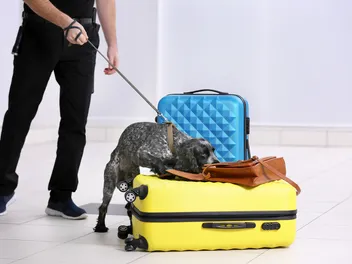
An Inside Look Into the Life of a Police Dog

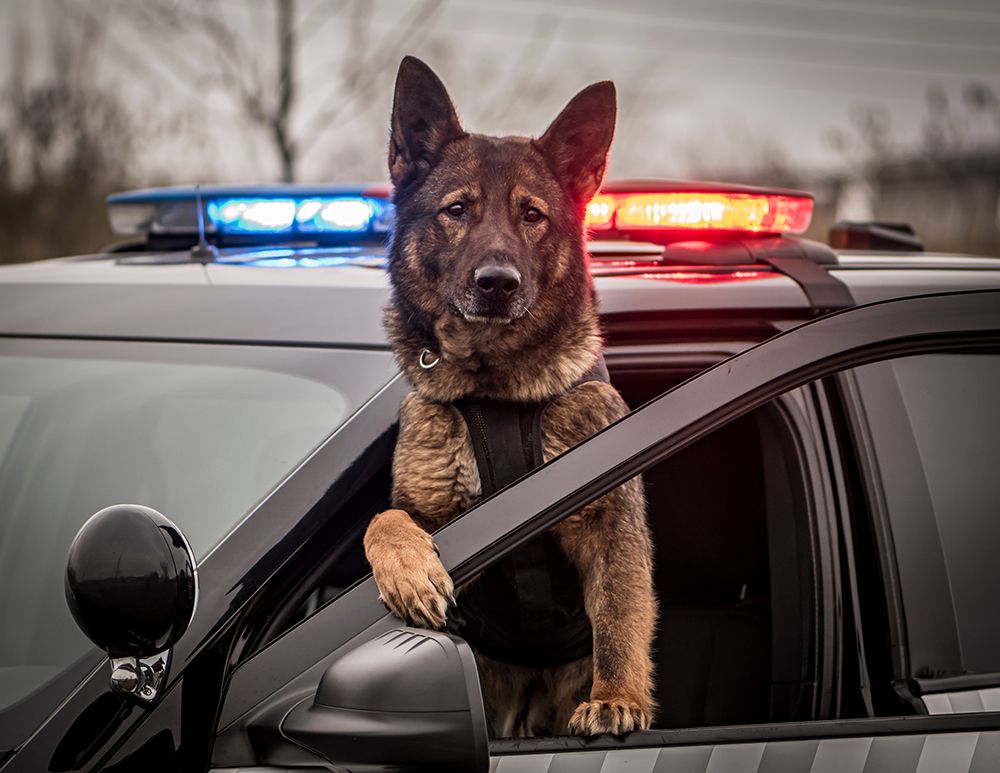
In this article
Have you ever seen a police dog in action up close and personal? Recently, I had the chance to not only see one of these heroes practice doing his job, but I got close enough to have him give my nose kisses. Gasp — you let a big, mean, police dog lick your face? Yup, and I got to pet him and give his bum some loving scratches.

Sargent’s story
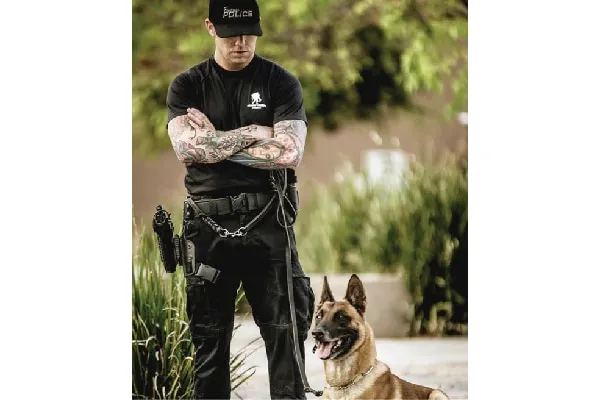
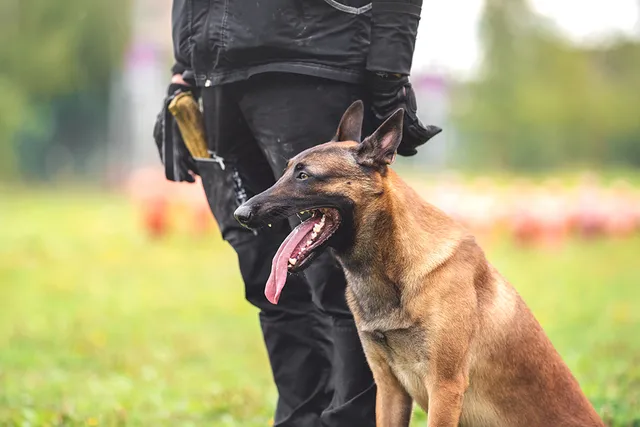
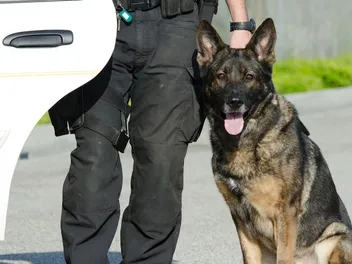
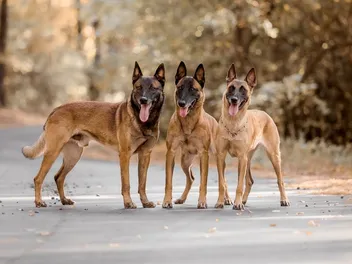
The pup who slobbered on my face, with my consent, of course, was Sargent, a 9½-year-old Belgian Malinois and senior team member of the Fontana police K-9 unit in Fontana, California. Sergeant Kurt Schlotterbeck, who commands the K-9 dog unit, explains, “The perception of a police dog is that of a vicious animal. Our dogs aren’t vicious. Every training, before they start, we walk up to them, shake the handler’s hand, and pet the dog on the head. We want them
to be social.”
I sat down with Sergeant Schlotterbeck and Sargent’s handler, Officer Mark Wyrick, to learn more about the work they and their dogs do. Wyrick, like all the K-9 dog handlers in the unit, spent time on the traditional police force before applying to the specialized K-9 team. Once chosen, he was paired with Sargent, and the two went through a 240-hour training course to make them a skilled team.
Sargent, like all dogs currently on the Fontana force, is cross-trained in two specialties. His training includes suspect apprehension and narcotics/firearms detection. Wyrick and Sargent’s training didn’t end after that first extensive session; it is continuous. Most of the unit’s dogs work for six to seven years, starting between the ages of 18 months and 3 years old. Even Sargent, who is near retirement age, takes part in 10-hour practice sessions with the unit and individual training with Wyrick during their shift. Wyrick has a bite sleeve and other training tools in his patrol vehicle so he can meet up with another K-9 police unit for some in-field practice.
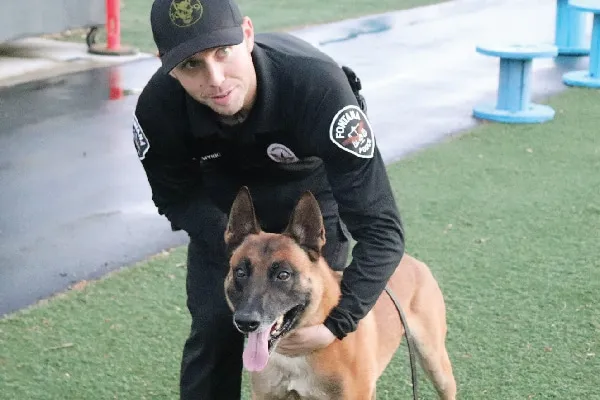
Sargent at work
My visit was during one of their long days at their training facility, so I experienced Sargent’s talent firsthand. The Fontana K-9 Unit has strong community involvement. Its civilian-led support group, Fontana Police K9 Pals, raises funds to ensure the dogs and handlers have the equipment needed to do their jobs and keep them safe. This included the donation of a training facility that houses several practice structures and equipment. At this training facility, one of Wyrick’s fellow K-9 officers suited up in a full bite suit that allowed Sargent to show off his apprehension skills. Each human member of the team takes turns in these suits, playing the part of the suspect.
“One of the most important things is having a decoy who has learned to understand the dog’s behavior. If you’re training them
, you don’t want to train them the wrong way. Decoys are as important a piece of the puzzle as the handler is,” Schlotterbeck explains. The suit does an excellent job of keeping the faux criminal from getting hurt. In fact, analyzing a dog’s bite pressure is an important part of the job. You don’t want a pup who’s hesitant to take someone down, bites down with too little pressure, or releases that pressure before being told to do so by his handler.
Sargent sat patiently next to Wyrick, waiting to be told what to do. Once commanded — Sargent’s commands are all in French — he jumped forward, running at full speed toward the decoy until close enough to leap and latch on to an arm. There, he stayed until Wyrick commanded Sargent to release and return to his side. Apprehension practice continued with different scenarios designed to have Sargent practice responding quickly and accurately to his partner.
When not working, Sargent can be found in his kennel in Wyrick’s patrol vehicle or at his home, which Sargent shares with Wyrick, his wife, two human siblings, and two small dogs. Fontana police K-9 vehicles are equipped to keep the canine officers safe even during the triple-digit temperatures that hit their area of California. Should the inside of the vehicle become too hot, the car’s fans turn on, the windows roll down, and the horn goes off, as does an alarm attached to the officer’s belt.

Police Dogs Are Just Like Us
At home, Sargent has a kennel outside and a crate inside, which he prefers, and where he sleeps at night. The force has strict rules on what happens to the dogs when their handlers are not at home. Although Sargent gets along very well with everyone in the house, when Wyrick isn’t there, Sargent is in his crate or kennel. When Sargent does retire, Wyrick will buy him back from the city, and the talented pup will live out his life as a very well-trained family pet!
When their partner retires, officers return to the traditional force. However, Wyrick has been chosen to lead a new specialized group within the K-9 dog unit. His new partner will be trained in Digital Media Electronic Storage Device detection, a new discipline for working dogs that allows officers to locate and identify storage devices, like thumb drives, often used in child pornography, child sexual exploitation, and terrorism cases. Wyrick is excited about the opportunity to stay with the K-9 unit, but he will undoubtedly miss working with Sargent. “As long as I’ve been a police officer, he
has been the best partner I’ve ever had.”
Q: What is Sargent’s diet? A: Sargent eats Canidae dog food and is fed 4 to 5 cups daily, depending on our work schedule. Sargent gets dog treats as a reward (on occasion).
Q: Does Sargent get any human food?
A: I do not feed him human food. (Writer’s note: I almost feel silly for asking!)
Q: What type of gear does Sargent use?
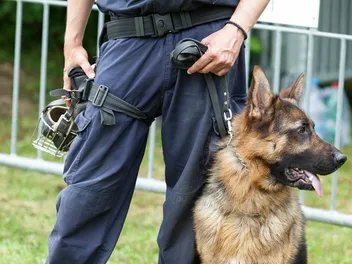
A: Sargent uses various leashes (depending on the task), a lowering harness, and, occasionally, a muzzle. Writer’s note: Fontana’s K-9 units do not wear bulletproof vests. They have found that the vests are not only heavy and hot but also restrict the animal’s movement and ability to get into small areas, like crawl spaces, that they are often asked to search. If there is a high probability that a suspect has a gun and will use it, the officers will, most likely, find a solution to apprehend that doesn’t include the dog.
Q: Are there certain health issues that Sargent’s job causes him to have, and how do you address those? A: Sargent uses flea/tick medicine like any other dog. We monitor his weight just like an athlete to ensure he is ready for work and any potential task. (Writer’s note: If you follow Sargent online, you may notice that his tail is “docked.” His tail was partially amputated due to the growth of a mass that had become a health issue.)
Q: Do you groom Sargent yourself, or do you take him to someone to be groomed? A: I groom him myself with baths every month and inspect him daily to ensure no health issues arise.
Related post: Why Are Police Dogs Called K9?

Learn more about police dogs
To learn more about police dogs, visit nationalpolicedogfoundation.org. The National Police Dog Foundation promotes education and awareness and raises funds for the purchase, training, and also veterinary care of active and retired police K-9s.
Read more about working dogs on Dogster.com:
Featured Image Credit: K9 and photography, Shutterstock
Expert dog care, straight to your inbox
News, insights, expert advice, and everything dog.

No spam — unsubscribe anytime.
By signing up, you agree to our Terms & Conditions and Privacy & Cookies Policy.
How useful was this post?
Click a star to rate. You can leave written feedback afterwards. (We read all feedback.)
Wendy Newell is a former VP of Sales turned dog sitter, which keeps her busy being a dog chauffeur, picking up poop and sacrificing her bed. Wendy and her dog, Riggins, take their always-changing pack of pups on adventures throughout the Los Angeles area. Learn more about them on Facebook @The Active Pack and on Instagram @wnewell.