How Far Away Can a Dog Smell a Person? Vet-Verified Facts & FAQ


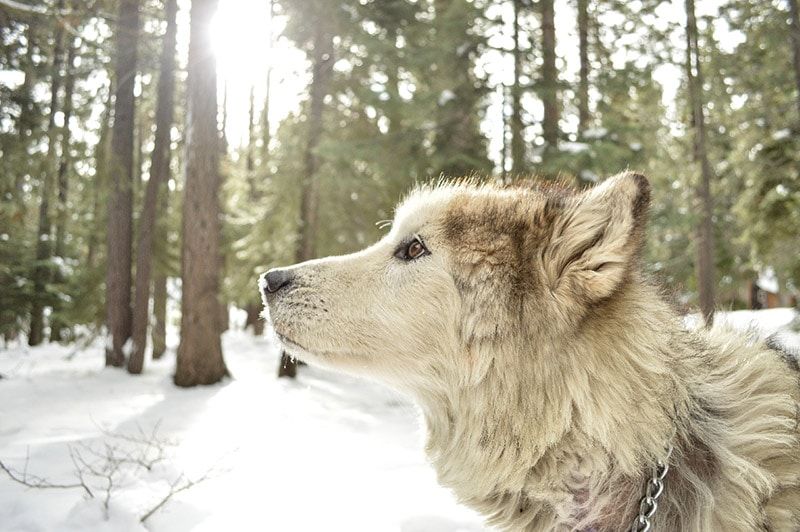
Dogs are renowned for their keen senses, particularly their sense of smell. A dog is believed to be able to detect a person’s scent from a considerable distance, sometimes well beyond 40 feet, depending on environmental conditions such as wind, humidity, and terrain.1
Certain factors affect how far away a dog can smell a person. Wind speed and direction, for example, affect how far away a dog can "catch" a scent and how much of that scent is carried.

Wind Speed and Direction
If a dog is trying to smell a person and is "downwind" (meaning the wind is blowing from the person in the dog's direction), their scent will be pushed toward the dog by the wind. The scent molecules will be carried toward them this way, and the opposite is true if the wind is blowing away from the dog toward the person.
The speed of the wind is also a factor, as it influences how scent molecules disperse and travel through the air. If the breeze is gentle, scent molecules may disperse more widely, creating a broader scent trail for the dog to detect. Conversely, if the wind is fast and strong, scent molecules may form a more concentrated plume that travels in a narrower path depending on conditions.

Rain
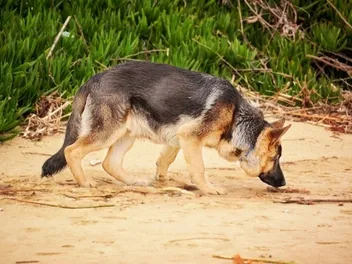
The type of rain makes a difference when a dog is tracking a human scent. If the rain is heavy and oppressive, it can move the scent molecules down and press them close to the ground, meaning a dog would have to be "nose to the ground" to find the scent trail of a person.
On the contrary, light rain can sometimes alter how scent is dispersed and may either help or hinder tracking depending on conditions, but it does not reliably make scent easier to detect at greater distances.
Other Smells
It may seem obvious, but distractions and other overbearing smells can also affect how far away a dog can smell a person. In a controlled environment, a dog may be able to detect a person’s scent from varying distances, depending on conditions, with no fixed maximum range. If out in the field, such as during search and rescue, there will be a cacophony of other scents and smells to filter through, which can distract a dog.

Can Dogs Smell Illness in People?
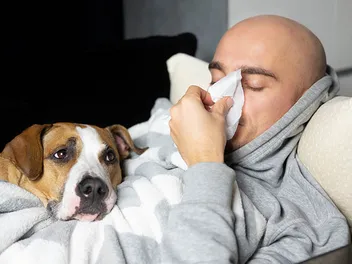
Dogs have an excellent sense of smell. It's so good that some can detect when a person is sick. It’s so good that some can detect when a person is sick, and there are occasional observations of dogs appearing to act differently around their owners prior to a diagnosis. Some dogs have been reported to act differently around their owners without an obvious cause, and in rare cases this has coincided with medical conditions later being diagnosed, such as cancer. There have been years of research detailing how dogs can do things, and dogs can now be trained to detect illness in their owners, ranging from incoming seizures to drops in blood glucose and even narcolepsy and COVID-19.
Dogs can do this due to their incredibly sensitive sense of smell. Some illnesses, such as cancer, give off specific scent molecules that people exude in their breath, sweat, or urine. These can be picked up by dogs trained to signal when they smell them, making them incredibly useful as service dogs in the community.
Dogs trained to detect seizures, for example, can not only smell minute differences in their owner's natural smell but are also clued into their behavior. Scent changes and subtle behavioral cues may sometimes be associated with seizure onset, and some trained dogs can learn to alert their owners before or during episodes, allowing them to seek safety.
What Breed of Dog Has the Best Sense of Smell?

All dogs have olfactory receptors in their noses and olfactory bulbs in their brains. Their sense of smell seems to be a dog's main sense, and all breeds have an incredible olfactory system, including olfactory receptors and a vomeronasal organ. A human’s sense of smell is not directly comparable since dogs have roughly 125–300 million olfactory receptors, compared to about 5–6 million in humans.
However, the Bloodhound has the most advanced sense of smell. They were bred for hunting and tracking and have been used for tracking people since the Middle Ages. Everything about this breed is made to amplify scent, from their creased faces that direct scent molecules to their noses to their long ears that prevent wind from scattering nearby scents.
This gives them an incredible gift for tracking and finding humans. There are documented cases of Bloodhounds tracking scents over long time periods, including historical reports of extended tracking, though exact records and details vary and are not consistently verified. Because of this, the Bloodhound is often used as a search and rescue dog or a cadaver dog.

Final Thoughts
Dogs have extraordinary senses of smell that have been used to track humans for centuries. They can detect human scent from varying distances depending on environmental factors such as wind speed, wind direction, and weather, and there is no fixed maximum range. Some breeds are more skilled at tracking scents, such as the Bloodhound, and dogs are now being used more than ever to detect toxic chemicals, bodies, and even diseases.
Related Read: Can a Dog Smell Human Pheromones?
Sources
Featured Image Credit: JumpStory
Expert dog care, straight to your inbox
Vet-reviewed advice, training tips, and the best of Dogster. Free, and you can unsubscribe anytime.
By signing up, you agree to our Terms & Conditions and Privacy & Cookies Policy.
Nicole has loved animals of all sizes her whole life so it's no wonder she has dedicated her career to helping them through what she loves best: learning, writing, and sharing knowledge with others. She’s the proud mom of two dogs, a cat, and a human. With a degree in Education and 15+ years of writing experience, Nicole wants to help pet parents and pets around the planet to live happy, safe, and healthy lives.
Join the conversation
Ask a question, share your story, or send private feedback.