War Dogs of History: Sergeant Stubby and the Birth of the American War Dog Legend
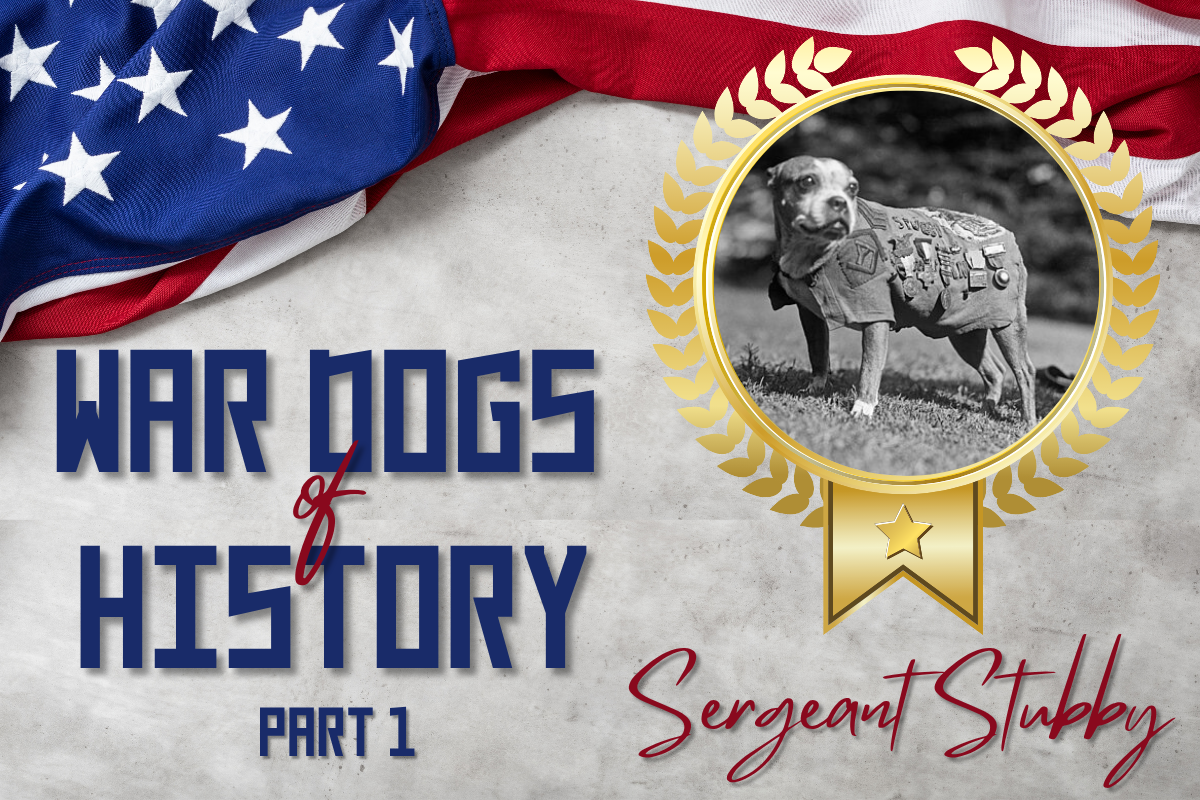
Long before the United States military established an official war dog program, one small stray taught the Army what a dog could do in combat. His name was Stubby, and by the time the First World War ended, he had become the most decorated dog in American military history.
A Stray Finds His Regiment
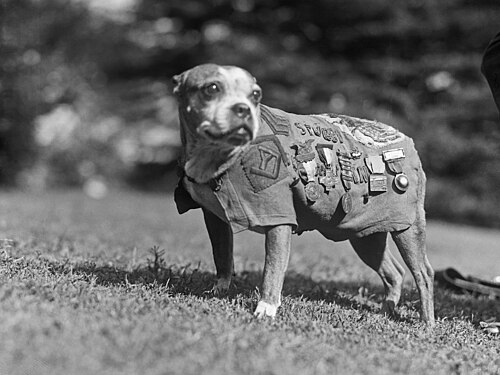
Stubby’s story began in the summer of 1917 at Yale Field in New Haven, Connecticut, where the 102nd Infantry Regiment of the 26th “Yankee” Division was training before deployment to France. A short-tailed, brindle-colored dog of uncertain breeding, likely part Boston terrier and part American bull terrier, wandered into camp and was adopted by Private J. Robert Conroy. Soldiers were not permitted to keep pets, but Stubby won over the men, and eventually the officers, by learning to mimic military customs. He reportedly marched in step with the troops and raised a paw to his brow in a passable salute.
When the 102nd Infantry shipped out for France, the transport ships barred dogs. Conroy smuggled Stubby aboard the SS Minnesota hidden beneath his overcoat. Conroy’s commanding officer discovered Stubby during the crossing, but his salute reportedly charmed the officer into letting him stay.

From Mascot to Combatant
Once in France, Stubby’s role shifted from morale booster to something closer to that of a working soldier. He entered combat on February 5, 1918, at Chemin des Dames, enduring shelling for over a month, and went on to serve through 17 battles over 18 months on the Western Front.
After surviving a mustard gas attack, Stubby developed a heightened sensitivity to the smell of gas. Historians and contemporary newspaper accounts credit him with warning his regiment of subsequent gas attacks before the men could detect it themselves. This allowed soldiers time to don their masks. He was also credited with locating wounded soldiers in no man’s land and comforting them until stretcher bearers arrived.
Stubby’s most famous exploit occurred when he discovered a German soldier mapping the layout of Allied trenches. According to accounts preserved by military historians, Stubby seized the man until American soldiers arrived to take him prisoner. For this act, Stubby was informally promoted to the rank of sergeant, making him, according to most accounts, the first dog to receive a rank in the United States Armed Forces. This was, of course, an honorary and unofficial designation rather than a formal commission, since the military does not commission dogs.
During the April 1918 German offensive on the town of Seicheprey, France, Stubby was wounded in the chest and leg by grenade shrapnel while accompanying the 102nd Infantry in combat. After recovering, he returned to visiting wounded soldiers in the hospital, walking the wards to lift the spirits of recovering men.
Life After the War
Stubby returned home a celebrity. He led parades, attended war bond rallies, and met three sitting or future presidents: Woodrow Wilson, Warren G. Harding, and Calvin Coolidge. General John J. Pershing personally honored him at a 1921 ceremony for the 102nd Infantry Regiment, presenting him with a gold medal from the Humane Education Society, an award that, while not an official military commendation, cemented his reputation as the greatest war dog of his era.
Conroy went on to attend Georgetown University Law Center, and Stubby went with him, becoming the unofficial mascot of the Georgetown Hoyas football team. At halftime, he would nudge a football around the field to the delight of the crowd.
Stubby died in 1929, reportedly in Conroy’s arms. His remains were preserved and are held today by the Smithsonian’s National Museum of American History, where he wears the medals and blanket he wore during his years of service. In 2018, an animated film called Sgt. Stubby: An American Hero introduced his story to a new generation. That same year, the descendants of Conroy dedicated a life-sized bronze statue of him at the Connecticut Trees of Honor Memorial in Middletown, Connecticut.

Why Stubby Matters
Stubby served nearly a quarter century before the United States Army established a formal War Dog Program in 1942. He had no training pipeline, no breeding program, and no structure to recognize what he did. He was, in the truest sense, an amateur who became indispensable through instinct, loyalty, and repeated exposure to danger alongside the men who fed and sheltered him. Later advocates of formal military working dog programs often cite his legacy as early proof of concept: a dog’s senses, courage, and bond with a handler could save human lives on a modern battlefield.
Next week, we meet World War II hero, Chips:
If Sergeant Stubby proved what an untrained stray could do in the First World War, Chips proved what a dog could do once the United States built an actual program around him. Chips became the most decorated American dog of World War II. His story also marks the moment the Army decided it should never again give such awards to an animal.
Expert dog care, straight to your inbox
Vet-reviewed advice, training tips, and the best of Dogster. Free, and you can unsubscribe anytime.
By signing up, you agree to our Terms & Conditions and Privacy & Cookies Policy.
Morgan Farr is a writer, graphic designer, and advocate who has spent her career telling the stories of working dogs and the people who love them. She serves as the Social Media Coordinator for both the Military Working Dog Heritage Museum and the National Service Animals Monument. She previously served as the social media manager for the U.S. Army Military Working Dog Program.
Together with her husband, an Army veterinarian, Morgan co-founded Canine Advancement Group, which offers education on canine wellness and welfare for both working and companion dogs. She is a member of the American Veterinary Medical History Society, the American Historical Association, the American Association for State and Local History, and the Society for Military History. In 2025, she was named the Armed Forces Insurance Military Spouse of the Year for Joint Base San Antonio.
At home, Morgan is a military spouse, a homeschooling mother of four, a small business owner of Dog-Eared Press, and a co-op instructor. She shares her household with a high-drive Dutch Shepherd and a spirited Bombay cat, who remind her daily that every animal, working or companion, deserves understanding, partnership, and thoughtful care.
You can find her across social media platforms using her handle @morgandfarrauthor.
Join the conversation
Ask a question, share your story, or send private feedback.