War Dogs of History: Chips
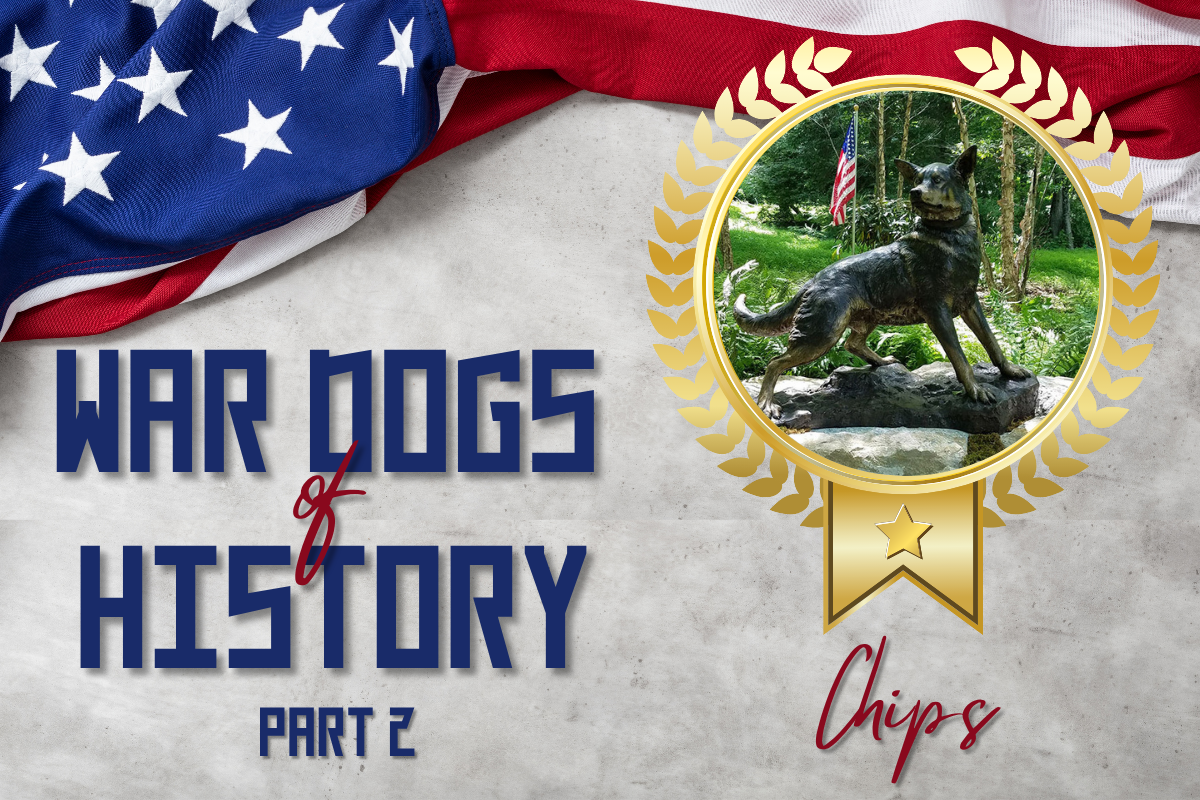
If Sergeant Stubby proved what an untrained stray could do in the First World War, Chips proved what a dog could do once the United States built an actual program around him. Chips became the most decorated American dog of World War II. His story also marks the moment the Army decided it should never again give such awards to an animal.

From Family Pet to Sentry Dog
Chips was a mix of German Shepherd, Collie, and Husky, born around 1940 and raised as a family pet by Edward Wren and his family in Pleasantville, New York. In 1942, the Wrens donated Chips to the newly formed Dogs for Defense program, part of the Army’s larger War Dog Program, formally authorized on March 13, 1942. Chips trained at the War Dog Training Center in Front Royal, Virginia, and was partnered with Private John P. Rowell. The two served in the 3rd Military Police Platoon, 30th Infantry Regiment, 3rd Infantry Division, under General George S. Patton.
Chips and Rowell landed in North Africa during Operation Torch in November 1942 and served through campaigns in Sicily, Italy, southern France, and the Rhineland and central European theaters. He was also present as a sentry dog at the 1943 Casablanca Conference, guarding the meeting between Winteon Churchill and Franklin D. Roosevelt.
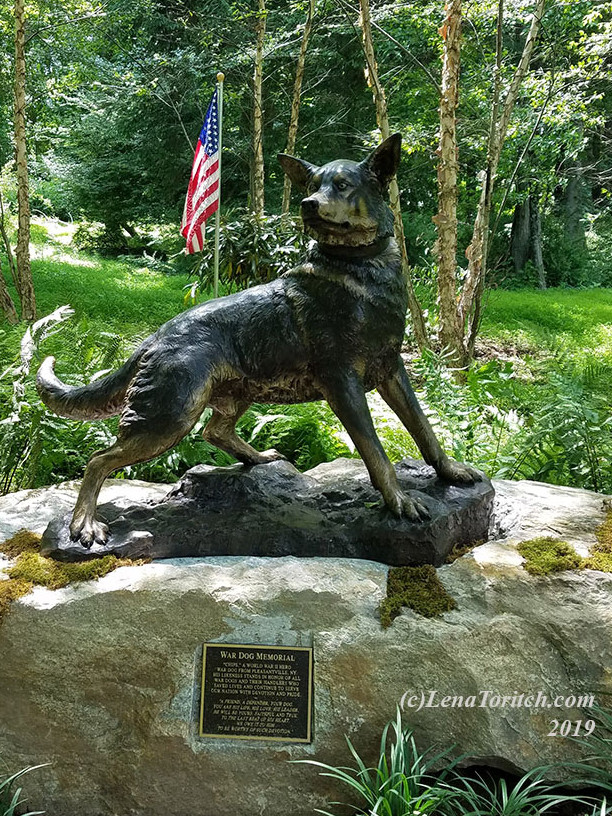
The Sicily Landing
Chips earned his fame during the Allied invasion of Sicily, Operation Husky, on the morning of July 10, 1943. As Rowell and Chips came ashore, a hidden machine gun nest opened fire and pinned down their platoon. Chips tore free of his handler and charged the position alone, seizing the gunner by the throat and forcing the crew to surrender. As a result, four Italian soldiers surrendered. That same night, Chips alerted the platoon to ten additional enemy soldiers attempting to slip through the lines under cover of darkness, leading to their capture as well.
Chips did not escape the encounter unscathed. He suffered burns around his mouth and eye and a wound to his scalp. His actions, however, quickly became national news. Captain Edward G. Parr, the company commander, recommended Chips for the Distinguished Service Cross, citing his “courageous action in single-handedly eliminating a dangerous machine gun nest and causing surrender of its crew”. On November 19, 1943, Major General Lucian K. Truscott Jr. awarded Chips the Silver Star, and accounts differ slightly on whether the Distinguished Service Cross was also formally conferred or only recommended. What is well documented is that Chips also received a Purple Heart for his wounds.
A Bite of Ike
In 1945, Chips met General Dwight (Ike) D. Eisenhower, who bent down to pet the famous dog. Chips, true to his sentry training, nipped the general’s hand. The incident became one of the more good-humored footnotes in his legend.
Washington reacted less good-humoredly to the idea of a dog receiving human military honors. After public objection to the precedent of awarding animals medals intended for soldiers, the War Department revoked Chips’s Silver Star, Distinguished Service Cross, and Purple Heart in early 1944. His platoon nonetheless unofficially awarded him a Theater Ribbon with Arrowhead, an honor reserved for assault landings, along with eight battle stars, one for each campaign in which he served. Chips was honorably discharged on December 10, 1945, and returned to the Wren family in Pleasantville. He died a few months after returning home, from complications related to his wartime wounds.

A Medal, Decades Later
In January 2018, more than seven decades after his service, the United Kingdom’s PDSA posthumously awarded Chips its Dickin Medal, the animal equivalent of the Victoria Cross, in a ceremony at the Churchill War Rooms in London on the 75th anniversary of the Casablanca Conference. John Wren, then 76, traveled from the United States to accept the medal on Chips’s behalf. PDSA Director General Jan McLoughlin remarked that the honor finally allowed Chips to “take his place in the history books as one of the most heroic dogs to serve with the US Army”.
Chips is estimated to have been one of more than 10,000 dogs who served in the American military during World War II. His story, and the controversy his medals caused, shaped military policy for decades: no American war dog would again receive an official human combat decoration, a policy that held until working dogs began receiving other forms of formal recognition much later in the twentieth century.
Next week, we get to know York:
Among the dogs of the 26th Infantry Scout Dog Platoon, one German Shepherd stood out for the length and success of its combat record. Scout Dog York is credited with taking part in 148 combat missions without a single man in his patrol being killed, a record that made him one of the war's most celebrated scout dogs.
Expert dog care, straight to your inbox
Vet-reviewed advice, training tips, and the best of Dogster. Free, and you can unsubscribe anytime.
By signing up, you agree to our Terms & Conditions and Privacy & Cookies Policy.
Morgan Farr is a writer, graphic designer, and advocate who has spent her career telling the stories of working dogs and the people who love them. She serves as the Social Media Coordinator for both the Military Working Dog Heritage Museum and the National Service Animals Monument. She previously served as the social media manager for the U.S. Army Military Working Dog Program.
Together with her husband, an Army veterinarian, Morgan co-founded Canine Advancement Group, which offers education on canine wellness and welfare for both working and companion dogs. She is a member of the American Veterinary Medical History Society, the American Historical Association, the American Association for State and Local History, and the Society for Military History. In 2025, she was named the Armed Forces Insurance Military Spouse of the Year for Joint Base San Antonio.
At home, Morgan is a military spouse, a homeschooling mother of four, a small business owner of Dog-Eared Press, and a co-op instructor. She shares her household with a high-drive Dutch Shepherd and a spirited Bombay cat, who remind her daily that every animal, working or companion, deserves understanding, partnership, and thoughtful care.
You can find her across social media platforms using her handle @morgandfarrauthor.
Join the conversation
Ask a question, share your story, or send private feedback.