How Long Will It Take to Crate Train a Dog? Vet-Approved Facts & Timeline


In this article
Crate-training dogs can be a great way to teach your dog how to be safe in a secure place, separated from their owners or other dogs. This method of training dogs is most effective when taught to puppies, as they will generally learn more quickly than if you were to crate-train an older dog.
The amount of time it takes for a dog to get familiarized with crate training depends on the age of the dog, their personality, and whether they associate crate training with something positive. Most dogs can take between 1 and 4 months before they are fully crate trained and feel comfortable being in a crate without trying to escape.

What Is the Purpose of Crate Training Dogs?
Crate training a dog can help teach your dog how to become familiar with creating a safe place for them to stay for a couple of hours.
This can help prevent dogs from urinating around the house or stop them from chewing things. Crate training should not be used as a form of punishment but instead, as something positive so that your dog feels more comfortable in a crate.
Crate training can also help dogs with separation anxiety because they can get used to being separated from their owners before learning how to deal with being home alone. It can also be a form of behavioral management to provide a safe place for new puppies and dogs to retreat to when they are still learning how to be potty trained or stopped from chewing furniture and other items.
How Long Does It Take for a Dog to Become Crate Trained?
Your dog's age and past experiences play a role in how quickly your dog will become used to creating. Some dogs will take as short as a month before they get used to being in a crate if they associate it with a positive experience. Other dogs (especially older ones) can take up to 4 months to get used to it.
Crating your dog should form part of a training process with rewards such as treats and positive words. Avoiding using this method as a form of punishment can help speed up your dog’s familiarisation with being in a crate. Not all dogs can be trained quickly, so it is important to make crate training as comfortable as possible for your dog.
Dogs who have had a negative experience with crate training will take longer to become used to being in a crate, for example, if your dog thinks they are being placed in the crate as punishment for breaking certain rules such as chewing furniture or urinating around the house. Puppies are easier to crate train because they usually have no negative experiences being in a crate or enclosed space, and their developing brains allow them to pick up new behaviors more easily.


Pros and Cons of Crate Training Dogs
Crate training your dog is not ideal for every dog owner and their dog, so you should consider the pros and cons of crate training dogs beforehand.
Pros
- Allows your dog to have a safe environment to retreat to.
- Helps with obedience training.
- Can be a resting place for dogs who are injured and recovering from a medical condition.
- It may help dogs who suffer from separation anxiety from their owners.
- Prevents your dog from escaping by providing them with a secure environment.
- Keeps dogs away from harmful substances if you are painting or refurbishing the home.
- Provides a safe place for your dog to be when you are away from home for a short time.
Cons
- Crates that are too small can cause your dog to feel trapped or prevent them from moving comfortably.
- Dogs that are not comfortable in crates may excessively whine and bark to be let out.
- Dogs should not be kept in a crate for more than 4 hours.
- No free access to water or food, and water bowls may be turned over.
- Crates cannot be placed in a sunny spot as your dog can quickly overheat.
How to Keep Dogs Safe in Crate Training
Once your dog has gotten used to being in a crate, it is important to take the right safety measures to make sure nothing goes wrong when they are placed in the crate. This is especially important before you start to leave your dog unsupervised in the crate.
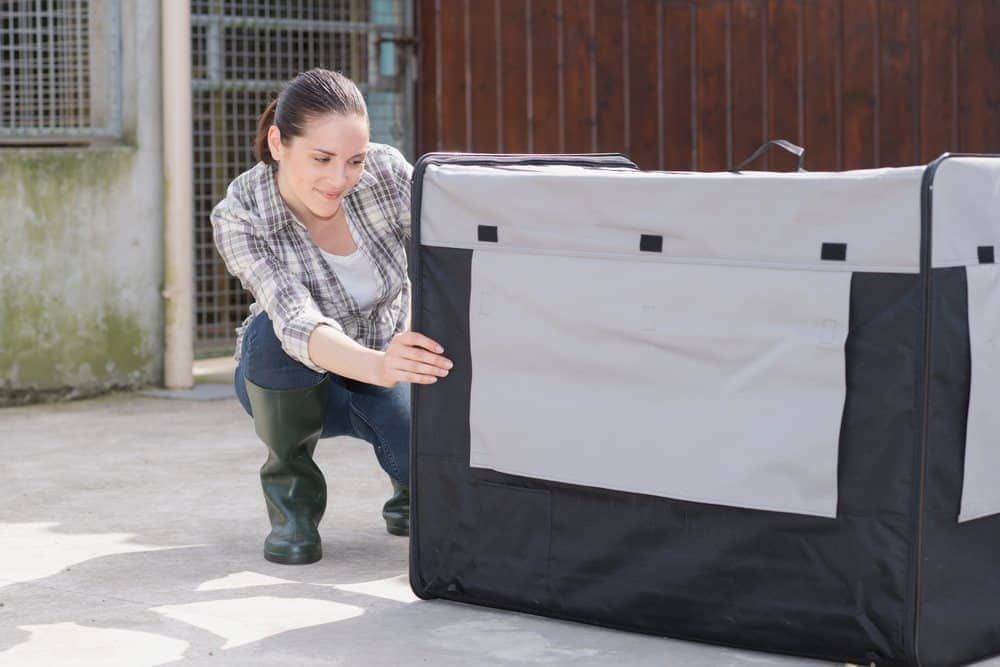
The dog crate should be the correct size for your dog’s size and breed. Small crates can be uncomfortable and will not allow your dog to stretch, stand upright, or lie comfortably. If you get a crate for a puppy, keep in mind that you will need to buy a larger crate as they begin to grow. You want to avoid making your dog feel like they are cramped as this can make your dog feel uneasy.
Remove your dog’s leash, collar, harness, and any clothing on their body. If your dog gets a clothing item or collar trapped in the crate it can quickly become a hazard. Your dog may begin to pull the trapped item to try and remove it, however, this will put pressure on its throat and chest, potentially causing them to choke.
Place something soft to line the crate so your dog does not have to lie on the hard floor. Dogs can quickly become uncomfortable if they are lying on a hard floor with bars at the bottom.

Keep the crate out of the sun and make sure the entire crate has been constructed securely so that your dog does not accidentally collapse a part of the crate and become trapped. It is also important to ensure you're crate has been closed securely to prevent your dog from escaping.
Do not place small toys, plush toys, or any other item that your dog needs to be supervised while chewing or playing with. This puts your dog at risk of choking or ingesting an inedible item that can cause blockage issues.

Summing Up
By rewarding your dog with treats and words of encouragement and not using the crate as a form of punishment, most dogs and puppies will begin to associate being in the crate with something positive, which will make them more willing to be crate trained. Most dogs and puppies can be fully crate trained within 1–4 months, however, the time it takes for puppies to get adjusted to their crate depends on their experiences with it.
Some dogs will be more difficult to crate train than others, so it will take some trial and error before it works for your dog. Some dogs will never be fully crate trained and may want to escape, so some dogs will need more encouragement and training before they get comfortable being placed in a crate.
See also:
Sources
Featured Image Credit: ALPA PROD, Shutterstock
Expert dog care, straight to your inbox
News, insights, expert advice, and everything dog.

No spam — unsubscribe anytime.
By signing up, you agree to our Terms & Conditions and Privacy & Cookies Policy.
How useful was this post?
Click a star to rate. You can leave written feedback afterwards. (We read all feedback.)
Sarah lives in South Africa with her partner and pets. She is currently interested in veterinary science and ichthyology, which she wants to study alongside her main passion: pet content writing. Sarah has over 60 fish including: goldfish, tropicals, shrimp, and snails. She also keeps hamsters and a tarantula. Sarah wishes to provide quality content to readers and allow others to learn from her experience and knowledge. Sarah has much experience in all aspects of pet care. Providing the world with the knowledge on ethical pet ownership is her lifelong dream.