German Shepherd Bite Force: The Strength of Their Jaw


In this article
Measuring bite force is challenging, and there are many variables involved in getting precise figures. Scientists have determined which physical factors influence it, and these will differ depending on the animal’s breed, size, and context. Researching this question also uncovered a lot of unsubstantiated figures. There are many articles and websites that list very specific bite force measurements, but there is no research or data to back these figures up. The other issue involves the different methodologies of the available studies.
We can conclude that the German Shepherd’s bite force is at least twice or more of a human. We found that most places concur that their bite force is approximately 220 PSI (pounds per square inch), although there are documented studies where this is mainly measured in Newtons (N). Frustratingly, the two units do not easily translate to one another.

Measuring Bite Force

Published data includes various measurements that you can’t necessarily convert interchangeably because of the varying study methods. However, PSI is more useful because it makes for more straightforward comparisons. PSI is pounds per square inch. Its practicality comes from what we’re trying to measure—the pressure being applied to a given area by a dog’s jaws.
An early study determined the bite force of dogs based on 101 samples collected from 22 dogs.1 The team’s findings ranged from 13 to 1394 N; a very wide range. That’s because the animals vary in the strength and motivation behind the act. One way to gauge bites is with Dr. Ian Dunbar’s Dog Bite Scale. It goes from aggressive behavior toward a victim to a fatality.
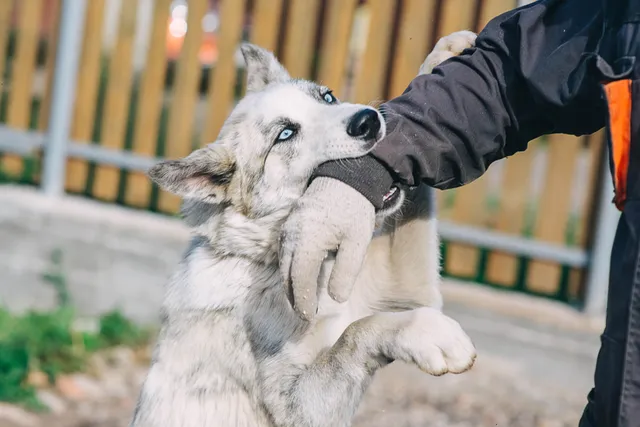
It shows that the motivation and the degree of threat vary considerably. Another source of variability is a study’s methodology to measure bite force. The earlier figures come from experiments done with anesthetized dogs, theoretical calculations, and active male police dogs using a customized helper sleeve. The data highlights the difficulties of accurately and consistently determining the bite force for a German Shepherd.
Other Ways to Determine Bite Force
The theoretical calculations spotlight the dog’s anatomy and its role in determining bite force. Scientists hypothesized that the animal’s skull shape would play a role. It’s simply a matter of physics using something called the cephalic index - the ratio of the width and length of the skull. There are three general types: brachycephalic, mesocephalic, and dolichocephalic.
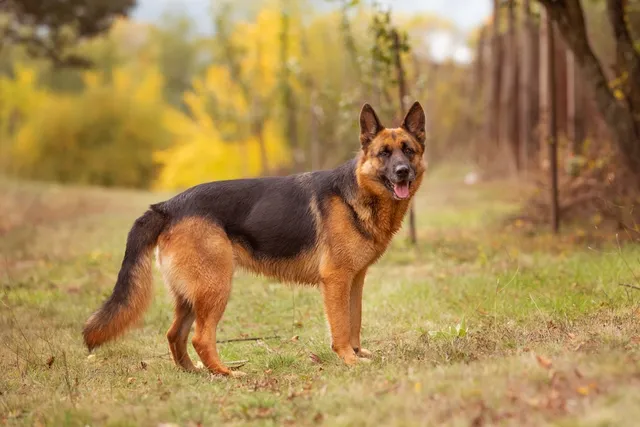
Brachycephalic dogs (eg. Bulldogs. Pugs) have short muzzles and broad skulls. Mesocephalic dogs (eg. Beagle, Golden Retriever) have a muzzle that is narrower than the skull, but not excessively long. Dolichocephalic dogs have an elongated skull and muzzle. Depending on who you ask, the German Shepherd is classified as either Meso- or Dolichocephalic.

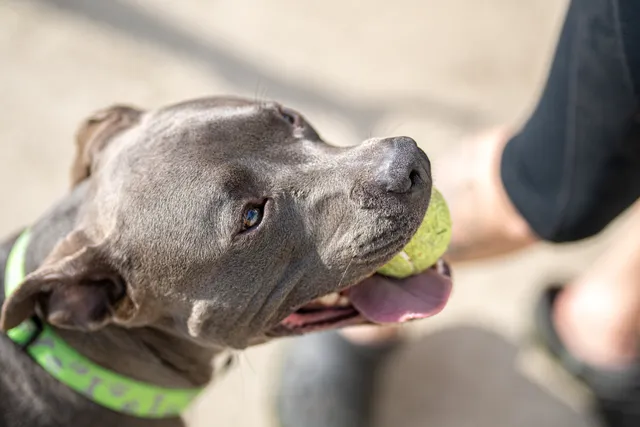
The other consideration is the dog’s jaw musculature. Researchers have concluded that the temporal muscle contributes to half of the bite force.2 You can imagine that a dog with a large ‘meaty’ head like a Rottweiler or Pitbull will have a stronger bite than a Greyhound or Collie.
Measuring structures helps remove some of the limitations of measuring bite force. The team using German Shepherd and bite sleeves noted several possible issues with getting consistent measurements, including the following:3
- Location of the contact with the sleeve
- Angle of contact
- Leverage of the animal’s joint
- Width of the dog’s open mouth
While these dogs may have been highly motivated for the task, the researchers noted that varying mental states and temperament of the dogs, experience, and degree of excitement had a considerable impact on the bite forces exerted. These factors highlight how challenging it is to get an exact figure for a dog that has been rigorously trained to bite on command for their police work. Obtaining this sort of information for a broad cross-section of breeds sounds impossible. Scientists can choose the methodology, but they can’t control living animals.

Why It Matters
Even if research only gives an estimate, it still provides valuable information for veterinary medicine and pet owners. After all, the mission of the American Veterinary Medical Association (AVMA) is, “…advancing the science and practice of veterinary medicine to improve animal and human health.” That includes making informed choices regarding dog ownership.
Research has revealed several conclusions based on the findings. For example, brachycephalic dog breeds are likely to have higher bite forces, on average, than the other two groups, particularly with large breeds. This group includes the Cane Corso and Bullmastiff. Another study found that males had a larger bite force, with a positive correlation between the animal’s size. Additionally, intact males are overrepresented in the statistics.
Based on the data, German Shepherds are an anomaly. Aggression is usually seen in animals selectively bred for this trait, such as guardians or watchdogs. It’s worth noting that these dogs were originally used as herders. However, the German Shepherd’s intelligence and fierce loyalty made them excellent choices for law enforcement and the military.
They may not have the highest bite force, but they know how to use it effectively. What makes them such good candidates for police and military work is, not the strength of their bite, but their ability to be trained to bite and release, on command. These dogs are not intended to severely injure or kill a target, merely catch and restrain.
Explaining the Variability
That brings us back to the question of PSI versus N (Newtons). One Newton is roughly 0.22 pounds of force. Research using jaw shape to estimate bite force put the German Shepherd at around 1,000 N or approximately 220 PSI. Physical measurements may provide a feasible way to gauge bite force. However, there’s another factor we must discuss.
We mentioned one study where the German Shepherd had bite forces of 170 PSI and 568 PSI. It turns out that location matters, particularly with the teeth. The former figure was from the front of the animal’s jaw, whereas the latter involved the back. That area includes the distinctive carnassial pair of the first lower molar and the large fourth upper premolar. It’s part of what makes carnivores, well, carnivores.


Final Thoughts
The German Shepherd is a handsome dog with a long history of service to humans. Their roles may have changed through the years, but they are still beloved canine companions. This dog is well-equipped with an impressive bite force, and they can back up the bark. However, their effectiveness as guard or police dogs does not stem from the power of their jaws but how well they can be taught to use and control them. Measuring bite force is challenging. However, you’ll know you’re well-protected with a German Shepherd at your side.
Sources
Featured Image Credit: dendoktoor, Pixabay
Expert dog care, straight to your inbox
News, insights, expert advice, and everything dog.

No spam — unsubscribe anytime.
By signing up, you agree to our Terms & Conditions and Privacy & Cookies Policy.
How useful was this post?
Click a star to rate. You can leave written feedback afterwards. (We read all feedback.)
Since 2009, Chris has written on a variety of topics. Her motto with all of her writing is “science-based writing nurtured by education and critical thinking.” She specializes in scientific topics, with a special love for health and environmental topics, and of course, pets of all shapes and sizes.
Chris lives happily with her husband and three cats in the land of 10,000 lakes, writing, wining, and boating as much as she can. She and her husband, Norm, were awarded the State of Kentucky Colonel Honor for their restoration work at Mammoth Cave National Park.