My Dog Suddenly Won't Jump Up: 11 Vet-Verified Causes



Has your energetic pup suddenly started hesitating or refusing to jump up on their favorite spot on your bed? Have they stopped jumping up to greet you when you return home? It’s scary when your dog suddenly won’t jump up, as it makes you wonder what’s wrong.
A handful of things could be wrong with your canine pal if they don’t want to jump anymore. Most have to do with their health, so unless there is an obvious behavioral reason, we recommend visiting the vet for the best outcomes for your dog. Here’s a look at the 11 causes of dogs no longer wanting to jump up, although this list is not exhaustive and we recommend a veterinary consult for any mobility issues.

The 11 Causes Why Your Dog Suddenly Won’t Jump Up
1. A Negative Experience
The simplest explanation of this is a negative experience. Has your pup recently suffered a fall or a fright? Maybe they were on the bed and fell off, which scared them. Or perhaps they were scared by something while laying on the couch. If your dog has had a negative experience related to jumping or the object they were on, then they might be scared to try again. Luckily, if this is the case, you can encourage your pet to begin jumping up by rewarding them with tasty treats when they do!

2. Related to Age
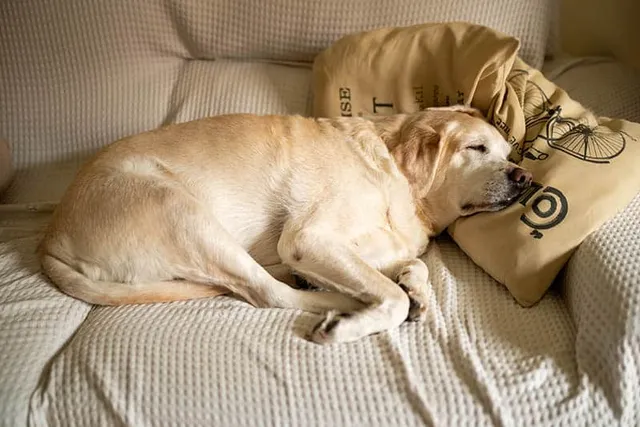
It’s a fact of life; when you get older, whether you’re a human or animal, you get slower and unable to do things you once could. If your four-legged friend is getting up there in age, they are more prone to painful conditions that impact their mobility, like arthritis. They simply may not be able to do it as easily as they used to, so it’s safer for them not to jump. When age is the cause of your dog not jumping up, you can help them by setting up ramps or steps so they can still get up on the bed and sofa. We also recommend a veterinary exam to diagnose and treat any health problems they might have.
3. Experiencing Lethargy
Does your dog seem to not feel well, or do they seem to be a bit under the weather? If your pup is dealing with underlying illnesses such as organ disease, an infection, or illness, they may be experiencing lethargy. That means they probably simply don’t have the energy to jump on things at the moment. If your pet seems to not feel well or you’ve noticed signs of illness other than lethargy, a vet visit is probably in order. Hopefully, your dog will be back to jumping up on things in no time!

4. Tick-Borne Diseases
Ticks are nasty little buggers that carry a host of diseases. So, if you’ve removed a tick from your dog recently, they might have been infected with something via the tick. A few examples of tick-borne diseases include Lyme disease (which you’re probably familiar with), Rocky Mountain spotted fever, and anaplasmosis. All these can cause joint pain, which could be why your pup is no longer jumping up. Needless to say, they need veterinary care.
- Our Recommendation: Best Flea & Tick Treatments and Prevention for Dogs – Reviews & Top Picks
5. Trauma/Injury
Another common cause of a dog not jumping up is trauma or injury to the hind legs. Your pup may have pulled a muscle when running around the backyard or run into something and bumped their leg. More serious injuries include fractures and cruciate ligament rupture. There are numerous ways a canine could injure their hind legs. If they are limping and having difficulty jumping up, this is a sign of pain, even if your dog is otherwise behaving normally. You should keep your dog rested while you wait to see a veterinarian for further advice.

6. Arthritis
Yet another common cause of dogs not jumping up is arthritis. If your pup is dealing with arthritis, they’re experiencing inflammation of the joints, which can be mildly to severely painful. So, jumping up may not be the most comfortable thing for them anymore. There are a range of arthritis treatments available, to suit many budgets. You should speak to your vet about which treatments are recommended for your dog. You may also want to install ramps or stairs at this point to help your pup out.
7. Luxating Patella
What exactly is a luxating patella? It’s a kneecap that’s moved out of its normal place. This condition is especially common in smaller breed dogs, and when it occurs, you may notice a sudden skip in your pup’s run or that they seem wary of jumping up on the sofa for a cuddle. If you suspect a luxating patella, you definitely want to speak with your vet, as this can be painful and cause long-term problems.

8. Hip Dysplasia
Though hip dysplasia can happen to dog breeds of any size, it is more common in large and giant breeds. It’s a fairly common skeletal condition wherein the ball and socket of a dog’s hip don’t fit together well, resulting in a loose joint. This can lead to pain and the early development of arthritis. This condition can reduce the quality of life for a dog, as they may no longer be able to jump up on things or could see a decrease in their range of motion. You should absolutely take your four-legged pal to the vet if you suspect hip dysplasia!
9. Degenerative Myelopathy
Degenerative myelopathy happens when the white matter that is part of the spinal cord starts to degenerate. When this occurs, it can cause rear leg weakness, making it harder for dogs to jump up (among other things). In the worst-case scenario, this condition can even lead to partial limb paralysis or the loss of the use of all four limbs. If you notice your dog not jumping and dragging their back legs when they walk, it’s time to consult a vet.
10. Intervertebral Disc Disease (IVDD)
Has your pup not only stopped jumping but is also hunched, walking strangely, or not turning their head from side to side? Then, they might be dealing with intervertebral disc disease (IVDD). IVDD is a spinal disc problem that commonly affects breeds such as Dachshunds, Toy and Miniature Poodles, and Beagles. If you suspect IVDD, take your dog to the vet immediately. This isn’t a condition where you want to wait around, as it is extremely painful and can lead to paralysis.
11. Myasthenia Gravis
This condition is an uncommon immune-mediated disease wherein the signals that go between the muscles and nerves malfunction. Several breeds are prone to myasthenia gravis, like English Springer Spaniels, Jack Russell Terriers, and Golden Retrievers. Because signals between muscles and nerves aren’t working properly, weakness and heavy fatigue can occur, making it more difficult for your dog to jump on things. This disease is serious, so this is another instance where it’s advisable to get your pup to a vet as soon as possible.


Final Thoughts
Your dog may have stopped jumping up for several reasons, most of which have to do with their health. While some of the conditions above are relatively mild, others are extremely serious, so if you notice signs (other than a lack of jumping) that your dog might be experiencing one of them, you should speak to your vet. Your pet could also have stopped jumping because of a mild injury or fear after a fall; luckily, minor problems should pass quickly, especially if you follow veterinary advice to help your pet heal.
Also see:
My Old Dog Can’t Jump On & Off the Bed: Vet-Approved Ways to Help
My Dog Jumps Out of Windows, What Should I Do? 6 Vet-Approved Tips & Facts
Featured Image Credit: otsphoto, Shutterstock
Expert dog care, straight to your inbox
News, insights, expert advice, and everything dog.

No spam — unsubscribe anytime.
By signing up, you agree to our Terms & Conditions and Privacy & Cookies Policy.
How useful was this post?
Click a star to rate. You can leave written feedback afterwards. (We read all feedback.)
Misty Layne lives out in the woods in small-town Alabama with her two Siamese - Serafina & Jasper. She also has an array of stray cats, raccoons, and opossums who like to call her front porch home. When she’s not writing about animals, you’ll find her writing poetry, stories, and film reviews (the animals are, by far, her favorite writing topic, though!). In her free time, Misty enjoys chilling with her cats, playing piano, watching indie and foreign films, photographing abandoned places, and catching up on her never-ending TBR list.