5 Dog Breeds That Can Be Different Sizes: Pictures, Facts & Info

Dogs come in all shapes and sizes, but in some cases, there can also be various sizes within a single breed. Rest assured, we're not talking about teacup dogs here—these are dogs that have been bred to be unnaturally small, often leading to a host of health problems.
Rather, we're talking about recognized breeds that have been developed to vary in size but remain generally healthy with normal or even above-average expected lifespans. Let's explore these differently-sized dogs further.

How Are These Breeds Classified?
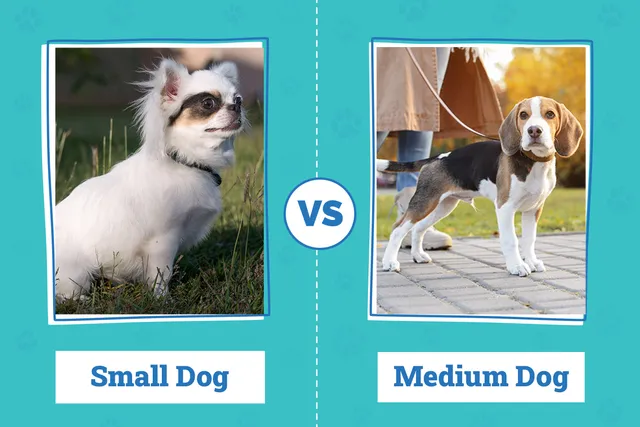
Breeds that come in different sizes are typically classified with terms like toy, miniature, medium, standard, and giant, though the exact terms can vary from breed to breed. As we touched on in this intro, recognized breeds that come in toy/miniature form as well as medium, standard, etc., are distinct from so-called "teacup" dogs.
Teacup dogs are bred by deliberately pairing the smallest dogs—often runts—in litters of already tiny dog breeds, like Yorkshire Terriers, Poodles, and Shih Tzus, to make the dogs even smaller than usual. Because of this, teacup dogs are prone to a huge number of health issues including hypoglycemia, liver shunts, heart disease, and more.
On the other hand, breeds that include toy or miniature-sized dogs have been carefully developed and, as long as they're produced by reputable, ethical breeders, have not been bred with the intention of making them unnaturally small.
In addition, many toy/miniature dogs within a breed are recognized as part of the breed standard by the American Kennel Club and many other kennel clubs, whereas teacup dogs are not.
The 5 Dog Breeds With More Than One Size
1. Poodle

Breed Overview
Origin:
Lifespan:
Height:
Though commonly associated with France, the Poodle originated in Germany as a water retriever or "Caniche" ("duck dog" in French), hence the waterproof coat. The word "Poodle" comes from the German word "pudelin" ("to splash in the water"). Poodles—no matter their size—are renowned for their affectionate nature and endearing goofiness, versatility, and sharp intelligence.
There are three size varieties recognized by the American Kennel Club: Toy Poodles, Miniature, and Standard, but the Federation Cynologique Internationale recognizes a fourth size: Medium. Standard Poodles are the most athletic types, but even the Toy and Miniature varieties have bags of energy and are happy to partake in various activities.
2. Schnauzer

Breed Overview
Origin:
Lifespan:
Height:
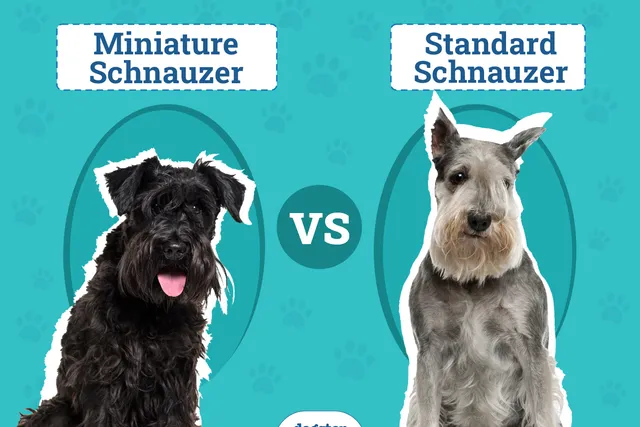
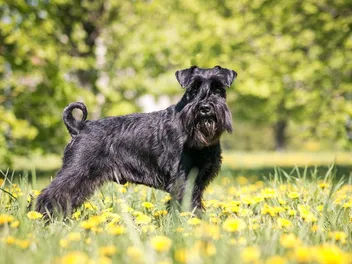
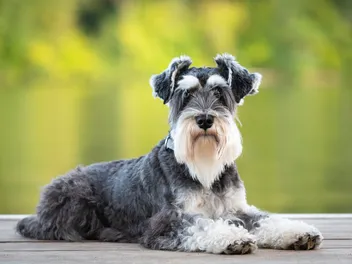
Schnauzers are instantly recognizable thanks to their square-shaped bodies; long, rectangular heads, serious expressions, and copious "beards". Like the Poodle, the Schnauzer originated in Germany where, for centuries, they were put to work as versatile, all-purpose farmhands. The breed dates back to the Middle Ages.
First came the Standard Schnauzer, and then the Miniature Schnauzer and Giant Schnauzer were later bred down and up respectively from the Standard. The Miniature is just as sturdy and energetic as the larger varieties, and the Giant has even worked with the police and the military in Europe. As companions, Schnauzers are loving, trainable, and friendly with a dash of high-spiritedness.
3. Dachshund

Breed Overview
Origin:
Lifespan:
Height:
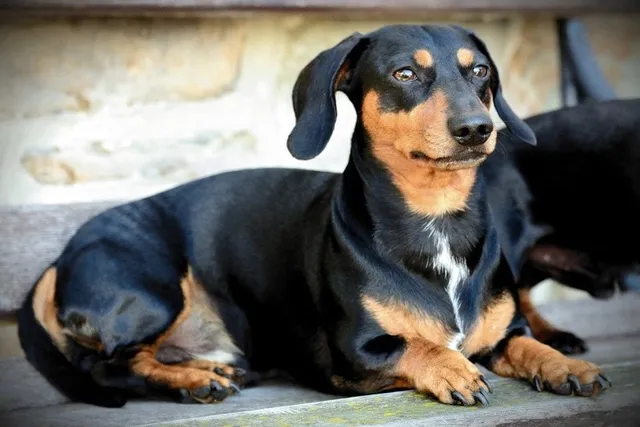
Another German breed, the Dachshund was originally developed as a hunter with a body type that would allow them to fit seamlessly into badger dens. Miniature Dachshunds were later developed to do the same work, but their job was to get down rabbit holes. If you spot your Dachshund digging from time to time, it means their instincts are kicking in.
Apart from a few inches, there aren't any significant differences between Miniature and Standard Dachshunds. Generally, Dachshunds are best described as tenacious, brave, tireless, and loving. They're not suited to strenuous activities like long runs or jumping up on furniture because of their short bodies and long backs (which can be fragile), but they greatly enjoy going for walks and exploring.
4. Bull Terrier

Breed Overview
Origin:
Lifespan:
Height:
The Bull Terriers of today are the descendants of British bulldog-terrier crosses once used in blood sports like bear baiting. Rest assured that these dogs are far less ferocious than their ancestors were, often being described as very affectionate, playful dogs with an air of mischief about them.
There are just two Bull Terrier sizes—the standard Bull Terrier (though the AKC's breed standard doesn't tag the word "Standard" onto this breed) and the Miniature Bull Terrier.
Both are good-natured, friendly dogs when properly socialized, but the AKC describes the Miniature variety as being generally better with other dogs, though it's important to note that personality types vary greatly. There's no one-size-fits-all in this area, and a lot depends on socialization.
5. Australian Shepherd

Breed Overview
Origin:
Lifespan:
Height:
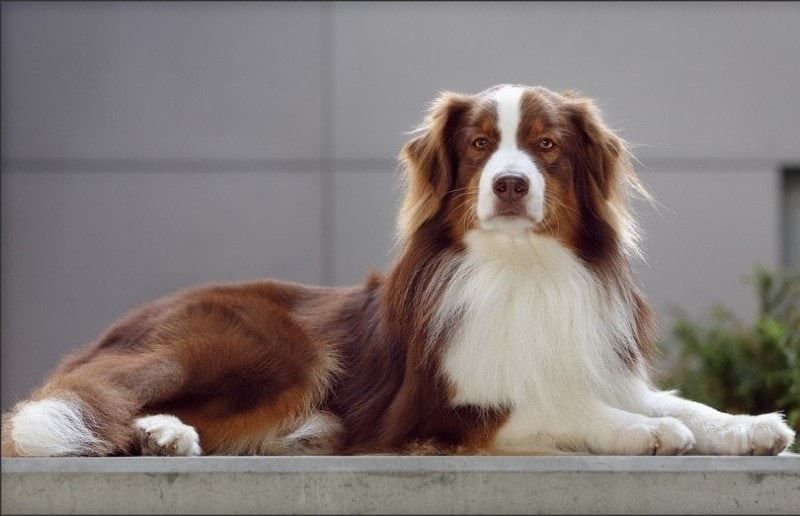
It may surprise some to learn that the Australian Shepherd is actually an American breed, having been developed in California, Wyoming, and Colorado as a ranch dog. That said, these dogs' ancestors hailed from lands far and wide, including Australia, Britain, Spain, and possibly Germany, and it could be argued that it is this diversity that makes the breed so American!
The Australian Shepherd stands at up to 22 inches tall, but there is a smaller variety: the Miniature American Shepherd. Yep, you read that right—small Australian Shepherds were used to develop the breed today known as the Miniature American Shepherd.
Like his progenitors, the Miniature American Shepherd is loved for his razor-sharp intelligence, exuberance, and people-orientedness.
Conclusion
In this guide, we've explored five wonderful and very diverse dog breeds by size: the Poodle, Schnauzer, Dachshund, Bull Terrier, and Australian Shepherd. Giant, big, medium, or small, each of these breeds has something special and unique that gives them a timeless quality.
In fact, two of them—the Poodle and Dachshund are so beloved in the U.S. that they're in the top ten on the American Kennel Club's breed popularity ranking, at number five and nine respectively. The Australian Shepherd isn't far behind at number 12.
Featured Image Credit: Fotoschauer, Shutterstock
Expert dog care, straight to your inbox
News, insights, expert advice, and everything dog.

No spam — unsubscribe anytime.
By signing up, you agree to our Terms & Conditions and Privacy & Cookies Policy.
How useful was this post?
Click a star to rate. You can leave written feedback afterwards. (We read all feedback.)
Kit Copson is a freelance writer and lifelong animal lover with a strong interest in animal welfare. She has parented many furry beings over the years and is currently a proud cat mom of two—one very chilled (unless hungry) Siamese and a skittish but adorable Domestic Shorthair—and dog mom of one—an adopted Bichon Poodle cross. When not writing about or spending time with pets, Kit can be found drawing in her sketchpad, reading, or more often than not, drinking tea.