Can Dogs See in the Dark? Vet-Reviewed Facts & FAQ


In this article
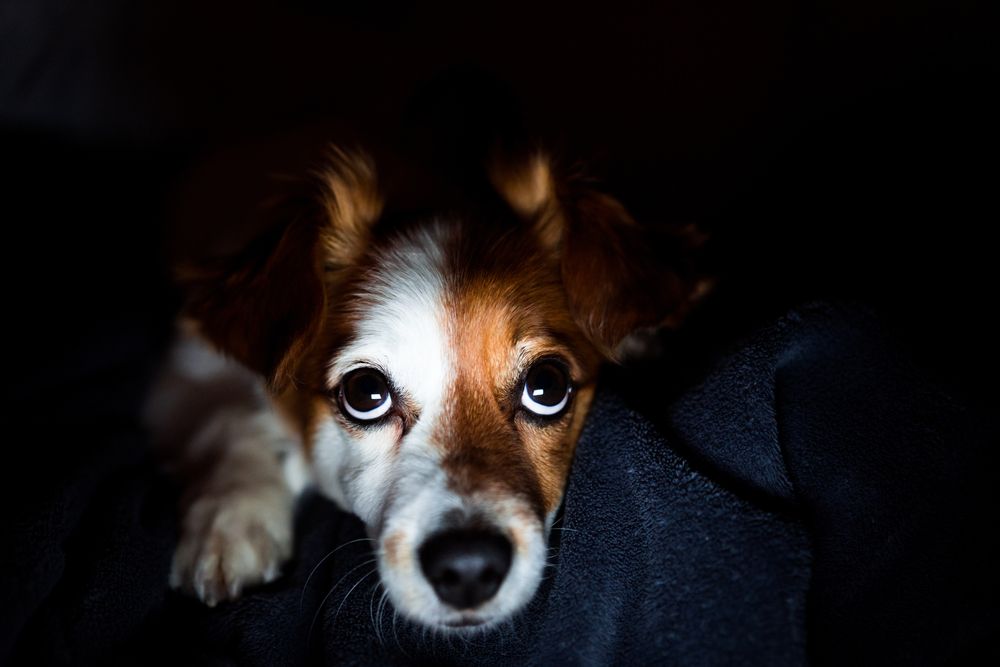
Although there are certain areas in which a canine's standard vision is weaker than that of a human, they certainly have an edge over us when it comes to night vision. While dogs can’t see in pitch-black darkness, their eyes are well adapted to make the most of minimal light, and they are much more adept at navigating darkness than we are. This ability to see in the dark is a trait inherited from their wild ancestors, which relied on this ability in order to hunt at night and therefore, survive.
If you're curious to learn more about why dogs have better night vision than humans, this guide is for you.

Why Can Dogs See Well in the Dark?

As explained by Paul Miller, a clinical professor of comparative ophthalmology at University of Wisconsin-Madison, to Science Daily, it's likely that dogs can "see in light five times dimmer than a human can see in" because they've adapted for low-light vision.
Conversely, humans have better color perception, depth perception (being able to see objects in 3D and tell how far away an object is), and visual acuity (sharpness) than dogs do. We're also adapted for navigating bright lighting conditions better than dim conditions.
To understand why dogs have such strong night vision, we need to look into various facets of canine eye anatomy.
Large Pupils
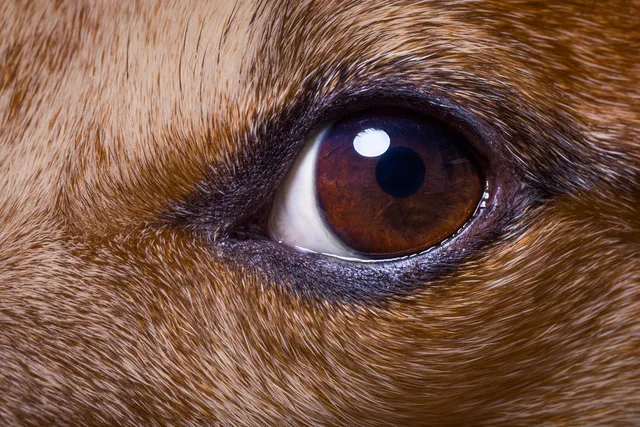
The pupil is the black circle in the middle of the iris that dilates (widens) and constricts (narrows) as light passes through. In dim light, the pupils dilate to receive more light. Since dogs have large pupils, they can take in more light and therefore, see better in the dark. A human's pupils are smaller than those of a dog.

High Number of Retinal Rods
A dog's retina contains a high number of rods, which are photoreceptor cells that function well in dim light. By contrast, photoreceptors called cones function better in bright light and give more detailed vision, helping animals see and differentiate colors. A dog’s retina has more rods than cones.
Tapetum Lucidum
So, although dogs and humans have different pupil sizes and a different number of rods and cones, we do have these factors in common. One thing that dogs have that humans do not is the tapetum lucidum, a special layer of reflective cells at the back of the eye between the retina and choroid.
The tapetum lucidum behaves similarly to a mirror, reflecting light to increase the effectiveness of the retina's ability to register light entering the eye and overall improving the animal's ability to see in low light. However, not all dogs have a tapetum, blue-eyed dogs in particular.

Frequently Asked Questions
Is It True That a Dog's Eyes Glow in the Dark?
Dog’s eyes do glow (or technically reflect) in the dark, and this is caused by the tapetum lucidum and triggered by light sources like camera flashes and bright headlights. In dogs with a tapetum, the glow is yellow-green in color, but in dogs that don't have a tapetum, you'll typically see a red glow instead. The red blood vessels in the eyes are responsible for this effect in tapetum-free dogs.

Can Dogs See in Complete Darkness?
The rod cells in the retina help dogs see in the dark, but these cells can't be stimulated unless there is at least some light. In spite of their powerful night vision, in complete darkness, a dog won't see a thing and will need to rely instead on other senses to navigate the conditions.
Luckily, a dog's sense of hearing and smell are both acute and can help them out if total darkness (rare) were to occur.
Can Dogs See Colors?
As we touched on earlier, humans have better color perception than dogs do due to a higher number of cones in the retina. That said, dogs can see colors, but they have dichromatic vision. This means they only have two types of cones compared to the three types humans possess, so they can only perceive blue and yellow. Moreover, dogs see colors less vividly than we do.
While humans can perceive a wide range of colors, dogs see things differently. For example, when we see purple, a dog likely sees just blue, and when we see red, a dog sees a brownish-gray shade. Yellow, orange, and green appear as simply yellow.

Final Thoughts
A dog's powerful night vision is due to the way that their eyes are structured, adaptations that made it easier for their wolfish ancestors—who hunted at night—to spot and catch prey in low-light conditions. Although domestic dogs no longer need to do this for survival, they're still anatomically wired in the same way.
See Also:
Sources
Featured Image Credit: eva_blanco, Shutterstock
Expert dog care, straight to your inbox
News, insights, expert advice, and everything dog.

No spam — unsubscribe anytime.
By signing up, you agree to our Terms & Conditions and Privacy & Cookies Policy.
How useful was this post?
Click a star to rate. You can leave written feedback afterwards. (We read all feedback.)
Kit Copson is a freelance writer and lifelong animal lover with a strong interest in animal welfare. She has parented many furry beings over the years and is currently a proud cat mom of two—one very chilled (unless hungry) Siamese and a skittish but adorable Domestic Shorthair—and dog mom of one—an adopted Bichon Poodle cross. When not writing about or spending time with pets, Kit can be found drawing in her sketchpad, reading, or more often than not, drinking tea.