What Colors Do Dogs Like Best? Canine Sight Explained (Vet-Verified)



We’ve almost all heard the myth that dogs see the world in black and white, but this myth just doesn’t hold up to reality. Dogs can, in fact, see certain colors! While their color vision isn’t as rich or vibrant as ours, it’s perfectly suited to their needs. Any limitations in color perception are more than compensated by their incredibly well-developed senses.
Compared to humans, dogs have far superior low-light vision and are much better at detecting motion. So yes, your dog might have “color preferences” based on what they can and can’t perceive, and you might not even realize it!

What Is Color Blindness?
In short, color blindness is an inability to differentiate between certain colors. It is a term used in human ophthalmology, and sometimes it’s called color deficiency. The most common color blindness in humans is red-green colorblindness which affects a person’s ability to differentiate or see shades of red and green.
Are Dogs Color Blind?

Using a very loose interpretation of the word, dogs could be considered color blind, they actually have dichromatic vision. The “error” comes from the fact that color blindness is typically a deviation from the norm, but in dogs, it’s the normal way their eyes and brain see. Dogs can see the world in shades of blue and yellow. Thus, for a dog to be “color blind,” they have to be unable to see either blue or yellow, something that we’re currently not able to test for, since even in people, color blindness is usually diagnosed through a self-reporting of signs.
Rather than thinking of dogs as being “color blind,” it makes more sense to think of a dog’s vision as fundamentally different from a human being’s vision. Dogs’ red-detecting cells aren’t faulty, they just don’t have them. It’s not a “lesser” version of our vision. It’s a different version.

A Dog’s Vision…What Is It Like?
As we’ve covered, dogs can see and process some color and they don’t know the world in shades of gray, as some may think. So, how else does a dog’s vision differ from a human's vision? There are a few features of vision that we talk about when analyzing a creature’s vision.

Visual Acuity
When analyzing your vision, the first thing we look at is your visual acuity. That is how sharp the images your eyes perceive are. Visual acuity is usually expressed as a Snellen fraction, a normal human’s acuity is 20/20, meaning what you see at 20 feet away over how far away other people can see with that same clarity.
“Perfect” vision is what you see at 20 feet away over how far away typical-sighted people can see the same image with the same clarity, or 20/20 vision.
Dogs have a visual acuity of roughly 20/75 when tested with an augmented vision test dedicated to dogs, meaning we can see from 75 feet away what they can only see from a maximum of 20 feet away. That’s quite a significant difference in image clarity!
Depth Perception
Dogs also have poorer depth perception than humans. Depth perception is the ability to perceive objects from a distance; the world looks flat, like a cartoon without depth perception. However, dogs have poor depth perception compared to humans.
Dogs’ poor depth perception is primarily due to their eyes not being as close together as humans’ eyes. Wide-set eyes decrease the power of an animal’s binocular vision and hamper their depth perception on a large scale.

Color Vision
Dogs also have a different color vision, as we’ve discussed. While humans see the full spectrum of trichromatic vision, dogs only have access to blue and yellow dichromatic vision. This means that humans can see colors that dogs can’t see.
Low-Light Vision
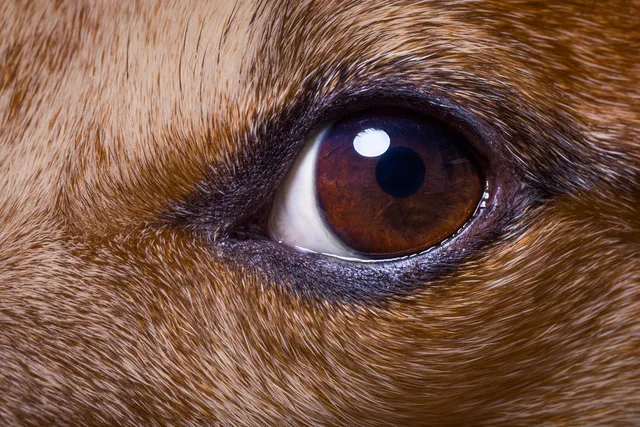
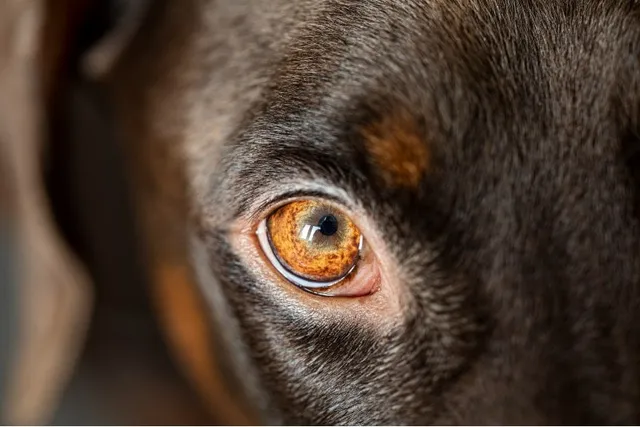
Low-light vision or “night vision” refers to a creature’s ability to see in the dark. This is where dogs surpass humans by far. They have a tapetum lucidum behind their retinas at the back of their eyes, which is a reflective layer that acts as a mirror, so they get the most from any light that enters the eye. This is why dogs’ eyes shine in the dark. Additionally, the central retina has predominantly more photoreceptors of the type that enable vision in dim light, which are called rods. In contrast, humans’ central retinas have more cones to help us see fine details and a richer range of colors. Humans have evolved to have excellent daytime vision, which perfectly suits our needs as a species. On the other hand, dogs are traditionally crepuscular animals with sharper night vision than humans.

How Does Their Vision Compare With Humans?
While dogs’ vision differs from ours in many ways, it is perfectly suited to their needs. Humans have richer color vision and sharper visual acuity, but dogs excel in areas where it matters most to them. They have superior motion detection, better night vision, and a wider field of view. These traits make their vision highly specialized for their environment and lifestyle, rather than inferior to ours.
How Do Dogs “See” the World?
Dogs see the world using all their senses, just like humans do. You don’t have to know a chicken roasting in the oven to smell its presence and know it’s there. Dogs are similar. Their primary sense is their sense of smell, and they use it to detect all kinds of things, from the presence of prey to toxins in their food. A dog’s nose is estimated to be between 1,000 times better than ours. That’s why your dog can smell their food when it’s still in the bag and how they know when another dog is intruding on their territory by walking by the house.
Dogs make up for their poor vision using their heightened sense of smell and hearing. Their other senses carry them through the world with the same ease as a human’s sight!
What Colors Do Dogs Like?
The colors dogs see best are bright yellows and blues. When looking for a toy, think less about whether your dog will like its colors and more if they’ll be able to enjoy it and whether it suits their needs. A toy that’s a rich red color as seen by us won’t be seen as such by a dog, but they have other senses, such as the smell, which they’ll use to gather plenty of information from it. They’ll also be able to have a great time playing with it! Your dog may not be able to tell you what they like and prefer, but you can guess it from their behavior.

Final Thoughts
While we can’t definitively say what colors your dog prefers, we do know which colors are easiest for them to see–vibrant yellows and blues. When selecting toys or accessories, you could consider these colors, but it’s not really that necessary. Remember, your dog’s world is rich and engaging not just because of their vision, but thanks to their incredible sense of smell, hearing, and overall sensory perception. Their preferences go beyond color, encompassing how well an item meets their needs and how much fun they have interacting with it!
Related Read: What Colors Can Dogs See? Vet-Reviewed Facts & FAQ
Sources
Featured Image Credit: Jeniffer Fontan, Shutterstock
Expert dog care, straight to your inbox
News, insights, expert advice, and everything dog.

No spam — unsubscribe anytime.
By signing up, you agree to our Terms & Conditions and Privacy & Cookies Policy.
How useful was this post?
Click a star to rate. You can leave written feedback afterwards. (We read all feedback.)
I’m a freelance writer with a passion for animal science and technology. I love to share the world of animal science with people to help them make informed decisions for themselves and their pets. I’ve worked in professional pet care for over six years and realised I could help change the world of pet care by bringing the information people needed to them in terms they could understand. Knowledge is power and I love to help everyone become the most informed they can be.