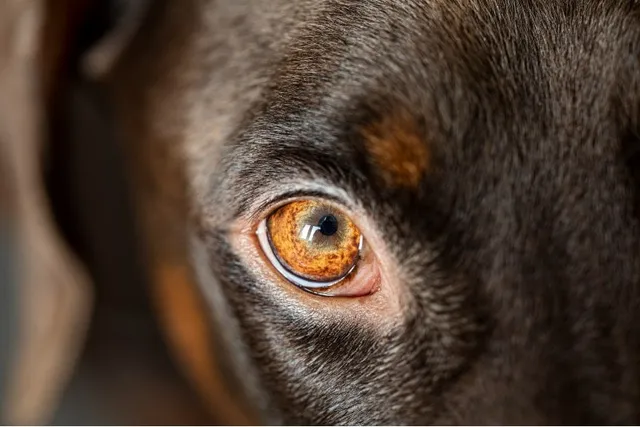
Are Dogs Color Blind? Vet-Approved Vision Facts



In this article
It is a common belief that dogs are colorblind and view the world in grayscale. However, research on canine vision has revealed that while dogs don’t see as many colors as humans, they’re not fully color blind. Rather, dogs are red-green color blind.1

Dog Vision vs Human Vision
Simply put, eyes perceive color through photoreceptors in the retina that are known as cones. Different animals will have different types and numbers of cones. In the case of dogs and humans, dogs have two kinds of cones in their retinas, while humans have three types of cones. They have fewer numbers of cones than humans as well, which makes the range and vibrancy of colors that they can see more limited than humans.

What Colors Can Dogs See?
Because dogs have two types of cones, their vision can also be described as dichromatic. They can see color combinations of yellow and blue. Therefore, it's believed that dogs can see the world through shades of yellow, blue, and gray. Humans have three cones that can identify color combinations of red, blue, and green. Therefore, we can see a wider range of colors than dogs can.
However, this doesn’t necessarily mean that when a dog sees an object that’s not yellow or blue, these objects will look colorless to them. For example, when a dog sees a red object, the object won’t look colorless. Red objects are believed to have a duller color and may appear brown or yellowish. Dogs may also see purple objects as blue.
A Dog’s Visual Advantages
It would be unfair and far too simplistic to say that humans have better vision than dogs because they can see more colors. Despite having two types of cones, dogs are still considered to be animals that have excellent visual advantages. Since their eyes are set more to the side of their heads, they have wider peripheral vision than humans.
A dog's pupils can also dilate much more than a human’s eyes can, which allows the eyes to capture more light. Dogs also have tapetums, which act like mirrors that reflect light. In addition, they have more rod cells than humans, which work to detect light and motion. This combination makes them much more adept at seeing in low-light settings than humans.
Another advantage that dogs have is motion sensitivity. The number of rods in the eyes affects motion sensitivity. Since dogs have more rods than humans, they’re capable of having 10-20 times greater motion sensitivity. This explains how your dog can be so quick to lick up crumbs and food scraps that fall from your dining table.
The tradeoff to these advantages is that they tend to be more near-sighted than us, meaning that an object at the same distance may appear sharp to us but more blurry to them.


Are Dogs Reliable Seeing Eye Animals?
You’ll be relieved to know that a dog’s dichromatic vision doesn’t cause significant issues with them being reliable seeing eye animals. Guide dogs play an essential role in the lives of many people living with vision impairment. The most common dog breeds that become guide dogs are Labrador Retrievers, German Shepherds, Poodles, Border Collies, and Australian Shepherds.
It's important to note that guide dogs don’t just rely on their vision to help lead people to their designated destinations. They use all their senses to perceive the world, look out for potential hazards, and safely guide and walk with their handlers. They undergo extensive training at a young age that usually lasts 4-6 months. Guide dog candidates must also exhibit a certain temperament and excel in obedience training.

Conclusion
Dogs may only be able to see blue and yellow hues, but this doesn’t mean that they have poor vision. Dogs have greater peripheral vision, and they can see better in low-light conditions than humans. So, even if they may have trouble distinguishing certain objects of different colors, they’re still considered to have good vision.
At the end of the day, dogs are still capable of having rich experiences in their lifetimes, even if they see a limited range of colors. In fact, their senses can perceive the world in ways that often go unseen by human eyes.
Sources
Featured Image Credit: George Trumpeter, Shutterstock
Expert dog care, straight to your inbox
Vet-reviewed advice, training tips, and the best of Dogster. Free, and you can unsubscribe anytime.
By signing up, you agree to our Terms & Conditions and Privacy & Cookies Policy.
Jessica is a freelance writer who spends bigger part of her day researching and writing while her furry companion Cavapoo, Nora, snoozes beside her. She loves dogs, pets and animals because there’s so much to learn from them, and they do so much for us. As a dog mom, she understands the strong connection that pet parents have with their pets. So, she loves sharing helpful information that pet owners can use to better understand their beloved pets. When she isn't writing, you may find her walking dogs, tending to her plants, or drinking her nth cup of coffee.
Join the conversation
Ask a question, share your story, or send private feedback.