How to Train Your Dog to Use a Dog Ramp: 6 Vet Approved Tips


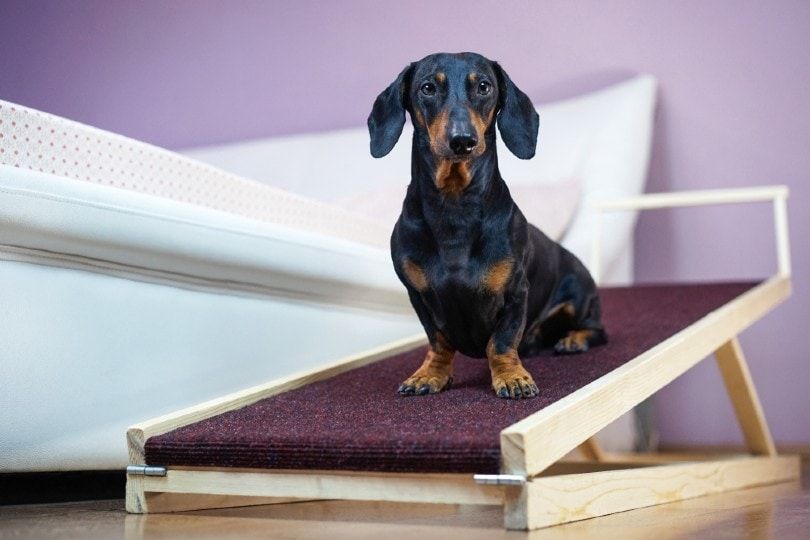
As your dog gets older, you may need to adjust things to help with the aging process. For example, older dogs often struggle to get on elevated areas, such as beds or couches, when they develop arthritis or other mobility issues. Ramps can also be especially helpful for long-backed breeds, such as Dachshunds, because reducing frequent jumping may help lower the risk of intervertebral disc disease (IVDD).
Dog ramps are a helpful tool to give dogs a sturdy, safe way to climb to their favorite resting areas, but the training process can take a little work. Here are six tips for training your dog to use a dog ramp. All you need to get started is some tasty treats, a good ramp, and some patience.

The 6 Tips to Train Your Dog to Use a Dog Ramp
1. Prepare the Ramp
Ramps can be adjusted to suit the object they’re used for, such as a couch or bed. When you’re introducing the ramp to your dog, it’s best to use a low incline that’s less intimidating. Practice by lying the ramp on a stable surface, such as a carpet, or other non-slip flooring, to give your dog confidence using it.
2. Start With One Paw
If your dog uses the ramp on its own, great! But realistically, it may take gradual measures to get your dog comfortable and confident. Introduce your dog to the ramp by placing one paw on the ramp, then offering a treat. Repeat this step a few times until your dog is comfortable.

3. Encourage Your Dog to Move Onto the Ramp
The next step is to get your dog to stand on the ramp on its own. Begin by rewarding your dog for placing one paw on the ramp, then progressively move the treat to encourage your dog to step onto the ramp. Keep rewarding for each positive step and gradually coax your dog to move farther onto the ramp. Eventually, your dog should follow the treat from one end of the ramp to the other.
If your dog jumps off the ramp, repeat the previous step and reward progress.
4. Remove the Treat
Once your dog is comfortable following the treat on the ramp, switch to using just an empty hand. The treat is now left as a reward for following your hand, not a way to coax the behavior. Gradually work up to walking from one end of the ramp to the other, rewarding your dog for positive steps and then slowly reducing food rewards while continuing to use praise or other reinforcement.
5. Introduce a Cue
When your dog gets to the end of the ramp, have them turn around and go back to the starting point. Introduce a verbal command, such as “up,” as you direct the dog with your hand. Treat your dog for moving at the cue.
6. Start the Incline
With patience, your dog should master the ramp on a flat surface with confidence. Now, you can introduce a slight incline to get your dog comfortable. Work slowly, raising the incline only once your dog adjusts to the previous position. If you go too fast, your dog may get nervous and jump off, which could increase the risk of injury or discomfort and set back your progress.

Tips for Using a Dog Ramp
Training a dog to use a ramp is a new—and sometimes intimidating—experience.
Here are some tips to make it go as smoothly as possible:
Conclusion
Dog ramps are helpful for older dogs or dogs with mobility issues that can’t jump on and off high places comfortably. They are also especially valuable for breeds prone to back problems, helping reduce strain on the spine. Unless your dog is already accustomed to walking on elevated or narrow surfaces, getting them to walking on a ramp can take some work and patience, but it’s worth it to ensure comfy spots like the bed or couch are still accessible.
Sources
Featured Image Credit: Masarik, Shutterstock
Expert dog care, straight to your inbox
News, insights, expert advice, and everything dog.

No spam — unsubscribe anytime.
By signing up, you agree to our Terms & Conditions and Privacy & Cookies Policy.
How useful was this post?
Click a star to rate. You can leave written feedback afterwards. (We read all feedback.)
Nicole has loved animals of all sizes her whole life so it's no wonder she has dedicated her career to helping them through what she loves best: learning, writing, and sharing knowledge with others. She’s the proud mom of two dogs, a cat, and a human. With a degree in Education and 15+ years of writing experience, Nicole wants to help pet parents and pets around the planet to live happy, safe, and healthy lives.