8 Mini Goldendoodle Health Issues: Signs & Care Tips


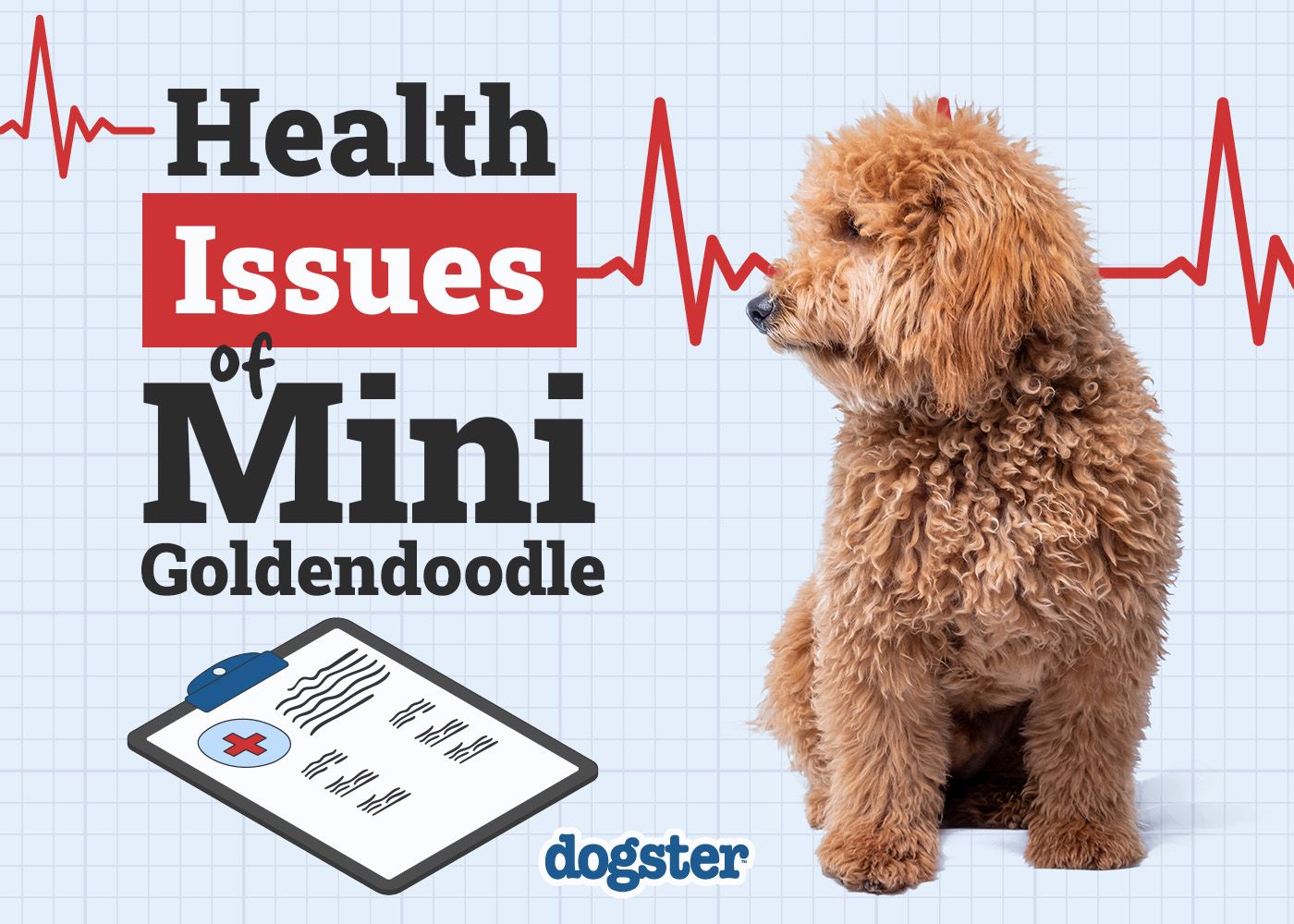
There’s no denying the cuteness factor of the Mini Goldendoodle. The outgoing and friendly Mini Goldendoodles are blessed with the desirable traits of the Golden Retriever and Miniature Poodle, including a friendly attitude and a lovely, huggable coat.
Like all dogs, Mini Goldendoodles are prone to some health issues, most of which are inherited. Below are 8 Mini Goldendoodle health issues you need to know, plus advice and tips that will empower you to help your precious puppy stay healthy and happy!

The 8 Mini Goldendoodle Health Issues
1. Luxating Patella
A luxating patella is a very common orthopedic condition that causes the patella, or kneecap, to slip out of place. When the patella is out of position or “luxated,” pups can hop on the leg until it pops back. In severe cases, Mini Goldendoodles can show frequent or constant signs of limping in the hindlegs and pain. The condition is graded from 1 to 4, with 4 being the most severe form.
Some cases require surgery, while others can be managed with medication and supplements. Prospective parents of Mini Goldendoodles, especially the Poodle parent, should be checked for luxating patella before breeding since the condition can be passed on.
Hip and Elbow Dysplasia Signs to Look For:
2. Ear Infections
Many Mini Goldendoodles are born with long, floppy, and fluffy ears, which are admittedly attractive and endearing. Those long ears, however, are also a haven for germs, bacteria, mites, and other microbes that can cause ear infections and a great deal of pain for your Mini Doodle.
You must clean your Mini Goldendoodle’s ears regularly to prevent the onset of ear infections and other issues. Checking their ears also ensures that minor ear issues can be treated before they become severe.
If you see any redness or swelling in your Mini Goldendoodle’s ear, take them to the vet as soon as possible. Veterinarians also recommended drying your Mini’s ears thoroughly after a bath or after they’ve been swimming. Since bacteria and yeast thrive in a moist environment, dry ears are your dog’s best defense against them.
Ear Infection Signs to Look For:

3. Hypothyroidism
Golden Retrievers are prone to hypothyroidism, a condition where the thyroid gland doesn’t make enough of the hormones your dog’s body needs to stay healthy and function optimally.
When a Mini Goldendoodle inherits this condition, their hormone levels drop significantly, causing their fur to fall out, their weight to increase, and their activity level to plummet. If this starts happening, you must get veterinary help and treatment. It’s important to note that Mini Goldendoodles diagnosed with hypothyroidism will need to be treated for the rest of their lives.
Hypothyroidism Signs to Look For:
If you are concerned about the health and well-being of your pet, we recommend getting in touch with a vet for guidance.
4. Von Willebrand’s Disease
This health issue is somewhat complicated and involves a glycoprotein called the Von Willebrand Factor. The glycoprotein helps blood to clot in dogs and other mammals, which stops a cut or wound from bleeding when your puppy gets injured.
A Mini Goldendoodle with Von Willebrand’s Disease will not have the Von Willebrand factor and, if they get cut or injured, will bleed profusely and take a long time to stop bleeding. Some will have noses or gums that bleed more than normal and bruise easily.
You should know that Von Willebrand’s Disease is the most common inherited bleeding disorder in the canine world. The good news is that, with correct management, most Mini Goldendoodles will live as long as dogs without the disease.
Von Willebrand’s Disease Signs to Look For:
5. Progressive Retinal Atrophy
Progressive Retinal Atrophy, or PRA, causes dogs like the Mini Goldendoodle to slowly but surely lose their eyesight. Inherited from both parent breeds, PRA has no cure or treatment. The disease affects the rods and cones in the retina of a dog’s eyes, causing them to break down faster than usual. In most PRA cases, a Mini Goldendoodle will first lose their night vision as the rods die and then lose their overall vision as the cones die.
PRA is a genetically based disease, meaning breeders can test for the presence of the genes in the parents before breeding. In this way, responsible breeders will avoid breeding pups affected by PRA.
PRA Signs to Look For:

6. Allergies
Dogs like the Mini Goldendoodle often suffer from allergies, usually to food, plants, pollen, or insects, and sometimes a combination. Allergies have several types and a wide range of signs, from constant scratching and recurrent ear infections to vomiting and diarrhea.
No matter the type of allergy, it’s imperative that you get veterinary help to determine a course of action. Different allergies require different treatments, so testing will sometimes be needed to determine which allergy is causing your Mini Goldendoodle’s misery. Most Mini Goldendoodles can be successfully treated for their allergies and live fulfilling lives.
Allergy Signs to Look For:
7. Addison’s Disease
Mini Goldendoodles may be prone to Addison’s disease due to their Poodle parentage. Addison’s disease occurs when the adrenal glands don’t produce enough hormones. The disease can be hard to diagnose as it requires specific tests, and the signs, which are very vague, can come and go.
Nevertheless, if you are aware of the condition, you can watch for some of the classic signs, including vomiting, diarrhea, shaking, and collapse. Especially if stress seems to trigger these signs, your pup may have Addison’s disease.
Addison’s Disease Signs to Look For:
8. Subvalvular Aortic Stenosis
Subvalvular aortic stenosis is a heart condition that is common in Golden Retrievers and may be passed on to Mini Goldendoodles. In this disease, the heart valve is narrowed. It’s a bit harder to push blood through this narrowed opening, like a partially blocked pipe. The abnormal flow of blood creates a sound called a heart murmur, which your vet can hear through a stethoscope.
If your vet hears a murmur, they will most likely recommend X-rays and a cardiac ultrasound to evaluate the heart. Pups with murmurs can behave fairly normally. Others may tire during exercise or even go into heart failure, which causes a cough. Unfortunately, dogs with this condition can also die suddenly.
Degenerative Myelopathy Signs to Look For:
What Is Hybrid Vigor?
All of this talk about the health issues your Mini Goldendoodle is prone to might make you think the breed is unhealthy, but nothing could be further from the truth. When bred by a reputable and caring breeder, Mini Goldendoodles have relatively few congenital issues and are typically healthy, long-lived canines.
One reason for their good health is hybrid vigor. Hybrid vigor occurs when you crossbreed two breeds, and by doing so, some undesirable traits are reduced in the offspring. However, more studies must be performed to confirm how much hybrid vigor affects breeding.

Final Thoughts
The biggest takeaway from this article should be that Mini Goldendoodles are relatively healthy dogs, especially when you adopt from a reputable breeder who knows what to look for (and breed out) in their dogs.
However, knowing the health issues above and the signs they display can empower you to help your Mini Goldendoodle live a longer, healthier life. You’ll now know which signs to look for and, more importantly, when to call your veterinarian for help or advice.
Sources
Featured Image Credit: LouisWorld1, Shutterstock
Expert dog care, straight to your inbox
News, insights, expert advice, and everything dog.

No spam — unsubscribe anytime.
By signing up, you agree to our Terms & Conditions and Privacy & Cookies Policy.
How useful was this post?
Click a star to rate. You can leave written feedback afterwards. (We read all feedback.)
Greg Iacono is a self-taught writer and former chiropractor who, ironically, retired early due to back problems. He spends his time writing scintillating content on a wide variety of subjects. Greg is also an accomplished video script writer known for his ability to take a complex subject and make it accessible for the layperson.
Before retiring from chiropractic, Greg had clinics in 3 different countries, including the U.S., Belgium, and Peru. When not writing, Greg spends his time traveling, riding his motorcycle, and doting on his 7-year-old daughter, Valery. He also has a massive Lego city he built with his son, Alex, and is very proud of his daughter, Catherine, an accomplished graphic artist.