Do Dogs Have Adam's Apples? Canine Anatomy Explained (Vet-Verified)



In this article
The Adam’s Apple is a piece of cartilage that protrudes from and surrounds the larynx. The larynx is the area at the top of the windpipe that contains the vocal folds. The cartilages found in this upper part of the neck are designed to protect the larynx. In humans, men and women develop Adam’s Apples during puberty but because male larynxes grow more quickly and larger than in females, Adam’s Apples are usually more pronounced in men than women.
Dogs also have laryngeal cartilage protection which can include a protrusion similar to that of an Adam’s Apple. However, it doesn’t tend to be as pronounced as in human males and if you have only just noticed your dog has a lump in this area, it is worth checking in with your veterinarian to make sure there is nothing amiss.
An Adam’s Apple, or to give it its scientific name, laryngeal prominence of the thyroid cartilage, is a piece of cartilage that sits around the larynx to offer protection. The larynx is involved in breathing, vocalizing and swallowing which is why it needs protecting. There are 9 laryngeal cartilages in the human body. The thyroid cartilage grows with the body, and in humans, because males tend to grow more quickly and larger than females, this causes the Adam’s Apple to become more prominent in males. It is what is called a secondary sexual characteristic as it develops during puberty and may be involved with the deepening of the voice as the vocal cords lengthen.
The cartilage is the reason that men tend to have deeper voices than women, although this isn’t true in all cases.

Do Dogs Have Them?
Dogs do have a laryngeal cartilage framework involving 5 cartilages, one of which is the thyroid cartilage. However, this doesn’t have a laryngeal prominence sticking out of it in the same way that the human one does. You can sometimes see, and you can feel, the thyroid cartilage in a dog’s neck and people may refer to this as the Adam's Apple but it is not exactly the same as the human one.
What the Adam’s Apple Does
The laryngeal cartilages in dogs are similar to the Adam’s Apple in humans, and it does serve similar purposes. It protects the larynx, or voice box, and gives the dog a deeper bark. The Adam’s Apple is essential because it helps with vocalization, enables comfortable breathing, and it also helps protect the larynx and airways.

Is It a Lump?
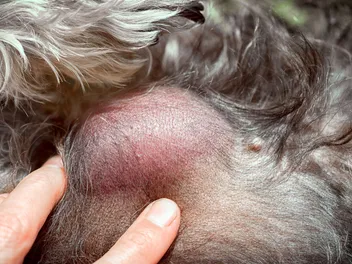
A Dog’s Adam’s Apple does not protrude as noticeably as one in a human male, and most owners will never notice their dog’s. If you can see a lump around your dog’s throat area, and especially if you’ve never noticed it before, it could be a sign of illness or some other complaint and it is worth investigating to ensure it’s nothing more serious.
Tumors in the throat are uncommon but they do happen. They can be benign but may also be cancerous. Signs include difficulty eating, difficulty breathing, and a change in the tone of a dog’s bark. You may also notice signs such as weight loss, lethargy, and coughing.
Other causes of lumps in the neck include injury, inflammation, foreign objects and abscesses.
If you have found or noticed a lump in your dog’s neck take your dog to see the vet. They will investigate the lump to determine what it is and its cause. Possible treatments include courses of antibiotics to help combat infection, anti-inflammatories to help reduce swelling, and possibly surgery following a biopsy if cancer is considered.

What to Do If You Find a Lump
If you notice a lump in your dog’s throat, first try to gently inspect the area. Checking to see if there is anything stuck in the fur, is the lump under the skin. Is it soft, hard, warm to touch and so on. Don’t poke or prod too hard, as it may cause pain or further damage. If your dog won’t let you near the protrusion, you may need to take further action such as visiting the vet.
Also monitor your dog’s eating, breathing, and barking, to see whether there are any differences. Take your dog to the vet and have them investigate the protrusion so they can determine whether it is a serious problem or not. Hopefully it is just your dog’s normal laryngeal cartilages you are feeling, but better safe than sorry.
Conclusion
Dogs do have protrusions around the area of the larynx. While they are not strictly the same as Adam’s Apples, they are cartilage and they do the same job of protecting the larynx and airways, while also affecting the dog’s bark. However, a dog’s Adam’s Apple is not as prominent as that of a human male, and if you do notice a lump in the throat, it might be a sign of something more serious that requires intervention.
Sources
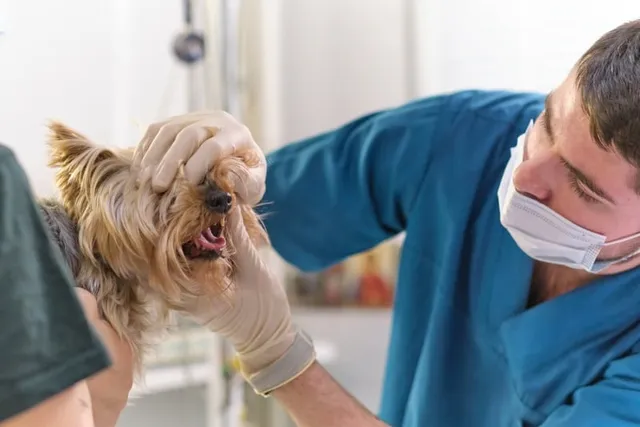
Featured Image Credit: Robert Kneschke, Shutterstock
Expert dog care, straight to your inbox
News, insights, expert advice, and everything dog.

No spam — unsubscribe anytime.
By signing up, you agree to our Terms & Conditions and Privacy & Cookies Policy.
How useful was this post?
Click a star to rate. You can leave written feedback afterwards. (We read all feedback.)
Matt is a freelance writer from the UK. He lives with his partner and daughter, as well as two cats and one dog. A data analyst by profession, Matt moved from numbers to words more than 15 years ago and has been writing ever since. Having volunteered at a local animal sanctuary, he has a lot of experience with dogs, cats, and horses. Matt has also kept bearded dragons, a variety of birds, fish, guinea pigs, hamsters, mice, and rats. His daughter has adopted the same passion for animals, keeping and breeding snakes. A geek at heart, Matt is a member of a local board gaming group and regularly forces his family to “enjoy” board games with him at home.