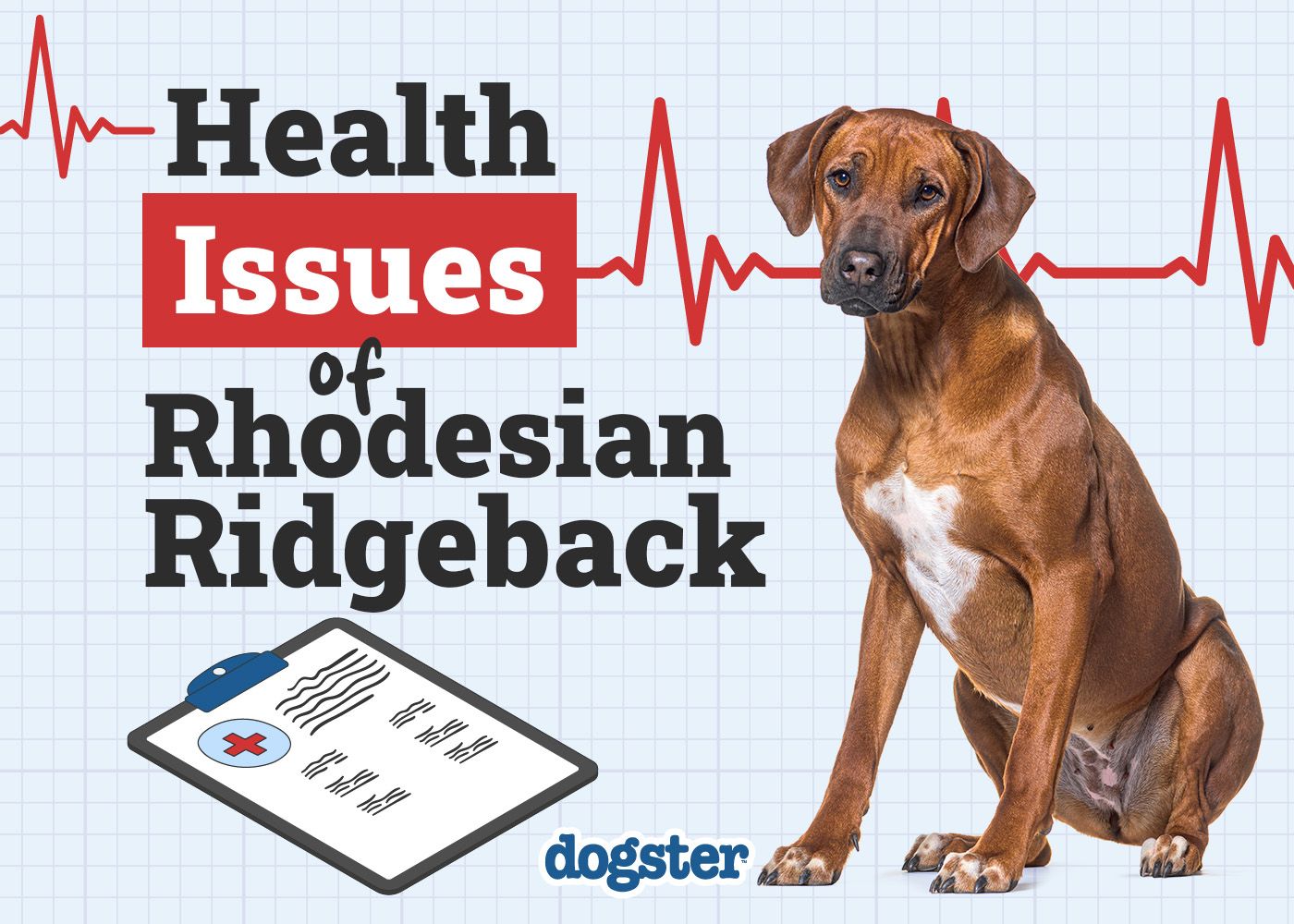
6 Rhodesian Ridgeback Health Issues to Watch For (Vet Answer)

In this article
The Rhodesian Ridgeback is a handsome breed that was developed in Africa to be a hunter and guardian. These dogs are smart but sometimes stubborn. They have a moderate level of energy and a coat that is easy to care for. Nowadays, they are more likely to hunt for a spot on the sofa after coming home from a walk or run.
They are mainly a healthy breed, but they can suffer from certain ailments. Potential owners should know about these so they can be prepared and watch for early signs.

The 6 Potential Health Issues for Rhodesian Ridgebacks
1. Hip Dysplasia
Hip dysplasia is a hereditary condition in which the hip bone (femur) is not well fixed in the hip joint (acetabulofemoral joint). In some dogs, this condition manifests with pain and lameness in one or both hind legs, but there are cases in which the owner does not notice any signs.
Dogs that suffer from hip dysplasia can develop arthritis when they age. Although the condition is hereditary, it can be accentuated by certain environmental factors:
- Rapid growth due to a hypercaloric diet
- Jumping accidents
- Fallings on slippery floors
A vet may recommend getting surgery to correct the problem, monitoring your pet's weight, or administering anti-inflammatory drugs to keep the pain under control.

2. Elbow Dysplasia
Elbow dysplasia is a hereditary disease that is common among large dogs, including the Rhodesian Ridgeback. It is likely caused by different growth rates of the humerus, ulna, and radius (the three bones that make up the elbow), which leads to the weakness of the joint. The clinical signs usually occur around 4–10 months of age, and the diagnosis is usually made around 4–18 months.
The clinical signs include:
- Sudden (acute) episodes of elbow lameness due to advanced degenerative joint disease (common in adult dogs)
- Intermittent or persistent lameness of the forelimbs that is aggravated by exercise (only noticed after the dog has rested)
- Pain when extending or flexing the elbow
- Tendency to hold the affected limb away from the body
- Fluid accumulation in the joint
- Reduced range of motion
Treatment is similar to that of hip dysplasia.

3. Hypothyroidism
Hypothyroidism is the most common endocrine (hormonal) disorder in dogs and often develops around the age of 4–10 years. Many dog breeds are prone to developing hypothyroidism, but the Rhodesian Ridgeback has a greater risk. This condition leads to an inadequate secretion of thyroid hormones T3 and T4. The occurrence of this disease has a hereditary component.
Hypothyroidism has two types: primary and secondary. Primary hypothyroidism is determined by changes/alterations of the thyroid tissue, and secondary hypothyroidism occurs when there is a problem at the level of the pituitary-thyroid regulatory pathway.
In primary hypothyroidism, the issue can be an inflammation of the gland, follicular atrophy, iodine deficiency, or tumors. In secondary hypothyroidism, insufficient secretion of the thyroid-stimulating hormone is the cause. In turn, this is caused by neoplasia, inflammation, or malformations of the pituitary gland.
Clinical signs of hypothyroidism in the Rhodesian Ridgeback breed include:
- Alteration of fur quality, such as excessive shedding and symmetrical hair loss on different parts of the body (most often the neck and chest, limbs, tip of tail, back part of thighs, and sides)
- Thinning fur and the hair becoming brittle, dry, and lackluster
- Dry, thickened, rough skin that can acquire abundant pigmentation
- Excessive scratching that can lead to secondary skin infections
- Infertility
- False pregnancies and lactation in females
- Disinterest in mating in males
- Weight gain
- Reduction of learning capacity
- Lethargy
- Sleepiness
- Anemia

4. Deafness
The Rhodesian Ridgeback breed can suffer from a hereditary condition called early-onset adult deafness, in which dogs will gradually (progressively) lose their hearing 1–2 years after birth, though there have been cases where the condition occurred at an even younger age (4 months).
Researchers have determined that the hearing loss is due to a variant of the EPS8L2 gene. For the dogs to be affected, both parents must have this variant. Genetic tests can help determine if your dog suffers from this condition.
5. Dermoid Sinus
Dermoid sinus is a congenital defect in which a cyst or a narrow structure (tubular indentation) develops above the spine, in the skin. Penetration into the skin may differ from individual to individual. Sometimes, it reaches the muscle tissue and the spinal cord. Other side effects can occur if it becomes infected, including intense pain.
Most of the time, this problem is identified at birth. Depending on the severity, some puppies with this defect are euthanized, and others are treated surgically.
If you are concerned about the health and well-being of your pet, we recommend getting in touch with a vet for guidance.
6. Eye Problems
Eye problems are not that common in this breed, but they can still occur. Although they can get a wide range of conditions, the Rhodesian Ridgeback breed is most prone to:
- Cataract — The clouding of the eye lens
- Ectropion — The eyelid turning outward
- Distichiasis — An extra row of eyelashes or an eyelash growing abnormally
- Persistent pupillary membranes — Fetal tissue remaining on the eye after birth

How to Care For Your Rhodesian Ridgeback
The Rhodesian Ridgeback breed can easily adapt to different environments, but you must make sure they get enough daily exercise. That said, they need to be allowed to stay inside with the family, not kept outdoors in the yard or in a cage. If these dogs get bored, they will try to run away. It’s recommended to have a yard with a solid fence that cannot be easily jumped, destroyed, or dug under.
Occupy your dog’s time with training, playing, and canine sports. If you leave them outside alone for too long, Rhodesian Ridgeback can become destructive. Even when they are not necessarily bored, these dogs tend to dig large holes to cool off in the soil.
Take them out twice a day for walks that are longer than 15–20 minutes, or play with them for 15–20 minutes two times a day. Also, give them the opportunity to run several times a week in fenced areas. This breed will chase cats, rabbits, or cyclists, regardless of how well-trained they are.
If you want to train them, start early. To get good results, you must be firm and persistent but not harsh.

Conclusion
The Rhodesian Ridgeback is a generally healthy breed, but they are prone to certain conditions. Common issues that this breed can get include elbow and hip dysplasia, deafness, hypothyroidism, dermoid sinus, and certain eye problems. If you think that your dog suffers from any medical condition or shows concerning clinical signs, a visit to the veterinarian is vital.
Sources
Featured Image Credit: SubertT, Shutterstock
Expert dog care, straight to your inbox
Vet-reviewed advice, training tips, and the best of Dogster. Free, and you can unsubscribe anytime.
By signing up, you agree to our Terms & Conditions and Privacy & Cookies Policy.
Dr. Iulia Mihai, DVM MSc (Veterinarian)
Dr. Iulia Mihai is a veterinarian with more than 13 years of experience in laboratory, cancer and pet pathology. Dr. Mihai studied at the University of Agronomical Sciences and Veterinary Medicine of Bucharest, Romania. She has a master’s degree in equine and pet pathology and studied epithelial cancer for her Ph.D. Iulia has a passion for internal medicine and parasitology and started volunteering at the faculty’s clinic in her third year of college. She enjoys writing and educating people about disease prevention, nutrition, behavior, and treatment. She has worked in a couple of veterinary clinics over the years as an internal medicine specialist.
Join the conversation
Ask a question, share your story, or send private feedback.