How Can I Tell If My Dog’s Leg is Broken or Sprained? Our Vet Explains the Signs & What to Do

In this article
Dog owners never want to see their canine companions in pain. Unfortunately, there’s only so much we can do to supervise our dogs and prevent injuries. Accidents happen to us, and they can happen to our dogs too. Dogs are known for their energetic demeanor and love for exercise, and these two factors may predispose them to injuries. If your dog has injured a leg, you’ve probably noticed them limping.
Next, you might wonder if they’ve suffered a sprain, or broken the leg. This can be challenging to decipher and is generally best left to the expertise of a veterinarian. A thorough physical exam, as well as the benefit of experience and imaging such as X-rays, enables vets to distinguish a sprain from a broken bone.

What Is a Sprain?
Sprain injuries occur when the ligaments are stretched or torn. Ligaments are the tough bands of fibrous tissue that connect bones together. Dogs tend to suffer sprains after high-impact exercise such as running, jumping, or playing with another dog. They can also occur following a slip, trip, or fall.
Common sites at which dogs experience a strain are the wrist (carpus) and knee (stifle) joints, though any joint can be sprained. A strain injury is slightly different from a sprain. By definition, a strain affects a muscle or tendon, whereas a sprain affects a ligament.

What Is a Broken Bone?
While sprains and strains are considered soft tissue injuries, broken bones (by definition) involve the bone. A broken bone can also be referred to as a fractured bone – the two terms mean the same thing. Any excessive force can cause a bone to break. Essentially, some form of trauma has caused the bone to break into two or more pieces.
Collisions with obstacles at speed, road-traffic accidents, and high-rise falls are the most common causes of broken bones in dogs. In general, bone fractures are considered more serious than sprains, though there are exceptions.

How to Tell the Difference: 4 Tips
As we have mentioned, differentiating a broken leg from a sprain must be done by a veterinarian. Below are four tips that might suggest that a fracture is more likely.
However, the absence of these signs does not mean the leg is definitely sprained: there may be a small or subtle fracture that appears as a sprain.
1. There is significant swelling or bruising
Many broken bones will have significant swelling and bruising due to the severity of the trauma. Some sprains will also have swelling and bruising, though it is usually more subtle.

2. You can visualize bone
In some “open” fractures, the bone has displaced significantly and pierced the skin, meaning you can see bone. This is a good indication that the bone is likely broken, and you should seek urgent veterinary attention.
3. The leg appears “floppy”
If the injured leg appears excessively floppy, unstable, or is “dangling”, there is a high chance that your dog has sustained a fracture.

4. Your dog won’t bear any weight
Most dogs with a broken bone will not bear any weight in the leg. They will be hopping around on three legs, as the pain is too much for them to carry weight through the broken leg. However, this can also be seen with severe sprains or anterior cruciate ligament injuries.
What Should I Do Next?
Contact your veterinary clinic or nearest emergency vet clinic. They might ask you a few questions to gauge how urgently your dog needs to be seen. If the injury appears mild or has been occurring for a while, you should book the soonest available appointment. If the pain is significant or you are concerned about a fracture, emergency care is warranted.
In the meantime, stay calm and gently restrain your dog. Avoid touching the injured leg. If your dog is unable to walk, try using a towel (or something similar) as a sling under their belly to assist them.
How Are Leg Injuries Treated in Dogs?
Sprains and strains can often be managed with painkillers and anti-inflammatories. Rest is often essential to give the body time to heal, though this can be the most challenging aspect of injury recovery in dogs (they never want to rest!). Icing the affected area, as well as using heat packs, may be beneficial but should be discussed with your veterinarian.
Braces are rarely used in veterinary practice. If your dog is overweight, following a weight-loss program (again, advised by your veterinarian) is critical for injury prevention in the future.
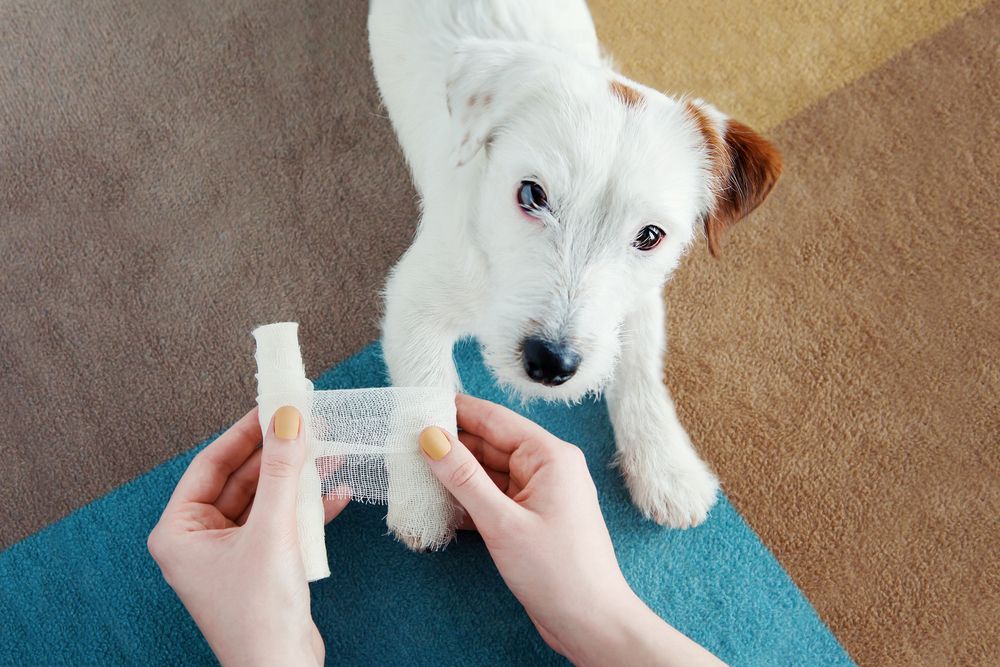
Treating broken legs can be more involved. Some fractures require splinting or casting to immobilize the affected limb. Other fractures require surgeries in which the bones are realigned and often held together with an internal plate, wires, or something similar.
Certain fractures (such as some hip fractures) may be allowed to heal on their own, again using rest and pain relief. For the most severe, inoperable fractures, amputation of the leg may be considered as a last resort.

Conclusion
Injuries are relatively common in dogs, including sprained ligaments and broken bones. These injuries are generally sustained in different ways, though the signs (limping, pain, and swelling) can be similar.
For the owner or layperson, distinguishing a sprain from a fracture can be difficult, if not impossible. If your dog has sustained an injury, do not hesitate to contact your veterinarian for prompt treatment and guidance.
Sources
Featured Image Credit: Liudmyla Guniavaia, Shutterstock
Expert dog care, straight to your inbox
Vet-reviewed advice, training tips, and the best of Dogster. Free, and you can unsubscribe anytime.
By signing up, you agree to our Terms & Conditions and Privacy & Cookies Policy.
Dr. Joe Mallat DVM (Veterinarian)
Joe is a veterinarian from Sydney, Australia. When he's not working, he enjoys cooking, exercising, and exploring the Australian wilderness. He has worked for 2 years at a mixed-species practice on the mid-north coast of New South Wales, treating animals of all sizes. His areas of particular interest include wound management, internal medicine, and oncology. Joe's love for the profession comes not only from helping dogs, but also from helping their parents and working with wonderful teams of people.
Joe completed his Bachelor of Veterinary Biology and Doctor of Veterinary Medicine at the University of Sydney in 2020.
Join the conversation
Ask a question, share your story, or send private feedback.