Cleft Lip & Palate in Puppies: Signs, Causes & Treatment (Vet Answer)

In this article
Cleft lip and cleft palate are birth defects caused by the incorrect formation of a puppy’s mouth during pregnancy. Similar clefts also occur in human babies. While some clefts can be visualized without any difficulty, others are far less obvious. Similarly, some clefts do not need any treatment at all, while others require corrective surgery. When it comes to clefts in puppies, information is plentiful but can be confusing or hard to decipher.
This article will cover all aspects of cleft lip and palate in puppies, from causes and signs to care and treatment.

What are Cleft Lip & Cleft Palate in Puppies?

A cleft refers to a split, or something that is partially divided into two. Both cleft lip and cleft palate in puppies are considered “congenital” diseases, meaning that they are present at birth, and may arise from either genetic or environmental factors (or both).
A cleft lip is a defect that occurs when the lip does not join properly at birth. A cleft lip may involve the underlying bone or hard palate (roof of the mouth) as well as the lip. You might hear cleft lip referred to as “harelip”, given the resemblance to the face of a hare, but this term is only used colloquially.
A cleft palate is a malformation of the different tissues that make up the palate (roof of the mouth). The palate has two separate regions—the hard palate, which is closer to the nose, and the soft palate, which is further back towards the throat. In most puppies, the left and right sides of the mouth come together and fuse during pregnancy.
In puppies with cleft palate, this process does not occur properly, leaving a hole in the roof of the mouth. Occasionally, this hole connects to the nose as well.
If you think your dog suffers from cleft lip and palate, you should contact your vet directly for an assessment. They can provide you with more information and a care plan.

What Are the Signs of Cleft Lip & Palate?

Signs of cleft lip and palate can be grouped into three categories—signs of cleft lip, signs of cleft palate, and signs affecting the puppy’s ability to thrive.
1. Cleft lip signs
- Part of the upper lip is missing
- Part of the upper lip is crooked
- The nostrils appear abnormal
- The nose appears connected to the mouth
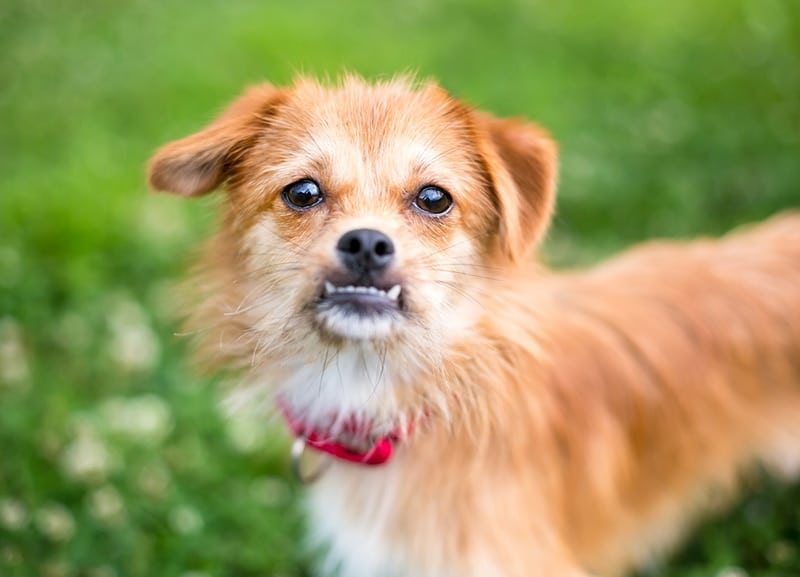
- The teeth are clearly visible all the time
2. Cleft palate signs
- Hole in the roof of the mouth
- Facial deformity
3. Signs of puppy ill-health
Dogs with cleft lip or palate will show some of the following signs:

Causes of Cleft Lip & Palate in Puppies
Congenital cleft palate occurs due to incomplete fusion of the mouth while the puppy is still a fetus. There are five main reasons:
Note: Puppies born with a cleft palate should never be used for breeding! There is a high chance of them passing on the cleft, or at least the gene for the cleft, to their offspring.
How Are Cleft Lip & Palate Treated?
There are no home treatments for cleft lip and palate. Minor clefts causing no difficulty eating or swallowing may be left alone, and some of these puppies go on to live full and happy lives. However, for those puppies significantly affected by their cleft, surgery is the only option. Without surgery, puppies are unable to get enough nutrition to survive. They are also prone to developing severe infections, such as pneumonia.
Surgery can be difficult and costly but carries the best prognosis. Complications are possible, and multiple surgeries may be required. Some surgeons may encourage tube-feeding until the puppy is 3 months of age, at which point they are more capable of handling a general anesthetic.

FAQ
Can Puppies Have Both Cleft Lip & Cleft Palate?
Yes, some puppies will have both cleft lip and cleft palate at birth. The majority, however, will have one or the other.
How Are Cleft Lip & Palate Diagnosed?
Most clefts can be diagnosed by a veterinarian through direct observation during a physical examination. Some clefts, if they are small and further back in the mouth, may require imaging scans such as CT. X-rays may also be used to check for pneumonia in puppies with a cleft.
What Happens if Clefts Aren’t Treated?
Cleft palates rarely repair themselves. Puppies with untreated clefts can develop infections of the nose and lungs, and these infections can be life-threatening.

Conclusion
Cleft lip and palate are congenital abnormalities, more common in certain breeds of dogs. Other factors during pregnancy may contribute to the formation of a cleft in the newborn puppy. Clefts range in significance from minor aesthetic defects to major, life-threatening disorders.
If you are a dog breeder or new puppy owner, and you are concerned about cleft lip or palate, always contact your veterinarian. Early diagnosis and treatment always improve the chance of a good outcome.
See Also:
Jackrabbit vs Cottontail: What’s the Difference? (With Pictures)
Cleft Palate in Dogs: Vet Reviewed Signs, Causes &Treatment Options
Sources
Featured Image Credit: Hannah Carl, Shutterstock
Expert dog care, straight to your inbox
Vet-reviewed advice, training tips, and the best of Dogster. Free, and you can unsubscribe anytime.
By signing up, you agree to our Terms & Conditions and Privacy & Cookies Policy.
Dr. Joe Mallat DVM (Veterinarian)
Joe is a veterinarian from Sydney, Australia. When he's not working, he enjoys cooking, exercising, and exploring the Australian wilderness. He has worked for 2 years at a mixed-species practice on the mid-north coast of New South Wales, treating animals of all sizes. His areas of particular interest include wound management, internal medicine, and oncology. Joe's love for the profession comes not only from helping dogs, but also from helping their parents and working with wonderful teams of people.
Joe completed his Bachelor of Veterinary Biology and Doctor of Veterinary Medicine at the University of Sydney in 2020.
Join the conversation
Ask a question, share your story, or send private feedback.