Are Hyenas Dogs? Our Vet Explains

In this article
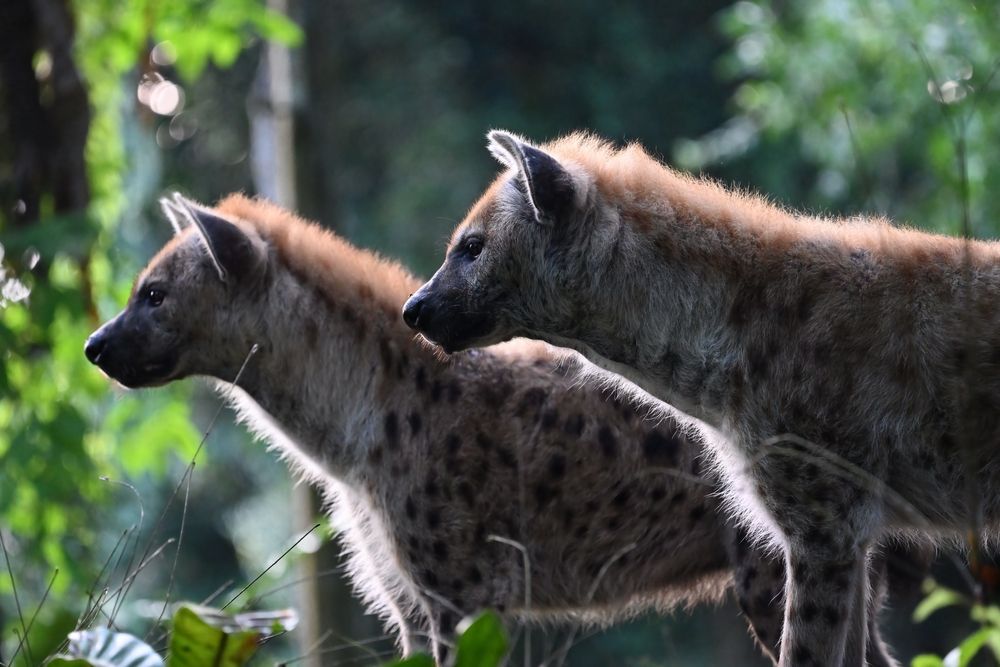
When you take a look at a hyena, it would be easy to imagine that they’re related to dogs. With their upright ears, loping gait, and social behavior, they seem to share many canine characteristics. However, you might be surprised to learn that hyenas are not closely related to dogs at all, and if anything, are more closely related to cats, though, they are not cats. In fact, the closest relative of the hyena is the mongoose (an animal known for being quite feisty and attacking animals far larger than they are, like the Chihuahuas of the African savannah). You might be more familiar with another type of mongoose, the inquisitive meerkat.
Let’s take a closer look at the hyena, and what they do and don’t have in common with our canine companions.

Are Hyenas Dogs or Cats?
Hyenas are neither dogs nor cats but are slightly more closely related to our feline friends than dogs. Within the class Mammalia (mammals), the order Carnivora (carnivores) splits into two main groups: Caniformia and Feliformia. As you can probably guess, caniforms share more canine-like features, while feliforms are more cat-like. Feliformia is further divided into Feloidea, which contains the Felidae family, including lions, tigers, and domestic cats. On another branch is Viverroidea, which contains creatures like civets, and the group Herpestoidea, home to the mongoose and hyena.
These divisions have changed and reorganized over the years, as classifications that were predominantly based on animal morphology have become more accurately categorized based on their DNA.
There are four species of hyena; the most well-recognized is the large Spotted Hyena (Crocuta crocuta). The name of the smallest of the group, the Aardwolf (Proteles cristatus), suggests that confusing them with canines is an easy mistake to make.

Are Hyenas Related to African Wild Dogs?
If you were to base your decision on appearance alone, it is even more reasonable that you would confuse these two for close relatives—just look at those ears! However, the African Wild Dog (Lycaon pictus) actually is a member of the canid family, which just goes to show that you really can’t judge a book by its cover!
What Are Hyenas?
We’ve established that hyenas are not dogs and they’re not cats; so what are they?
Hyenas are carnivorous mammals that are closely related to the mongoose (including meerkats) and the Fossa, a medium-sized carnivore native to Madagascar. With the exception of the Aardwolf, which is mainly an insectivore, hyenas are hunters and scavengers, with an appetite that is far from picky! With large carnivore competitors, and even larger prey species to hunt, the hyena evolved into a far more intimidating form than their diminutive relatives. Although they are often depicted as being savage and sly, these highly social creatures form strong and complex relationships within their clan, with a female-dominated system that favors group stability over individual gain.

Can You Keep Hyenas as Pets?
You may have seen some crazy images out there of people walking a hyena on a leash. This is NOT a good idea for several reasons:
- Hyenas are wild animals. They have not been domesticated, and are not even as amenable to being tamed as some other wild animal species. No hyena species has a history of being kept tame or as pets, so there is no ‘genetic memory’ that would make these animals readily accept being kept as pets. It is difficult enough to provide for their needs in a zoo or conservation park, let alone in your house or backyard.
- Hyenas have some of the strongest jaws on the planet, with a crushing bite force of around 1000 Newtons (N). To put that into perspective, the Hippopotamus has the strongest bite force of any land animal at over 8000 N, a Great White Shark can bite with a force of 18,000 N, while a German Shepherd has been found to average around 360 N. If a hyena were to bite, there is a good chance you would lose a limb or your life.
- Most hyenas are pack animals that form strong bonds with their familial groups. Although dogs will also form packs and social groups, the process of domestication means that their social needs are easily met by their human families. A hyena without a pack will be stressed, and if keeping one hyena as a pet is a bad idea, keeping a whole pack would be a disaster!


Interesting Hyena Facts
They may not be the most cuddly-looking creatures, but when it comes to the hyena, there is far more than meets the eye.
Hyenas live in matriarchies
The spotted hyena lives in medium to large clans where females rule. Unlike wolves, where only the dominant pair will breed, there will be a number of matrilines (families under one matriarch) within a group who often hunt or forage separately, but live and defend a territory together. Once they reach sexual maturity, males will disperse to find another clan.
Hyenas have a complex pecking order
Within a matriline, the mother will always be dominant to her offspring, but younger daughters are dominant to their older siblings. Behaviorists believe that this unusual structure may serve to favor coalitions and stability over an outright ‘survival of the fittest’ strategy.
Girls will be boys
Likely a result of their female-dominated social structure, the external genitalia of the female hyena has evolved to closely resemble that of the male. An enlarged clitoris and phallic vagina paired with modified labia that mimics a scrotum, gives the female hyena a very masculine appearance, making it almost impossible to differentiate between the sexes without close inspection. With their matriarchal society and transexual morphology, hyenas are proving once and for all that gender roles are about more than just Xs and Ys.


Final Thoughts
At first glance, hyenas can easily be mistaken for a strange-looking dog, and a female hyena can also be mistaken for a male! These captivating creatures seem to defy many of the rules followed by nature and do so very successfully. Although a hyena is far better appreciated from a distance than up close, if you get the chance to observe their quirky personalities and fascinating family relationships in their natural environment, it is well worth taking the time to do so. They may not be the most traditionally beautiful members of the animal kingdom, but hyenas are certainly one of the most interesting.
Also see:
How Big Are Wolves Compared to Dogs? (Size Chart & Comparison)
How Big Are Coyotes Compared to Dogs? Vet-Reviewed Size Chart & Comparison
Sources
https://www.sciencedirect.com/science/article/pii/B9781455773978000517
https://www.sciencedirect.com/topics/agricultural-and-biological-sciences/carnivora
https://www.sciencedirect.com/science/article/pii/B9781455773978000517#bbib12
https://www.pbs.org/wnet/nature/blog/african-wild-dog-fact-sheet/
https://www.nationalgeographic.com/animals/mammals/facts/fossa
Featured Image Credit: tristan tan, Shutterstock
Expert dog care, straight to your inbox
News, insights, expert advice, and everything dog.

No spam — unsubscribe anytime.
By signing up, you agree to our Terms & Conditions and Privacy & Cookies Policy.
How useful was this post?
Click a star to rate. You can leave written feedback afterwards. (We read all feedback.)
Dr. Karyn Kanowski, BVSc MRCVS (Vet)
Dr. Karyn is originally from Queensland, Australia, and has resided in the UK for the past 10 years. She graduated from The University of Queensland School of Veterinary Science in 2010, and also holds a Bachelor’s degree in Zoology. Karyn is passionate about using experience, evidence, and working with pet owners to provide the best solutions for pets. She also believes in making reliable information about animal health accessible to everyone. 5 cats and 4 dogs let her share their home with her and her husband, and when she is not practising as a veterinary surgeon, she spends her time writing, gardening, and cleaning up pet hair!