How to Communicate with a Deaf Dog: 6 Vet-Approved Tips



In this article
Caring for any dog is a big responsibility, but owning a pet with special needs, such as deafness, presents unique challenges. Because humans rely so much on speech to communicate, it can be hard for us to imagine how to talk to our dogs if they can’t hear us. Thankfully, dogs rely on more than just their ears to navigate the world. In this article, you’ll learn six important tips on communicating with a deaf dog. We’ll also give you general tips to help keep your deaf dog safe and avoid unnecessary stress.

Preparation
To help you communicate with your deaf dog, you’ll need patience, consistency, and a positive attitude. Dogs are already excellent at interpreting human body language and emotions, and being deaf just increases that ability. You’re communicating with your dog even when you don’t know it.
For some of our tips, you’ll need additional supplies besides your positive attitude:
How to Communicate with a Deaf Dog
1. Teach a “Marker” Hand Signal
To make communicating with your deaf dog easier, teach them a hand signal to let them know they’ve done something positive. This “marker” hand signal functions as a clicker would for a hearing dog. You might use a “thumbs up” or a hand flash, which is quickly opening a closed fist. It doesn’t matter which signal you pick as long as you are consistent.
Teach your dog that the marker signal leads to treats by using it and then giving them a treat immediately. For example, give the signal with one hand and a treat with the other. Repeat this exercise until your deaf dog understands the signal means they get a treat.

2. Use Light, Vibration, or Movement to Get Your Dog’s Attention
Once your dog learns their visual clicker sign, use it to reinforce desired behaviors and encourage your dog to repeat them. However, you’ll need to get their attention first! Since you can’t just call your dog to look at you, you’ll need to try other methods.
In the house, try stomping your feet on the floor and using the vibrations to get your dog’s attention. For outdoor settings, it may be easier to stand in your dog’s line of sight and wave your arms or jump up and down to get them to focus on you. At night, try using a flashlight or flickering the lights in a room on and off.
3. Teach Your Dog to Make Eye Contact
Whichever method you use to get your dog’s attention, reinforce the action of making eye contact with you. Each time your dog looks at you, use their marker hand signal and give a treat. Over time, your dog will learn that paying attention to you leads to a reward. Because you’ll be relying on visual signals to communicate with your deaf dog, teaching them to make eye contact and pay attention is vital.

4. Use a Shoulder Tap
Another method to communicate with your deaf dog is to train them that a tap on the shoulder means to look at you. This method can be trickier because the deaf dog can’t hear you coming and may react negatively if startled. The idea is that you tap your dog’s shoulder and feed them a treat when they turn to look at you.
If your deaf dog startles easily, you may first need to teach them to associate being approached by a person with treats. Carry treats with you and offer them to your dog when you go near them. Have other people do so as well so your dog develops a positive association with people coming near them.
5. Choose Hand Signals for Commands
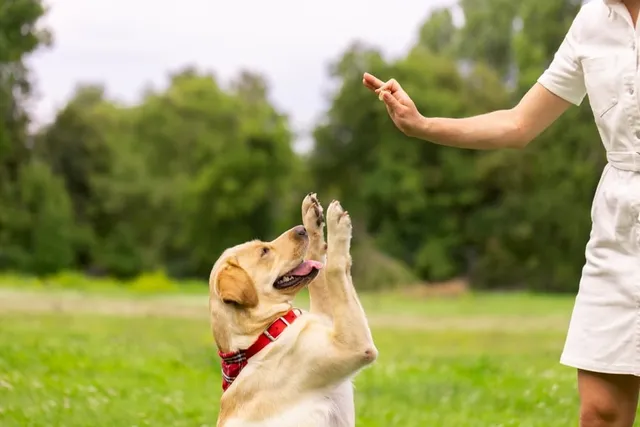
Once your dog learns to pay attention to you, you can teach them basic commands using visual signals. Some deaf dog owners use American Sign Language or simplified versions of the signs for commands such as sit, stay, and come. You can also choose your own hand signals.
The key is to be consistent about using whichever hand signals you choose. These gestures should also look different enough that the dog can tell what you’re asking them to do, even from a distance.
When teaching commands, follow the basic pattern of using a treat to lure the dog into position (sit, down, etc.) while giving the hand signal you decided on. When the dog does what you ask, give the marker/clicker signal, followed by a treat. This cycle teaches your dog to associate the hand signal with the reward.

6. Use Positive Reinforcement to Shape Behavior
Teaching a deaf dog to stop bad behavior takes more work and creativity. After all, you can’t just tell them “No!” Instead, you’ll need to use positive reinforcement to encourage the behavior you want while ignoring the ones you don’t.
If that sounds like advice you’ve heard for training a dog who can hear, you’re correct. It’s generally the most effective way to change a dog’s behavior in the long term. However, it takes a lot of patience that some dog owners don’t have.
Other Tips to Keep Your Deaf Dog Safe
Knowing how to communicate with your deaf dog is one of the most important steps you can take to keep them safe.
Here are a few more tips that may help:
Conclusion
Despite the challenges, living with a deaf dog can be a rewarding and positive experience. However, they’re not the right fit for every household. Deaf dogs usually do best with experienced owners. Families with young children should also be cautious about caring for a deaf dog. If you feel ready for life with a deaf dog, the tips you’ve learned can help you communicate effectively with your pet.
Related read: How to Train a Deaf Dog: Vet-Approved Tips for Success
Sources
Featured Image Credit: Jne Valokuvaus, Shutterstock
Expert dog care, straight to your inbox
Vet-reviewed advice, training tips, and the best of Dogster. Free, and you can unsubscribe anytime.
By signing up, you agree to our Terms & Conditions and Privacy & Cookies Policy.
Elizabeth Gray is a lifelong lover of all animals great and small. She got her first cat at 5 years old and at 14, she started working for her local veterinarian. Elizabeth spent more than 20 years working as a veterinary nurse before stepping away to become a stay-at-home parent to her daughter. Now, she is excited to share her hard-earned knowledge (literally--she has scars) with the readers. Elizabeth lives in Iowa with her family, including her two furry kids, Linnard, a husky mix and Algernon, the worldʻs most patient cat. When not writing, she enjoys reading, watching all sports but especially soccer, and spending time outdoors with her family.
Join the conversation
Ask a question, share your story, or send private feedback.