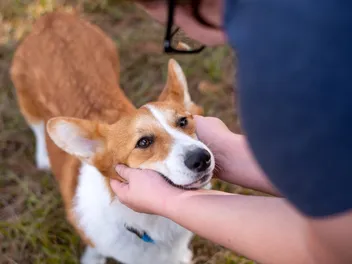
Do Dogs Like Baby Talk? Vet-Approved Facts & FAQ



In this article
It’s difficult to resist the urge to speak to your dog in what scientists call “Dog-Directed Speech.” Dog-Directed Speech is similar to “Infant-Directed Speech.” We exaggerate our enunciation and raise the pitch of our voices.
Scientists think it helps infants learn to speak. But does this have any bearing on dogs? Why do we feel the urge to do this with dogs? Baby talk with dogs generally results in positive reactions from them; it can lead to reassurance and positive reinforcement.

Dog-Directed Speech: What Is It and Why Do We Do It?
Dog-Directed Speech, or Companion Animal-Directed Speech more broadly, is the process of using a voice and hyper-articulating words, also known as baby talking or using Infant-Directed Speech, with your pet. While it may seem to be a nonsensical behavior, there are some scientifically notable features of Pet-Directed Speech.
While, at first, it may seem like Pet- and Infant-Directed Speech are different, they’re almost identical in pitch and intonation. Some scientists have suggested that there may be a link between the two; essentially the two are one comprehensive type of speech behavior associated with speaking to a creature that cannot talk back.
In some ways, it makes sense. Think of it this way. When we use Infant-Directed Speech, we use a similar intonation and hyper-enunciation; scientists think this helps infants learn to speak. Even though dogs don’t learn to speak English, they learn many of the words you say.
If you’ve ever had to spell out the word “walk” to prevent an overexcited pup from getting his hopes up, you’ll know that dogs learn a surprising amount of human speech and can understand and apply meanings to the words we speak to them.
With their ability to learn and apply meaning to words in mind, it makes more sense that we’d naturally gravitate to a slow, exaggerated voice as we use with infants. Dogs will better understand the words we say to them if we tell them like that because they’re cute and can’t talk, like infants!

Do Dogs Care About Dog-Directed Speech?
While it may seem like utilizing Dog-Directed Speech is just a scientific idiosyncrasy with no substantial effect, studies show that dogs care a lot more about Dog-Directed Speech than you might first think. For example, Companion Animal-Directed Speech has been tested with dogs, cats, and even horses. All animals tested showed positive reactions to Companion Animal-Directed Speech compared with animals spoken to using Adult-Directed Speech.
To test the animals’ reactions to Companion Animal-Directed Speech, the researchers used two different “models” who played recordings of their voices, where one model used Adult-Directed Speech and one used Companion Animal-Directed Speech. Recordings of their voices were used to eliminate the risk of any differences in intonation, timbre, or tempo that would be present in live-spoken speech.
First, the researchers measured how long the dogs spent looking at the person “speaking.” Then, after the recording ended, the researchers let the dogs off the leash, and the time the dog spent with each person was monitored. Researchers found that dogs spent more time looking at the speaker using Companion Animal-Directed Speech and spent more time playing with them after the recordings ended.
Then the researchers conducted a second experiment to test whether the dogs’ interest was related to the topics being discussed. It naturally makes sense that a dog may be able to discern which words in our language are most important to him, like walks and treats.
In the second experiment, the dogs were played recordings of the people’s voices. The intonation and topic were incongruous: the Companion Animal-Directed Speech was about topics relating to human world “adulting” topics, while the recording with Adult-Directed Speech was about dog-related topics. The dogs showed no preference for either speaker. So, Dog-Directed Speech and dog-related topics are required for the dog to pay attention to it.
In other words, dogs know when they’re being spoken to, and not just by the name you call them. Dogs understand when you’re talking about subjects that they know relate to them, and when you combine that with Companion Animal-Directed Speech, dogs pay attention very closely.

Where Does This Behavior Come From?
It’s not entirely clear where the habit of Companion Animal-Directed Speech comes from or why it affects dogs positively. It may be that puppies are born with an innate preference for high-pitched noises, or perhaps they learn to associate the behavior with positive outcomes since it usually precedes things dogs like, such as walks or treats.
Past studies have also shown that while Companion Animal-Directed Speech and Infant-Directed Speech are similar, they have differences. For example, when using Infant-Directed Speech, speakers will profoundly exaggerate vowel sounds, often some of the more complex sounds for infants to learn. This is likely because we subconsciously know that our dogs aren’t learning to speak from us, and they don’t need to hear the prim and proper pronunciation.
So, rather than being a silly habit with no meaning, it seems we intentionally and subconsciously adjust our speech based on the potential language-learning abilities of the listener. If the listener can learn our language, we adapt to help them learn to speak it better. If they can’t, we adjust to help them learn to comprehend it better.
Does Baby Talk Help With Dog Training?
It’s not clear if baby-talk actively assists in dog training, but there’s one thing we can say for sure: your dog will pay more attention to what you have to say if you baby-talk at them. In addition, Companion Animal-Directed Speech showed positive effects on attention and socialization in dogs, cats, and horses. So, at a minimum, it’s making your dog pay more attention to what you’re saying during training sessions.


Final Thoughts
So, don’t stop baby-talking to your dog! When you do that, it helps them learn to comprehend our language and its mysteries better. Baby-talking also helps your dog while he learns to interact with other creatures. It provides them reassurance and positive reinforcement, helping them to become better-behaved citizens.
Sources
Featured Image Credit: VK Studio, Shutterstock
Expert dog care, straight to your inbox
News, insights, expert advice, and everything dog.

No spam — unsubscribe anytime.
By signing up, you agree to our Terms & Conditions and Privacy & Cookies Policy.
How useful was this post?
Click a star to rate. You can leave written feedback afterwards. (We read all feedback.)
I’m a freelance writer with a passion for animal science and technology. I love to share the world of animal science with people to help them make informed decisions for themselves and their pets. I’ve worked in professional pet care for over six years and realised I could help change the world of pet care by bringing the information people needed to them in terms they could understand. Knowledge is power and I love to help everyone become the most informed they can be.