10 Common Doberman Colors (With Info & Pictures)


Are you thinking about adding a Doberman to your household? They are known for being loyal, affectionate, and fearless, making them an excellent choice for a family pet.
As you are researching Dobermans, you may see some pictures of differently colored Dobermans. It may have made you think about the color you would like your Doberman to be. But what are all of the options available to you?
This article covers the 10 most common Doberman colors, as well as whether or not they fit in the breed standard.

The 10 Common Doberman Colors
1. Black and Rust

| Breed Standard Color | Yes |
Black and rust Dobermans are the traditional color combination of most Dobermans that you will see. It's the color that is typically portrayed on television and other media. Black and rust will also be the easiest to find, likely making this option cheaper when it comes to adopting or breeding.
2. Red and Rust

| Breed Standard Color | Yes |
Red and rust Dobermans are also sometimes referred to as chocolate Dobermans. The rusty color can appear redder or browner in different lighting, leading to the chocolate reference.
Though it is less common than the black and rust Doberman, the red and rust Doberman is still easy to find. They are considered a part of the breed standard, and locating a breeder should not be a problem.
3. Blue and Rust

| Breed Standard Color | Yes |
Dobermans in blue and rust colors are rarer than some other color combinations. Although the blue and rust coloration is accepted in the American breed standard, it isn't recognized by the FCI standard used in most of Europe.
Although they are called blue and rust, some may consider this dog to be silver, charcoal, or even purple.
4. Fawn and Rust
| Breed Standard Color | Yes |
If you have found a fawn and rust Doberman, consider yourself lucky. These Dobermans are the least common of the accepted breed standard colors.
Like the blue and rust Doberman, the fawn and rust Doberman isn't recognized by the FCI standard used in most of Europe.
5. Melanistic Black
| Breed Standard Color | No |
The melanistic black Doberman is the first of the Doberman colors that’s rejected as a breed standard. This is because the dogs look entirely black, with rust markings that are missing or too dark to see, and clear rust markings are a standard requirement.
The melanistic color is caused by a rare genetic combination, making the Dobermans scarce. That, combined with the fact that they are disqualified from breed standards, makes them a difficult dog to get a hold of.
6. Melanistic Red
| Breed Standard Color | No |
Melanistic red Dobermans are incredibly rare. They are so rare that some claim they are an example of crossbreeding rather than a result of pure Doberman breeding.
Due to their rarity, they can be more expensive than the more conventional Dobermans. They may also be at a higher risk for inbreeding, as some irresponsible breeders may prioritize the melanistic red gene over health.
7. Melanistic Blue
| Breed Standard Color | No |
When a Doberman has an overproduction of melanin and two copies of the color dilution gene, the melanistic blue Doberman is born. These Dobermans are essentially melanistic black Dobermans whose color has faded.
Like the other melanistic Dobermans on this list, the melanistic blue is incredibly rare, sometimes pricey, and at risk for inbreeding.
8. Melanistic Fawn
| Breed Standard Color | No |
Melanistic fawn Dobermans are lightly colored dogs that are often compared to the color of deer. As expected, they are incredibly rare and can be costly.
They're similar to the melanistic blue Doberman but are a melanistic red Doberman with a diluted color. They are also not considered a part of the breed standard.
9. White
| Breed Standard Color | No |
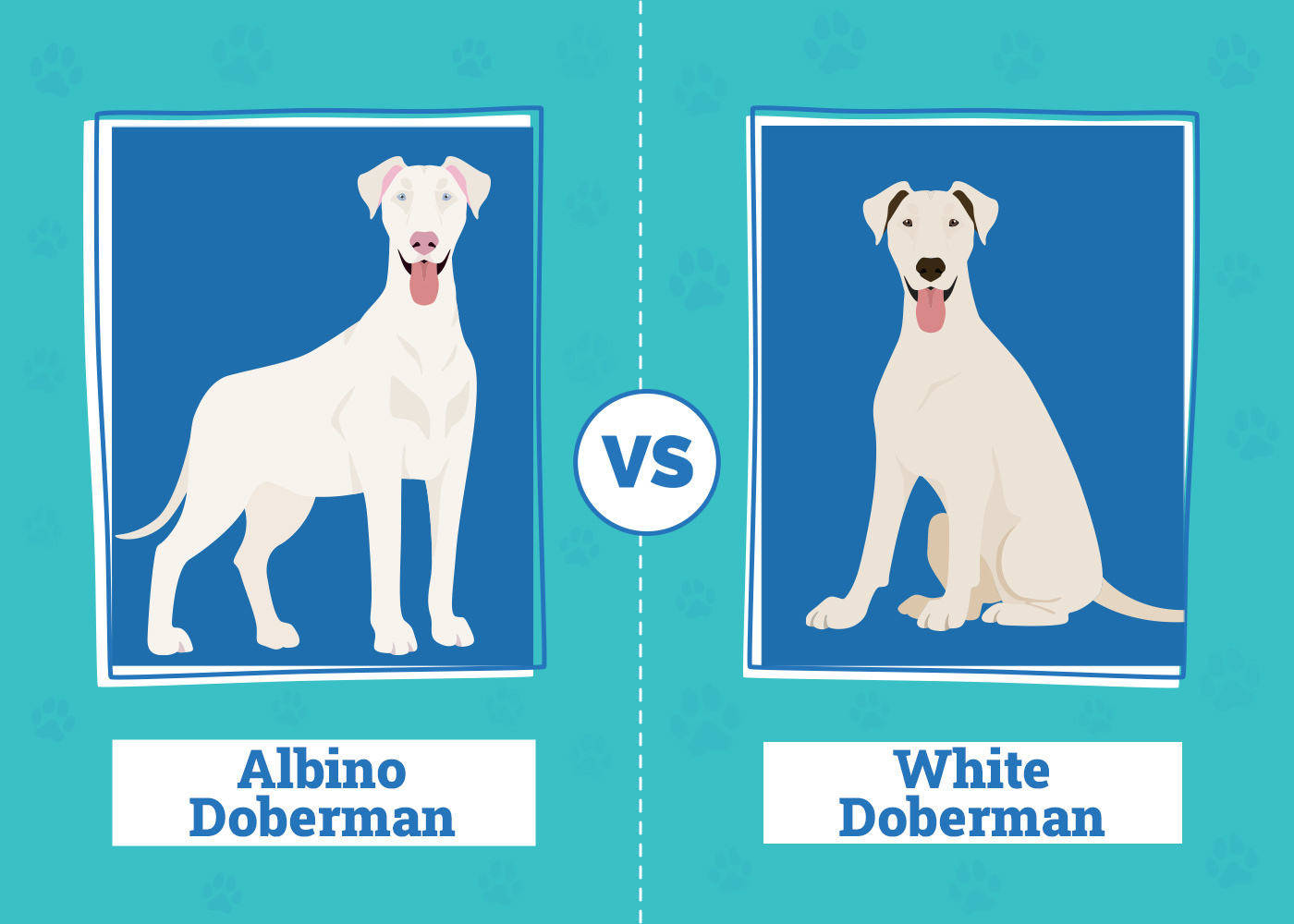
White Dobermans, or cream or ivory Dobermans, have a form of albinism. They still produce some pigmentation, preventing them from being fully albino, but the limited pigmentation removes most of their color.
The white Doberman is controversial. Some believe intentionally breeding a white Doberman is unethical since they have health risks. White Dobermans often have eyesight problems, sensitivity to bright light, and a higher risk of skin and eye tumors. It is recommended that all white Doberman owners do a thorough health check of their dogs regularly.
10. Albino

| Breed Standard Color | No |
Albino Dobermans have no pigmentation whatsoever. The easiest way to distinguish a white Doberman from an albino Doberman is to look in their eyes. White Dobermans have blue eyes, whereas a fully albino Doberman has pink eyes.
However, no fully albino Dobermans have been known to exist. Theoretically, they are a genetic possibility, but none have ever been recorded. Any health issues the white Doberman may have will undoubtedly be present in the albino Doberman.
Conclusion
Dobermans are majestic, awe-inspiring dogs, and the variety of colors they can be found in only adds to their beauty. When on the hunt for a new puppy, it's essential to research your options and search for an ethical breeder to ensure your pet's best quality of life. Doing so will ensure that your Doberman can live the happiest life possible.
Related Reads:
Sources
Featured Image Credit: elis aksenova, Shutterstock
Expert dog care, straight to your inbox
Vet-reviewed advice, training tips, and the best of Dogster. Free, and you can unsubscribe anytime.
By signing up, you agree to our Terms & Conditions and Privacy & Cookies Policy.
Pets are Jordyn’s passion, especially cats. Whenever she has the opportunity, she loves to learn about animals and share her knowledge with everyone. She is devoted to her mischievous tabby cat named Jack and works hard to buy him his favorite toys and treats. Discovering new ways to better care for her pet is always on the top of her to-do list, and she is eager to help pet parents everywhere who have similar pursuits. In her free time, she loves to write, read, and take long walks. She has a creative spirit, which often helps her to come up with funny cat names.
Join the conversation
Ask a question, share your story, or send private feedback.