Dogster is reader-supported. When you buy via links on our site, we may earn a commission at no cost to you. Learn more.

Dog Nutrition

Thyme for Dogs: Our Vet Explains Potential Benefits, Uses & Risks

Dr. Luqman Javed
Written and fact-checked by Dr. Luqman JavedVet Approved
Dr. Luqman Javed
Reviewed & Fact-Checked byDr. Luqman JavedDVM (Veterinarian)
Dr. Luqman (also known as Dr. Lucky) grew up with an extreme fondness for animals of all kinds. By becoming a veterinarian, he turned his childhood dream into reality. Now, his goals are focused on providing help to dogs all around the world by helping dog owners to understand their canine friends better to ensure the best quality of life for them. His passions are wildlife, exotic pets, pet owner education, and animal welfare. He graduated with his DVM from the Universiti Putra Malaysia in 2020. Dr. Lucky has experience with a variety of animal species and has decades of personal experience with keeping many different types of exotic pets, such as turtles, hamsters, freshwater fish, chickens, songbirds, and parrots (and he has extensive skills in training parrots, too).View authorThe information is current and up-to-date in accordance with the latest veterinarian research. Learn more
Updated on July 10, 2026
Share
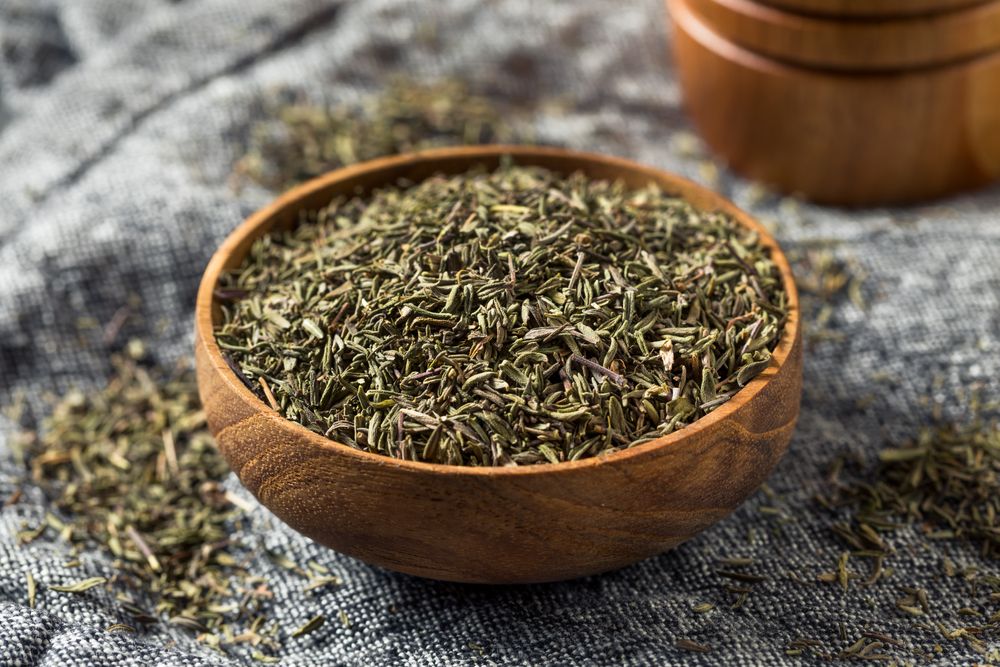
Dry Organic Thyme Spice in a Bowl

Thyme (Thymus vulgaris) is a popular spice that many people keep in their homes. You can even grow it in the garden or indoors to have a fresh herb to use in your dishes. Many people wonder if this herb is safe to give your dog, and the short answer is yes. Your dog can eat small portions of thyme and may receive some health benefits from it. However, the primary reason it’s often added to a dog’s diet is for providing some vitamins and minerals; at times, this is necessary to ensure a diet is complete and balanced for dogs.

Keep reading as we look at the potential benefits and precautions needed when this herb is used in a dog’s diet.

divider dog faces oct 2024

Benefits and Uses of Thyme for Dogs

The full extent of the potential benefits of thyme for dogs aren’t completely understood. However, thyme is a popular medicinal herb when it comes to dogs.1 That being said, it’s often used in conjunction with other herbs in experiments and herbal veterinary prescriptions.2 As such, the benefits of thyme should be interpreted cautiously.

It’s important to note that the digestibility of herbs by a dog’s digestive system isn’t comparable to that of a humans, and therefore, the benefits thyme offers to us wouldn’t necessarily be seen in dogs.

Vitamins & Minerals

Thyme’s primary use in diets for dogs is the fact that it can offer a slight improvement in the vitamin and mineral profile of a diet. Cumulatively, thyme offers 10 vitamins and minerals (in varying amounts). However, it’s important to note that the inclusion of thyme isn’t just going to improve the nutritional yield of the diet; depending on the other ingredients, the balance of the diet will change and the yield of some other nutrients will decrease.

Image Credit: Pixabay

Antimicrobial Properties

Thyme oil has been used with some success in a study involving the microbes found in dogs with otitis externa, an inflammation of the outer ear.3 As such, it might have potential benefits against some microbes. That being said, it’s very important to note that the experiment was done in petri dishes in a lab, not on actual dogs. Furthermore, thyme oil wasn’t the sole antimicrobial used in the study. The study also concluded that additional research was necessary to further explore the potential of thyme as an antimicrobial agent.

Get Free Dog Food Recall Alerts!

Stay on top of dog food recalls

Flea Control

A study conducted with dogs which attempted to use an herbal product as a flea preventive incorporated thyme extract as one of the ingredients in the herbal product. This study found improvements in the amount of fleas on dogs involved in the experiment. Nonetheless, the product didn’t completely eliminate fleas, and the effectiveness of the herbal product was only seen after a duration of 5 months (after which there were still fleas on the dogs used in the study).

Therefore, if your dog has a flea infestation, relying on herbal remedies will not guarantee immediate results (the dogs in the study showed no benefits for the first 30 days), and such products may not completely eliminate fleas either.

Image Credit: kobkik, Shutterstock

Gastrointestinal Protectant

Prolonged use of NSAIDS (non-steroidal anti inflammatory drugs) can have negative effects on the digestive system of a patient. A study which attempted to find gastrointestinal protectants for dogs found thyme to be a useful herb – however, it was only effective when used in conjunction with other medications investigated in the study. In addition, thyme was a part of an herbal product (which contained other herbs too); therefore, to attribute the effect of the protocol solely to thyme wouldn’t be accurate.

This study also highlights the importance of not self-diagnosing and self-medicating a pet. A NSAID should only be administered to your pet on the instructions of a veterinarian, as they have side effects which must be accounted for.

Cancer Preventive

Thyme contains a flavonoid, baicalein, which was found to be somewhat effective at controlling a specific dog cancer (osteosarcoma) cells in one study. However, the study was not conducted on live dogs, but rather in petri dishes in a lab. The study also concluded that the exact mechanism by which baicalein helped against cancer needed further investigation. As such, your veterinarian should still be your first point of contact if you suspect that your dog has a sinister medical issue (knock on wood).

Image Credit: Ermolaev Alexander, Shutterstock
divider dog faces oct 2024

Risks of Thyme for Dogs

Though thyme is safe for dogs and seems promising in studies conducted on dogs thus far, it doesn’t mean you should go about adding thyme to your dog’s food without any rhyme or reason, and certainly not without first consulting a veterinary or animal nutritionist. Doing so is considered risky, for several reasons.

The Potential Risks of Thyme

  • May Throw Off Nutritional Balance – As mentioned earlier, thyme (and in fact, any herb) will “interact” with the other ingredients in your dog’s diet, and it can alter the total yield of certain nutrients. When used inappropriately, it will most likely lead to nutritional deficiencies in the diet.
  • Smoke, But No Fire – The current science involving thyme seems to show potential. However, much of the potential benefits of thyme remain unproven and as such, there is a possibility that it might not be as beneficial as one may assume.
  • Rejection from Your Pet – Though you may view thyme as beneficial for your dog, your dog might have different ideas. Your dog may simply refuse to eat the food with thyme sprinkled on it. In fact, this is a very important point many people seem to miss; no matter how beneficial an herb is, if your dog doesn’t enjoy it and refuses to eat it, the benefits obviously wouldn’t transfer to your pet. Trying to force feed your pet isn’t advised, as it can lead to issues (both behavioral and medical).
  • Digestive Distress – Consumption of thyme for the first time or in large quantities may result in digestive distress for your dog. These often manifest as either diarrhea or vomiting episodes, and unfortunately, it’s possible that your dog may experience both of these undesirable issues simultaneously.
  • Digestibility – The digestibility of plant matter in dogs isn’t as efficient as animal matter, especially with regards to protein. As such, dogs wouldn’t derive as much protein from thyme as they would from animal sources.
  • Quality vs Quantity – The thyme extracts used in studies involving dogs are often formulated in labs with other herbs and are usually in an entirely different concentration than what is found in natural thyme you would grow or purchase at a grocery store. As such, adding a certain quantity of thyme to your dog’s diet may not necessarily offer them the benefits you think IT would, as it may not even pack the relative qualitative “punch” of a product manufactured in a lab.

The risks associated with thyme are considerable. In fairness though, many of these risks are associated with other herbs too. In essence, the best way to safely incorporate thyme into your dog’s diet is at the discretion of a veterinarian or an animal nutritionist.

Image Credit: SeventyFour, Shutterstock
divider dog faces oct 2024

Conclusion

Thyme is safe for dogs and may offer them some health benefits. However, many of the benefits of thyme are considered as potential as opposed to definitive right now. The promising studies involving dogs which included thyme in the research model have called for further research, and rarely used thyme as the sole herb in their study methodology.

The inclusion of thyme (or any herb) into a pet’s diet does require the input of a trained professional (a veterinarian or an animal nutritionist), as it isn’t a herb that will offer only benefits; it may, in fact, interact unfavorably with the overall yield of some nutrients in the diet as a whole.

Related Dog Reads:

Sources

Featured Image Credit: Brent Hofacker, Shutterstock

The Dogster Newsletter

Expert dog care, straight to your inbox

News, insights, expert advice, and everything dog.

No spam — unsubscribe anytime.

By signing up, you agree to our Terms & Conditions and Privacy & Cookies Policy.

Click a star to rate. You can leave written feedback afterwards. (We read all feedback.)

Dr. Luqman Javed DVM (Veterinarian)
Authored by

Dr. Luqman Javed DVM (Veterinarian)

5 Herbs That Are Good for Dogs: Vet-Verified Safety & Benefits

5 Herbs That Are Good for Dogs: Vet-Verified Safety & Benefits

Adding herbs and spices to our meals not only enhances the flavor, but many of them also have various health advantages. So, if we can benefit from specific he…

Kathryn Copeland
By Kathryn Copeland · 2 weeks ago
Can Dogs Eat Sage? Vet Approved Facts & FAQ

Can Dogs Eat Sage? Vet Approved Facts & FAQ

Sage is a commonly used herb in the kitchen that flavors foods and is also used in essential oils, creams, ointments, and medicines. If you cook with sage or h…

Nicole Cosgrove
By Nicole Cosgrove · 4 weeks ago
Rosemary for Dogs: Our Vet Explains Safety, Potential Uses & Efficacy

Rosemary for Dogs: Our Vet Explains Safety, Potential Uses & Efficacy

Many dog owners wonder if they can add rosemary to a recipe for their pets or wonder about the use of essential oils on their pets. This may lead you to wonder…

Dr. Ashley Darby
By Dr. Ashley Darby · 3 weeks ago
What Seasonings Can Dogs Have Safely? 6 Vet-Approved Options

What Seasonings Can Dogs Have Safely? 6 Vet-Approved Options

We all know that seasonings can be extremely dangerous to dogs if they get a hold of the wrong ones. Knowing what's in your spice cabinet can really help you p…

Ashley Bates
By Ashley Bates · 4 weeks ago

Can Dogs Eat Dill? Vet-Verified Nutrition Facts & Preparation Ideas

Dill (Anethum graveolena) is a member of the parsley family, Apiaceae, and is safe to feed to dogs, in moderation. There is no evidence that indicates that dil…

Matt Jackson
By Matt Jackson · June 17, 2026
Can Dogs Eat Dill? Vet-Verified Nutrition Facts & Preparation Ideas

Should You Add Olive Oil to Your Dog’s Food? Read This First

“Healthy for humans” doesn’t always mean healthy for dogs. If you drizzle olive oil on your salad or use it to cook nearly everything, you’re not alone. This M…

Dan Seymour
By Dan Seymour · June 16, 2026
Should You Add Olive Oil to Your Dog’s Food? Read This First

Can Dogs Have Cumin? Vet-Reviewed Nutrition Facts & FAQ

When you think about giving your dog a bite of your food as a treat, you probably don’t think about what spices the food contains. You should, though, as some…

Misty Layne
By Misty Layne · June 17, 2026
Can Dogs Have Cumin? Vet-Reviewed Nutrition Facts & FAQ

4 Benefits of Turmeric for Dogs (Based on Science)

Dogs are like humans. They are susceptible to various diseases that can cause joint pain and inflammation and can also benefit from this yellow spice. We have…

Nicole Cosgrove
By Nicole Cosgrove · June 17, 2026
4 Benefits of Turmeric for Dogs (Based on Science)

Can Dogs Eat Cardamom? Is It Safe? Vet Reviewed Dietary Guidance

If you're a dog owner and a fan of flavorful spices, you might be wondering whether it's safe to share your love for cardamom with your furry friend. Cardamom…

Nicole Cosgrove
By Nicole Cosgrove · June 29, 2026
Can Dogs Eat Cardamom? Is It Safe? Vet Reviewed Dietary Guidance

Can Dogs Eat Fennel? Vet-Verified Facts & Info

Fennel is commonly used in salads, soups, and stews and has been widely used for health purposes in people, including for heartburn, bloating, and colic in inf…

Nicole Cosgrove
By Nicole Cosgrove · June 29, 2026
Can Dogs Eat Fennel? Vet-Verified Facts & Info

Apple Cider Vinegar for Dogs: Vet-Approved Uses, Safety & Effectiveness

Apple cider vinegar and home remedies are extremely popular right now, and for good reason. They’re usually affordable, and some have actually been proven to w…

Cassidy Sutton
By Cassidy Sutton · June 29, 2026
Apple Cider Vinegar for Dogs: Vet-Approved Uses, Safety & Effectiveness

Probiotics for Dogs: Vet-Reviewed Benefits, Risks & Considerations

You probably know that probiotics are good for your gut health and may have seen them advertised on yogurt. As a dog owner, however, did you know that probioti…

Codee Chessher
By Codee Chessher · June 17, 2026
Probiotics for Dogs: Vet-Reviewed Benefits, Risks & Considerations

Love Dogs? So Do We! Join the Dogster Community

Stay informed with expert pet care insights delivered straight to your inbox! Discover professional guidance on animal behavior, feeding tips, trusted product picks, and much more.

You may opt-out at any time. View our Privacy Policy for more information.

The Dogster app on a phone