Male vs Female Akita: The Differences (With Pictures)

In this article
So, you're interested in the gorgeous and loyal Akita. We can't blame you! These dogs are not for the faint of heart but make fantastic additions to homes that know how to care for them. If you have already selected the breed but need to decide whether you should buy a male or female, know that there are additional things to consider.
In this article, we discuss an overview of what an Akita is like as a whole and the differences between the two sexes. Hopefully, you can use this as a road map to lead you to your newest family member!

Visual Differences

At a Glance

Akita Breed 101
The Akita Inu is a visually stunning, incredibly protective Japanese breed. There are two types: the American Akita and the Japanese Akita. The main difference here is size. American Akitas are significantly larger than their Japanese counterparts. Deciding between the two will come down to preference. However, when it comes to personality and overall care, they are parallel with one another.
Here, we specifically discuss what owning a male and female Akita is like. Since this is a particularly challenging breed, we want to touch strongly on the negative aspects so you can make the best decision for your living situation.
These dogs are incredible to own, as they are remarkably intelligent, intensely faithful companions. But they are definitely only compatible with certain lifestyles. Let's get into it!

Male Akita Overview

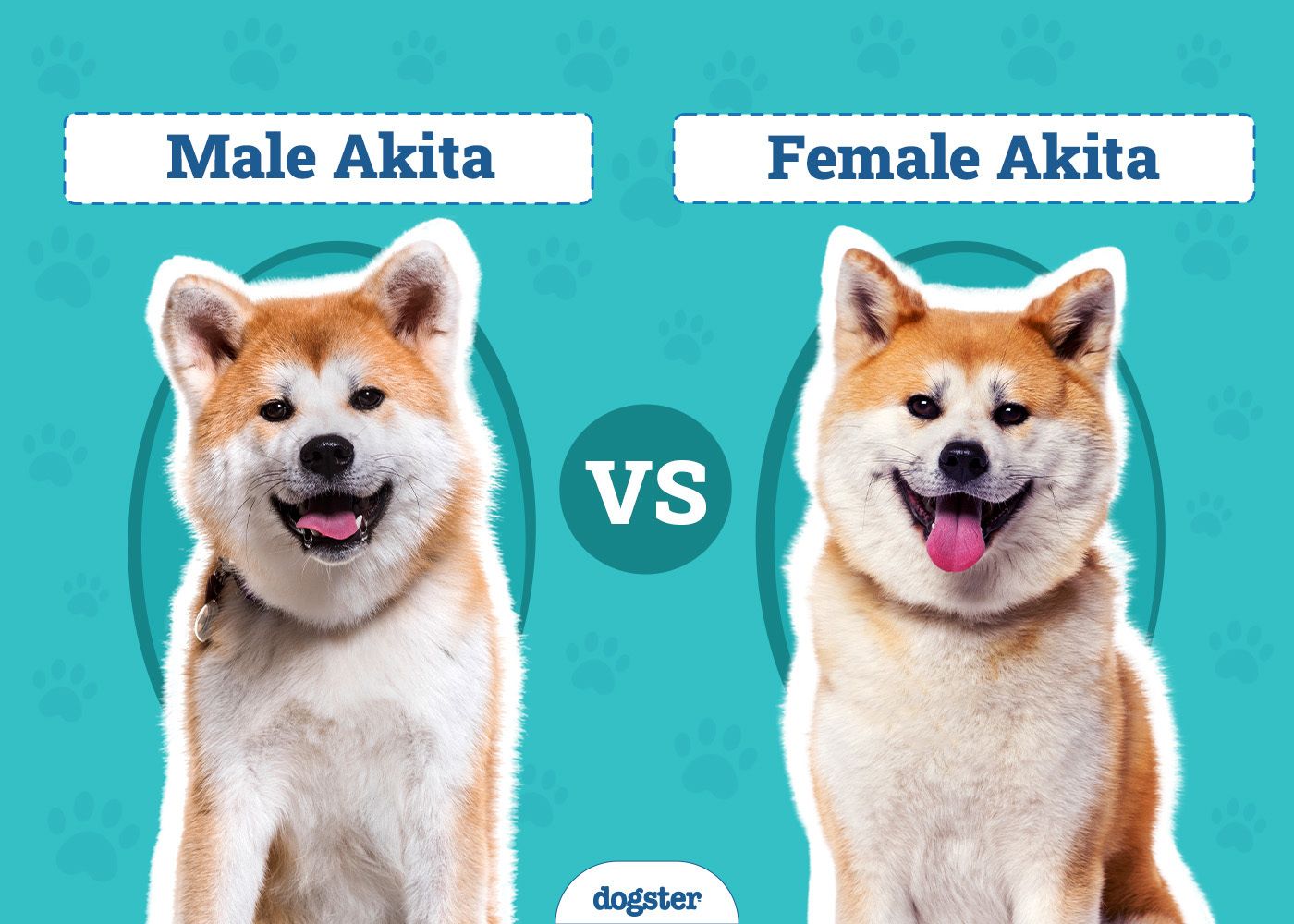
Male Akitas are far more substantial in size than their female counterparts, but what other differences can you expect?
Personality / Character
Male Akitas are incredibly friendly as puppies. They will be social, outgoing, and playful. But this can be seriously misleading for some owners. As your Akita begins to grow, some of their aloofness and territorial nature begin to come out.
Male Akitas tend to be dominant, challenging your authority and any other dogs in the home. It is incredibly important to be an experienced dog owner who can maintain a firm hand when training.
The male Akita must learn early on how the household hierarchy works. They will be bossy, demanding, and even disobedient if you let them. However, they will respect the head of the household.
While highly loyal and protective of family, they don't share the same sentiment toward strangers. Male Akitas tend to be a little more aggressive and untrusting of strangers and of their female counterparts, which means neither sex likes outsiders. While males are dominant, they tend to have more tolerance of the same sex than females.

Training 🎾
Training a male Akita is not for the faint of heart. These dogs are incredibly challenging to manage, as they love to test authority at every turn. Early training is absolutely crucial for the success and future relationship between the two of you.
Your Akita must learn to respect your authority and your boundaries. If you let an Akita rule the roost, they certainly will do so. Males tend to put up more of a power struggle than their female counterparts.
Often, even experienced dog owners find it difficult to maintain an Akita's temperament correctly. They often turn to the help of professionals to receive proper obedience training and learn appropriate manners.
Early socialization is also crucial for Akitas during their training phases. They should be exposed to as many different situations as possible to create a well-rounded personality. As your Akita matures, taking them around other situations can be challenging.
Each individual Akita will be different, but they almost always require pervasive training and often professional intervention. An inappropriately trained Akita can be hard to manage and even dangerous in some situations.

Female Akita Overview

Many things about female Akita will mirror their male counterparts. But that doesn't mean that they are created equal. Owning a female Akita is quite different from owning a male.
Personality / Character
Female Akitas make lovely additions to the right homes. When they are puppies, they tend to be playful and lovable. As they age, their aloofness starts to show through, and they tend to dislike strangers very much.
However, many female Akitas have a powerful maternal instinct, even with human children. So, they tend to carry a strong loyalty and make it their mission to protect and devote themselves to their owners.
Female Akitas tend to be less stubborn than their male counterparts, but they can have their fair share of downfalls. For example, if you have another female in the home or plan to get another female dog, you might want to get a male instead. Female Akitas are notoriously same-sex aggressive. They want to rule the roost, and they will be complicated to get along with and even sometimes violent with other females in the home. Often, owners in this predicament have to look at severe measures, including rehoming one of the dogs to create peace.
However, if you know of this possibility before getting the female Akita, you can always plan to get a male or only get an Akita if you already have existing males in the home or no other dogs at all.

Training 🎾
Since female Akitas tend to be less stubborn and rigid than their male counterparts, training is often easier in specific categories. For example, female Akitas tend to be more eager to please. They tend to be more attentive during training, and you can also typically start earlier than males.
It is not because female Akitas are necessarily more intelligent than males; it's simply because you can keep their attention at a younger age. Male Akitas are more difficult to convince during times of intense focus.
The females absolutely require an experienced owner to guide them. If you feel you need more confidence in your abilities, we highly recommend receiving professional training for your female Akita. After all, they pose different challenges than their male counterparts, and getting a professional to guide you can be helpful. However, overall, they should give you less trouble in this area of care.
And the Winner Is…
Now that you have a little more insight into each sex, let's get down to brass tacks. Here's a side-by-side comparison of all the pros and cons of each and which wins each category. The verdict: It depends on your lifestyle and preference!
More Substantial: Males
If you're looking for the bigger and scarier of the two, the male certainly wins this category. Males are always at least 10 pounds heavier than their female counterparts and are certainly bulkier and have heavier muscle tone.
So, if you're looking for a robust, intimidating-looking dog, the male wins this category hand over fist.
Easier to Train: Females
Even though males and females come up with their own challenges for training, females are easier. Males have a powerful dominance factor that can make it extremely rough for first-time owners.
So, if you are looking for the easiest to train, we have to recommend the female in this particular category. However, remember that females can be difficult in their own ways.

Aggression Problems: Both
Any Akita owner will tell you that one of the most challenging aspects of having these beautiful dogs is their inclination toward aggression. Males are more aggressive toward other pets and strangers who don't reside in the home.
Conversely, females tend to be a little more aloof with strangers and aggressive toward dogs of the same sex. So, aggressive factors are in play on both ends of this equation. If you have a female in the home already, we highly suggest getting a male instead.
However, if this category doesn't apply to you, understand that they both will come with their share of aggressive tendencies that must be curbed with early socialization and proper training.
Loyalty: Both
Something positive about Akitas is that they are definitely loyal to a fault. These dogs will imprint on their families and remain completely devoted as long as they live.
They certainly come with their fair share of challenges that take a unique living situation to manage, but they will give you love and affection until their dying day.

Which Sex Is Right for You?
Hopefully, after reading this, you understand the challenges and benefits of owning male and female Akitas. While either can be an incredibly amazing dog to have in your care, each has their own quirks.
We want to stress again that aggression is a huge problem with this breed. Females tend to dislike living with other females, and both males and females can dislike strangers and strange dogs. Due to their prey drive, they are often incompatible with cats and smaller pets.
So, before choosing a male or female, ensure your experience level and living situation is compatible with this breed.
Featured Image Credit: Shutterstock
Expert dog care, straight to your inbox
News, insights, expert advice, and everything dog.

No spam — unsubscribe anytime.
By signing up, you agree to our Terms & Conditions and Privacy & Cookies Policy.
How useful was this post?
Click a star to rate. You can leave written feedback afterwards. (We read all feedback.)
Ashley Bates is a freelance dog writer and pet enthusiast who is currently studying the art of animal therapy. A mother to four human children— and 23 furry and feathery kids, too – Ashley volunteers at local shelters, advocates for animal well-being, and rescues every creature in need. Her mission is to create awareness, education, and entertainment about pets to prevent homelessness. Her specialties are dogs and cats.