My Dog Is Bleeding After Birth: Vet-Explained Risks, Signs & Next Steps

In this article
When a dog gives birth, their human carer usually puts a lot of thought into getting ready for the delivery and where the puppies are going to be put when they arrive, but quite often we don’t think about what could go wrong during or after delivery. Becoming familiar with the normal, and not so normal, will not only prepare you for if things go wrong but will also allow you to recognize when things are proceeding normally.
You probably already know that some bleeding after birth is quite normal, but how much is too much? Post-partum bleeding can last for up to 7 days. The amount of blood should gradually decrease and will appear darker and more clotted over that time.
Let’s take a closer look at what sort of post-whelping bleeding is normal, and when you should call your vet.


Some Bleeding Is Normal After Giving Birth
The process of giving birth is a beautiful thing…it can get pretty messy! Leading up to, during, and after whelping, you may notice discharge from your dog’s vulva, in a range of colors and consistencies; some are normal, some are worrying. Blood, mucus, and green discharge are to be expected, while foul-smelling, black or brown discharge or pus are signs that there is something wrong.
It’s perfectly normal for your dog to have some bleeding after they have given birth, particularly if they have delivered a lot of pups or very large pups. Dogs that have had a cesarean will also likely have some bleeding, even if they were spayed at the same time.
In the first few days, you may see fresh-looking blood mixed with some clear or greenish fluid. The amount will depend on the size of your dog, but a couple of teaspoons worth in a small dog would be considered normal, or 1–2 tablespoons from a larger breed.
The blood should become darker over the next few days; it might contain clots but should be decreasing in the overall amount. After 7 days, you should not be seeing much, if any, discharge at all. If you are still seeing discharge, you should call your vet.
Why Do Dogs Bleed After Giving Birth?
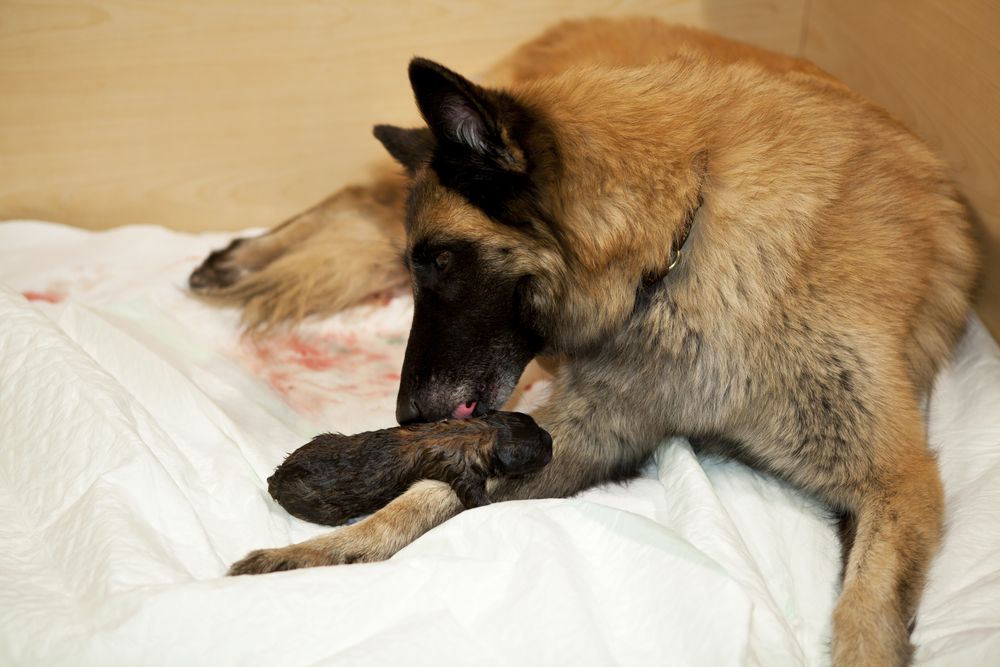
When humans give birth, the placenta is usually delivered after the baby has arrived. Puppies are normally born still inside the placental sac, which the mother usually removes by chewing and licking. Each sac was attached to the wall of the uterus, and when it is time to be born, the attachments break down, freeing the pups to be pushed toward the vaginal canal.
The placental attachment is almost entirely made up of blood vessels, so some bleeding is expected after even an uneventful birth. For each pup born, there is a separate implantation site in the uterus, so when there are lots of puppies, there are more sources of bleeding, which will be expelled over several days. If your dog has had a particularly difficult delivery (AKA dystocia), there may be additional bleeding from trauma to the cervix, vagina, or vulva.
Dogs that have gone into premature labor or had a cesarean before the placentas detached naturally are likely to have more bleeding because the attachment hasn’t broken down gradually, so there is more trauma as the pups break away from the wall of the uterus.
If your dog was spayed at the same time as the cesarean, it is not unusual to still have some bleeding, even though the uterus has been removed. This should be resolved within 2–3 days.

When Should I Take My Dog to the Vet?
If you are at all concerned about your dog or her pups, you should speak to a vet. Even if it turns out that there’s nothing to be worried about, it is far better to make an unnecessary phone call than risk the lives of your pet and her pups.
It’s always a good idea for a new mother and her pups to have a health check with the vet about a week after birth to make sure that everyone is healthy, but the following situations warrant immediate attention:

1. Your Dog Is Losing a Lot of Blood
Although bleeding after birth is normal, the blood should not be steadily flowing or pooling. If this is the case, you need to get to the vet immediately.
2. Your Dog Is Lethargic
It is not unusual for your dog to be a bit tired after giving birth, particularly if it has been a long or difficult delivery or if surgery was involved. However, if she continues to be quite lethargic 24 hours after the delivery, you should contact your vet for advice.
3. Your Dog Is Pale
Keep an eye on your dog’s mucous membranes (gums being the easiest to check). They should feel moist to touch, and look nice and pink - not dark, and not pale. You can also check her capillary refill time (CRT) by pushing on the gum and seeing how long it takes for the color to come back. A CRT of more than 2 seconds can indicate low blood pressure or hemorrhage.
4. Your Dog Starts Producing Smelly, Black, or Brown Discharge
This could be a sign of infection or retained placenta.

Final Thoughts
Some bleeding after giving birth is completely normal for your dog, but it should only be a fairly small amount, and it should gradually decrease over the next few days to a week. If your dog is losing a lot of blood, has a worrying discharge, or seems at all unwell, do not hesitate to get her to the vet. It is always better to be too cautious than too late.
See Also:
How to Keep Mother Dogs Healthy After Birth: Vet-Approved Postpartum Care Guide
Whelping Box for Dogs: What It Is & What Should Be in It (Vet-Approved)
Sources
Featured Image Credit: foto ARts, Shutterstock
Expert dog care, straight to your inbox
News, insights, expert advice, and everything dog.

No spam — unsubscribe anytime.
By signing up, you agree to our Terms & Conditions and Privacy & Cookies Policy.
How useful was this post?
Click a star to rate. You can leave written feedback afterwards. (We read all feedback.)
Dr. Karyn Kanowski, BVSc MRCVS (Vet)
Dr. Karyn is originally from Queensland, Australia, and has resided in the UK for the past 10 years. She graduated from The University of Queensland School of Veterinary Science in 2010, and also holds a Bachelor’s degree in Zoology. Karyn is passionate about using experience, evidence, and working with pet owners to provide the best solutions for pets. She also believes in making reliable information about animal health accessible to everyone. 5 cats and 4 dogs let her share their home with her and her husband, and when she is not practising as a veterinary surgeon, she spends her time writing, gardening, and cleaning up pet hair!