
Histiocytoma in Dogs? What It Is, Causes & Signs (Vet Answer)


In this article
View 3 More +Dogs can get all sorts of “lumps and bumps” that grow on them. Some occur in younger dogs, while most develop notice as dogs age. Many growths that develop on your dog may be harmless and nothing to worry about, but others may be aggressive cancers.
One of the more common types of growths we can see on the skin of dogs is a histiocytoma. It is a benign skin growth. Continue reading to learn more about this growth, what can cause it, and whether you should worry if your dog has one.

What Is Histiocytoma in Dogs?
Histiocytomas are benign or non-malignant skin growths that are fairly common in dogs. Benign means the mass will not spread to other organ systems or aggressively invade surrounding tissues. Benign growths can continue to grow and become large, but this typically happens slowly. Metastasis, or the spread to other organ systems and aggressive invasion of surrounding tissues, does not occur with benign growths.
Histiocytomas typically go away with time as well. This is because the body’s immune system will eventually identify the growth as foreign and trigger an immune response to destroy the tumor.

What Are the Signs of a Histiocytoma?
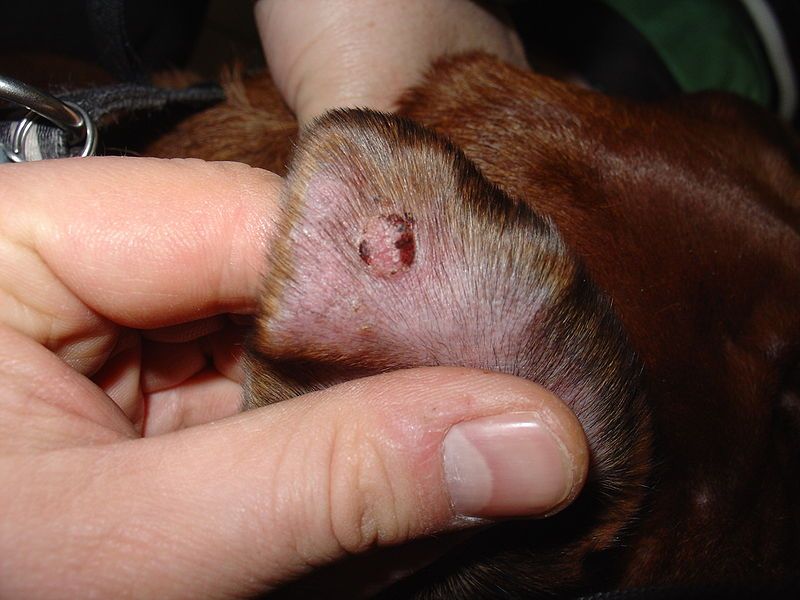
Histiocytomas are most common in dogs less than a few years of age. However, they can occur at any age and anywhere on your dog's skin. Typically, they will be rounded, button-like growths that are frequently pink and hairless. The growths come from the skin, not beneath the skin. They have a distinct appearance and border and are not associated with subcutaneous tissue or fat.
Histiocytomas usually are non-painful to the touch, have no odor, and will be freely moveable as the skin is moved beneath your fingers. Your dog may lick or chew at the mass simply because it is there, but the tumors do not tend to be itchy or cause irritation.
What Are the Causes of a Histiocytoma?
Histiocytomas are only associated with the skin. They originate from Langerhans cells, which are found in the epidermis. Langerhans cells help to capture foreign cells and “present” them to white blood cells for destruction. When the Langerhans cells group and grow together, they can form a tumor called a histiocytoma.
The good news is that these growths will eventually trigger your dog’s body to recognize them as foreign. Your dog’s immune system will eventually attack and destroy the tumors, resulting in their natural removal from the body.

How Do I Care for a Dog With a Histiocytoma?
The first thing you want to do when you find a new mass or growth on your dog is to document where it is. Take a picture of the growth and circle it with a Sharpie so that it can easily be found by your veterinarian.
Next, take your dog to your veterinarian to try and diagnose the growth. While histiocytomas are benign, there are other skin growths that can have a similar appearance and be malignant. For instance, mast cell tumors and melanomas are two types of potentially aggressive skin growths that can look and feel exactly like a histiocytoma. Because of this, your veterinarian will want to get a diagnosis to determine if your dog has a malignant or a benign tumor.
Depending on the location of the histiocytoma and its size, your veterinarian may be able to aspirate the mass with a needle (abbreviated FNA for Fine Needle Aspirate), put the cells on a microscope slide, and send it to a pathologist for cytology. Cytology means that the pathologist will look at those cells under a microscope to try and determine what they are and if they are cancerous.
Your veterinarian may want to remove the entire mass with a quick surgery and then send the entire growth to a pathologist for histopathology. Histopathology is when a larger piece of tissue is evaluated to determine if it is cancerous.
Your veterinarian will walk you through both options and depending on the size and location of the mass, they will determine which will be a better option for your dog.
Frequently Asked Questions (FAQ)
Are Histiocytomas Considered a Cancer?
A histiocytoma is considered a type of tumor but is not cancerous. A tumor is a growth that can occur anywhere on the body from cells that divide and grow more than they should. However, not all tumors are considered cancerous.
A histiocytoma is considered benign. For a tumor to be considered cancerous, it needs to possess the capability to spread to other tissues and parts of the body.
Do I Need to Have My Dog’s Histiocytoma Removed?
Typically, histiocytomas will go away on their own. Once your dog’s immune system identifies them as foreign, it will eventually trigger an immune response to destroy the mass. However, depending on the location and size of the histiocytoma, your veterinarian may choose to completely remove it with surgery so that it can be sent to the lab for diagnosis.
Summary
Histiocytomas are benign skin growths, most common in juvenile dogs. They will have a rounded, often pink, hairless appearance and be non-painful. Histiocytomas do not have to be surgically removed, though veterinarians will often remove them in order to obtain a diagnosis. Over time, histiocytomas will regress or shrink in size and eventually disappear completely.
Sources
Featured Image Credit: Histiocytoma | Image Credit: Joel Mills, Wikimedia Commons CC SA 3.0 Unported
Expert dog care, straight to your inbox
News, insights, expert advice, and everything dog.

No spam — unsubscribe anytime.
By signing up, you agree to our Terms & Conditions and Privacy & Cookies Policy.
How useful was this post?
Click a star to rate. You can leave written feedback afterwards. (We read all feedback.)

Dr. Kim Podlecki DVM (Veterinarian)
A graduate of The Ohio State University College of Veterinary Medicine, Dr. Podlecki has more than 12 years of experience working with small animals in the US. Dr. Podlecki worked almost exclusively in specialty medicine and emergency for more than a decade before transitioning to relief in both general practice and ER. Dr. Podlecki also owns her own consulting company (renewvetconsulting.com) with the focus of helping veterinary hospitals prioritize their staff to promote a healthier internal culture.