Are All Tumors Cancerous in Dogs? Our Vet Explains the Differences

In this article
A tumor—in a dog or another animal—is a swelling due to the unregulated growth of tissue cells. While that may sound bad, it doesn’t necessarily mean cancer. Tumors can either be benign (noncancerous) or malignant (cancerous). Knowing which type your dog has will require a veterinary diagnosis. It’s nearly impossible to discern a cancerous tumor from a noncancerous tumor just by looking at it, so it’s best to always see your vet any time you notice a new growth on your dog.

Tumors in Dogs
It is important to understand how different tumors form in the first place. The body is all about balance: If something goes in, something has to come out, and if you use up something, it has to be replaced, and so on.
The same principle goes for tissue growth. Normal tissue cells are actively dividing and reproducing to make new cells. Conversely, other tissue cells are dying and thus, need to be replaced. To maintain a healthy balance, bodily tissues need to reproduce a new cell to replace every dying cell. But sometimes, that balance gets out of whack, and the tissue cells start reproducing more rapidly than they are dying off. Therefore, you get an abundance of new tissue that creates a lump, mass, or tumor.
Depending on the type of cells that are overly multiplying, that tumor may keep to itself or look to relocate elsewhere in the body.

What Is the Difference Between Benign and Malignant Tumors?
Just because a group of cells gets overly excited and starts multiplying out of control doesn’t mean that they are cancerous. Different types of cells may simply multiply, creating tumors that stay put. These are benign tumors. They don’t spread to other parts of the body or even get into the healthy tissues around it. While they can grow large and displace surrounding tissue, they don’t actively invade it.
Conversely, malignant tumors tend to spread around. They will invade the surrounding tissues and disrupt their normalcy, often creating a great deal of damage. Certain ones also spread to other areas of the body, like the lymph nodes, liver, and lungs.
As you can imagine, a tumor that keeps to itself is less likely to destroy normal surrounding tissues than one that is more invasive. That’s the difference between noncancerous and cancerous tumors.
Malignant tumors need to be treated immediately to minimize their spread and resulting damage. That said, benign tumors will sometimes also need veterinary care.
If you are concerned about the health and well-being of your pet, seek veterinary advice for the best course of action.
Can a Dog Have a Non-cancerous Tumor?
It’s estimated that 25% of dogs will develop a tumor at some point in their lives and that malignant tumors are about twice as likely to develop as benign ones.1 Of course, this proportion depends on the type of tumor. For example, most skin tumors tend to be benign. So, it is completely possible for your dog to develop a tumor that isn’t cancerous.
Still, even noncancerous tumors may require treatment to prevent sometimes severe complications, so be sure to see your vet if you notice a new lump or bump on your dog.

How Do I Know If My Dog’s Tumor Is Cancerous?
Cancerous tumors can look similar to noncancerous tumors, so it’s suggested that you have your vet check out any new lump on your dog. While a veterinary diagnosis is needed to definitively determine whether a tumor is cancerous, there are a few telltale signs that you may recognize at home.
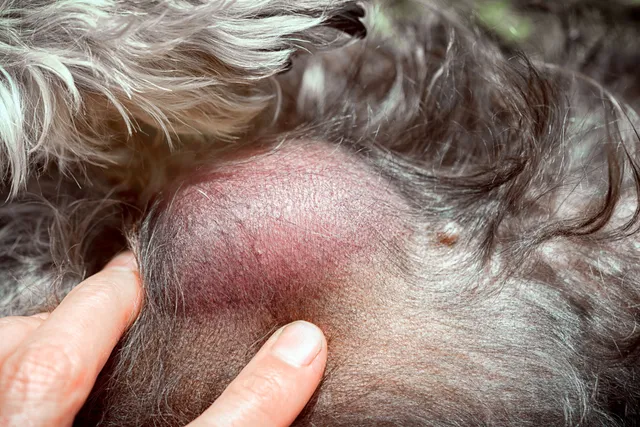
Malignant tumors tend to grow more quickly than benign ones. So, if you notice a small bump one day that turns into a large bump within a matter of days, it may be cancerous. They also tend to quickly change in color, shape, and texture. A skin-colored lump that suddenly turns black or purple may be a red flag for cancer. Discharge from the lump may be another possible indicator.
If you notice a new lump, particularly if it’s growing and changing rapidly, see your vet as soon as possible. They will be able to take a sample of the tumor to find out what cells are growing there and determine whether it’s cancerous. Sometimes this requires them to send a sample to a different lab for a second opinion.
Conclusion
Finding a tumor on your dog is never a good time. That said, while no tumor is considered normal or good, you should know that tumors can be either cancerous or noncancerous, and there’s no way to tell without the help of a veterinarian. So, be sure to seek professional help whenever a new lump or bump pops up or if you start noticing changes in your dog’s appetite, behavior, or elimination habits.
Sources
Featured Image Credit: Pickadook, Shutterstock
Expert dog care, straight to your inbox
Vet-reviewed advice, training tips, and the best of Dogster. Free, and you can unsubscribe anytime.
By signing up, you agree to our Terms & Conditions and Privacy & Cookies Policy.
Dr. Chyrle Bonk DVM (Veterinarian)
On top of caring for animals and writing for veterinary publications, Dr. Chyrle Bonk owns a small cattle herd! When she’s not busy with those things, she can be found somewhere enjoying the Idaho outdoors with her husband and two kids. Dr. Chyrle Bonk received her Doctor of Veterinary Medicine (DVM) from Oregon State University in 2010.
Chyrle has practiced in a mixed animal clinic for over a decade. She also writes for various veterinary websites and magazines, like Dogster!
Join the conversation
Ask a question, share your story, or send private feedback.