The therapeutic benefits of acupuncture are becoming more widely recognized and incorporated into mainstream medical treatment plans, a move that many would say is long overdue. So, it’s no surprise that acupuncture is also gaining popularity among pet owners and veterinary professionals. With its myriad potential applications and minimal risks, this ancient form of treatment is an option that’s worth considering and that should perhaps be offered more routinely.
If you have been wondering about veterinary acupuncture and how it might benefit your dog, you’re in the right place. We take a closer look at how it works, its potential applications and limitations for canines, and the risks that you need to be aware of.
How Does Acupuncture Work?
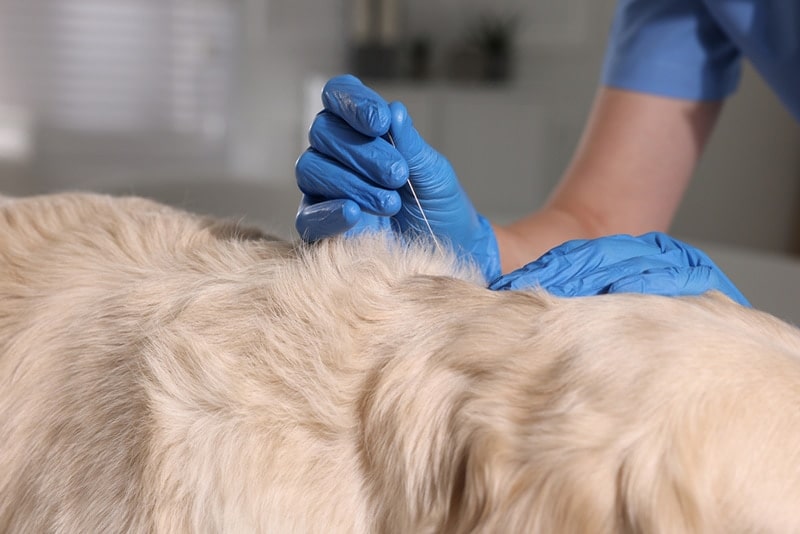
Acupuncture is a specific form of dry needling, which involves placing tiny needles into or through the skin without injecting a substance. Dry needling is a term typically used when the needles are placed close to or directly into painful areas like joints or muscles. What we often think of as “knots” in muscles are referred to as trigger points, tense bands of fascial tissue within the muscle, that respond to pressure.1
Dry needling techniques can target these points, providing powerful relief with minimal pressure and discomfort. Some trigger points relate directly to the tissue surrounding it, while others can have effects in structures that are deeper and farther away. Needles can also be placed in tender points near painful joints or into sore muscles to provide relief. Sometimes, these trigger points and tender points also relate to ancient acupuncture points, which is why dry needling and acupuncture are not really distinct entities, just different approaches.
What Do the Needles Do?
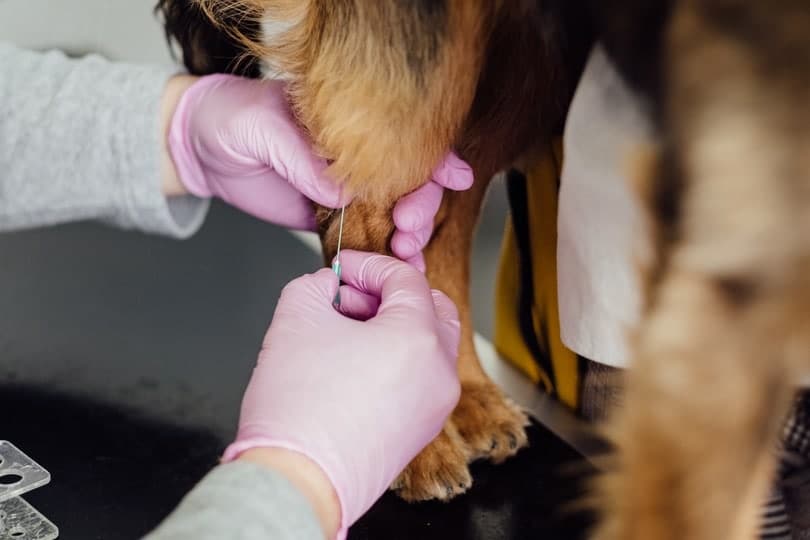
The main principle behind acupuncture is the release of nerve growth factor, which can help repair inflamed and damaged tissue in the immediate area and follow nerve pathways to have healing effects elsewhere in the body. Of course, when the Chinese emperor Huangdi wrote the text known as “The Yellow Emperor’s Classic of Internal Medicine” in 300 B.C.E., it is unlikely that he knew about the nerve growth factor.
Although the scientific knowledge and terminology weren’t there, the way in which acupuncture was used and described back then has parallels with how we understand it today. Ancient Chinese medicine was largely based on the treatment and manipulation of the body’s life force, known as Qi (pronounced “chee”), and it was believed that pain and disease occurred when a person’s Qi was blocked.
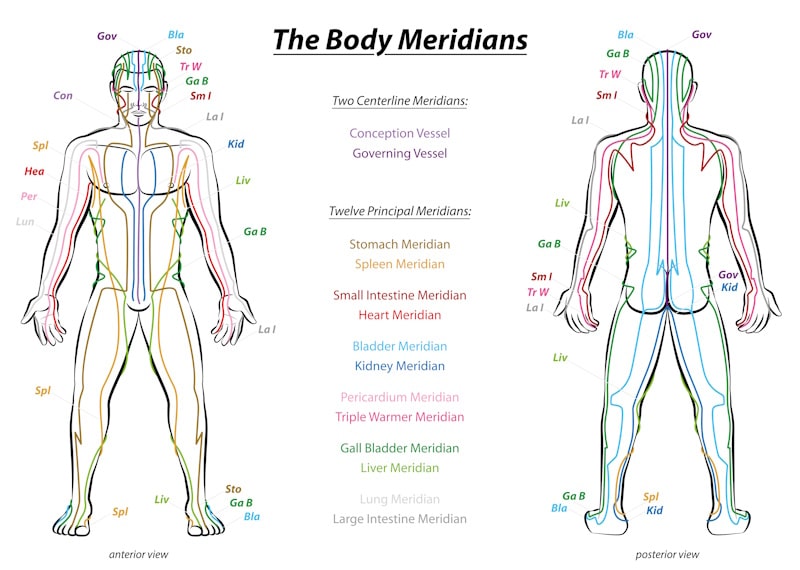
Acupuncture was how they unblocked the flow of Qi, which in many instances, led to improved health and the treatment of illness. Over time, they learned that needles placed in certain locations seemed to have effects on different parts of the body, which they mapped, creating 12 distinct meridians that cover the entire body.
Acupuncture Meridians and Embryology
Just as we can make a correlation between nerve growth factor and Qi, the concept of meridians is also reinforced by science. The idea that a point on the hand might somehow correspond to the intestines or the heart doesn’t seem so far-fetched if you take a look at how embryos develop. There is an early point of development, called gastrulation, when the cells start to differentiate into three main types: endoderm, ectoderm, and mesoderm.
- Endoderm becomes the gastrointestinal, respiratory, urinary, and endocrine (hormonal) systems.
- Ectoderm becomes the skin and nervous system.
- Mesoderm gives rise to the spine, skeleton, cartilage, skeletal muscles, kidneys, and blood.
When we consider how different organ systems are connected by cell origins and that the skin and nervous system originated from the same cell type, it’s not difficult to imagine how placing needles in certain spots on the outside of the body may indeed affect internal organs.

Can You Use Acupuncture on Dogs?
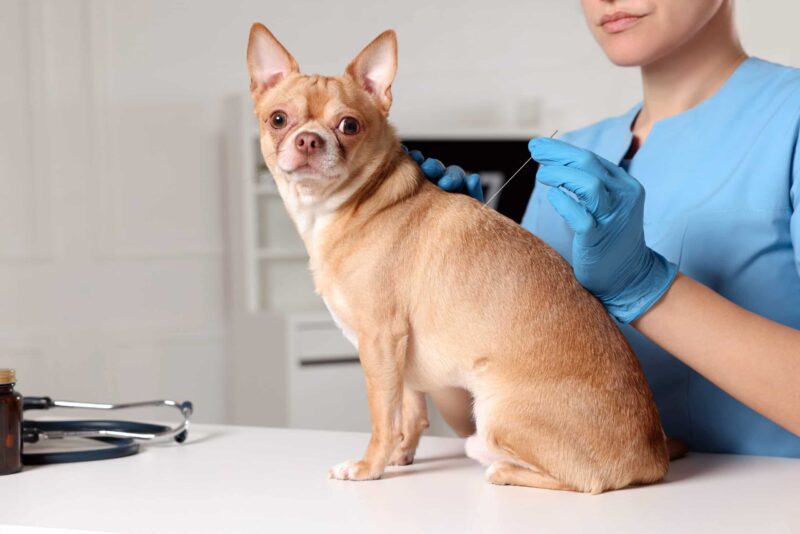
If you’ve ever had an acupuncture treatment yourself, you will know that unless the area being treated is particularly tender and sore, you usually don’t feel the needle, though you may feel a little pressure. It is the same when we treat dogs. Even fidgety, boisterous, or nervous dogs can be treated with acupuncture, and most dogs actually feel quite settled and relaxed once the treatment has started.
If your dog won’t tolerate having needles placed directly in a specific location, veterinary acupuncturists can take advantage of other points along the meridian or nearby trigger points, or even use points on the opposite side of the body (contralateral acupuncture points) to stimulate a therapeutic effect in the central nervous system, which can indirectly affect that area.
How Is Acupuncture Used on Dogs?
In most cases, your dog will be starting a course of acupuncture treatments, and the first session will be slow, with only a few needles placed. This gives the veterinary acupuncturist the opportunity to gradually introduce your dog to the needling process and allow them to see how they will respond.
Some dogs become tired the day after an acupuncture treatment, so the veterinary acupuncturist needs to make sure they don’t overwhelm them. Depending on the type of condition being treated, your dog may have a course of weekly sessions, which may be reduced to monthly or 3-month intervals.
Sometimes, acupuncture can be used as a one-off treatment, like treating a muscle spasm or helping wound healing. Acupuncture is most commonly used to treat canine arthritis or injury, but there are a range of potential applications, including:
- Osteoarthritis
- Stress
- Neurological disorders
- Soft tissue injury
- Gastrointestinal, respiratory, and urogenital problems
- Wound healing
We recommend you consult a veterinarian for the best advice on which would be the best treatment for your pup.
If you need to speak with a vet but can't get to one, head over to PangoVet. It's our online service where you can talk to a vet online and get the advice you need for your dog — all at an affordable price!
Acupuncture Should Be Used Alongside Modern Medicine, Not Instead of It
One of the biggest misconceptions about alternative or complementary therapies like acupuncture is that they should be used instead of more traditional modern medical treatments. But the best results for your dog will be achieved by using acupuncture in combination with regular veterinary treatments and therapies. For example, when managing a dog with arthritis, the use of anti-inflammatory medications is the most effective way to treat the pain of the condition and help reduce the inflammation and buildup of the arthritis in the joint.
However, many of the medications used to treat arthritis put pressure on the liver or kidneys, so doses need to be limited to prevent organ damage. Using acupuncture to treat arthritis has been found to improve mobility and reduce pain in many patients, though it may not be as powerful at controlling the inflammatory changes. Still, by using a combination of acupuncture and medical treatments, vets can achieve a better result than by using either modality alone.
Who Can Safely Perform Acupuncture on Dogs?
In most states, only veterinarians who have completed the required training by an authority recognized by the American Academy of Veterinary Acupuncture can perform acupuncture on animals. Not all vets or veterinary practices will offer acupuncture, so you may need a referral if this is something you would like to explore as an option.
Benefits of Acupuncture for Dogs
Incorporating acupuncture into a treatment plan has numerous potential benefits:
- Acupuncture can be used with almost any medication or illness (with the exclusion of conditions or medications that inhibit blood clotting).
- It has minimal side effects.
- Acupuncture can provide additional analgesia for patients on maximum medication doses.
- It can result in lowered doses of medications.
- Acupuncture is less expensive than some other treatments.
Risks of Acupuncture for Dogs
The biggest advantage of using acupuncture for dogs is that the risks are quite minimal, but there are a few things to be aware of:
- Pneumothorax: Although small, there is a risk that an acupuncture needle could pierce the lung and cause a pneumothorax (collapsed lung).
- Skin irritation/bleeding: There could be a local reaction to the needles, causing itching and redness (rare), and there may be a small amount of bleeding at the site (rarely noticed).
- Pain: The stimulation from the needles may result in pain and tenderness (usually short-lived).
- Lethargy: It is quite common for patients to feel sleepy the day after a treatment.
- Swallowed needle: It’s always important to count the needles in and out, as it’s not unheard of for a needle to disappear into a dog’s fur. There is a small risk of that needle being ingested if the dog licks their fur, but this risk is very low.
- No response: Some dogs simply do not respond to acupuncture.

Final Thoughts
Acupuncture has been used for thousands of years to treat an array of illnesses and injuries, and our modern understanding of the embryological origins of nerve pathways has allowed us to appreciate the science behind it. Increased recognition of its undeniable therapeutic benefits has led to acupuncture being embraced by more and more mainstream medical practitioners, including those in the veterinary field.
Not every dog will be amenable to this ancient practice, but it is better tolerated than most people would imagine and can have numerous benefits for many canine patients. We do not recommend replacing modern techniques and medication with acupuncture, but there is definitely scope for it to be used as part of a synergistic approach to a number of health conditions, most notably, the pain of injury and arthritis. If you think that your dog might benefit from acupuncture, talk to your vet.
Featured Image Credit: New Africa, Shutterstock