Why Are Dachshunds So Long? Vet-Reviewed Anatomy & Special Considerations


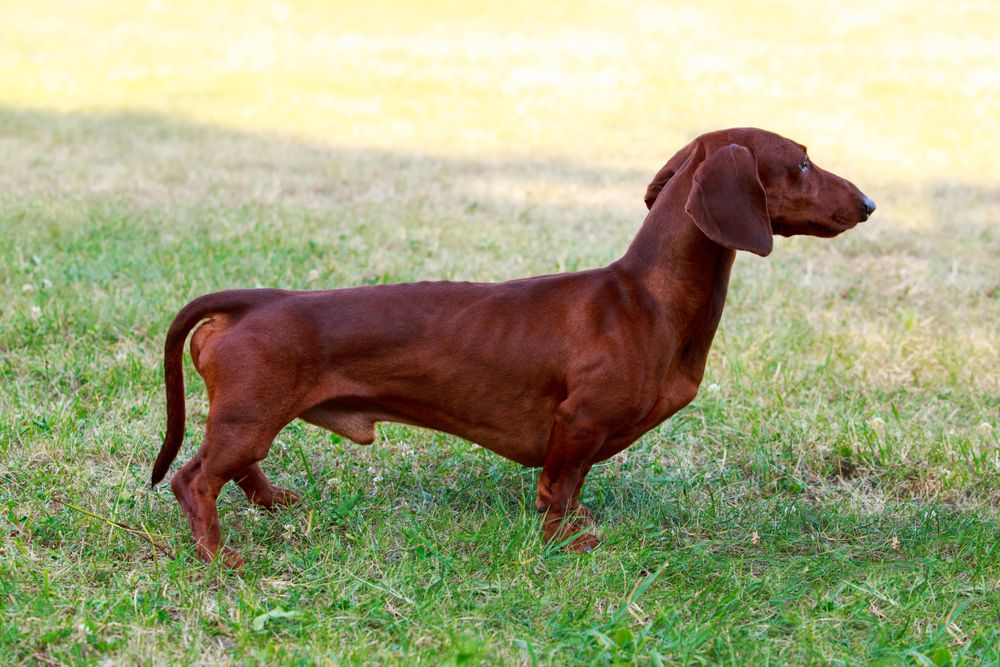
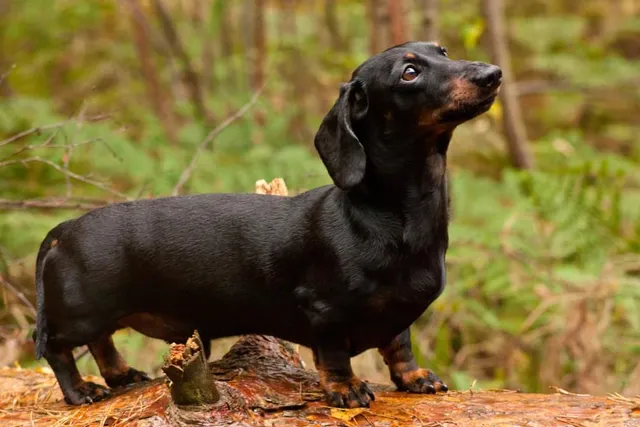
There’s no doubt the Dachshund is unique among canines. From their independent personalities to their short legs and long bodies, this is one truly distinctive dog breed. And though they’re known for their personalities, these dogs are probably most well-known for their intriguingly long body shape, which has earned them such nicknames as “Wiener Dogs” or “Sausage Dogs.” But why are Dachshunds so long?
The answer lies in this breed’s origins and what it was created to do. These canines were originally bred to hunt badgers who live in burrows, so they needed to be shaped to allow them to get into those burrows. This is why Dachshunds are so long!

How the Dachshund Ended Up With Their Shape

The Dachshund breed has existed since the 18th century when Germans began breeding a canine specifically to hunt badgers. These breeders knew these dogs would need to fit into badger burrows, which meant they had to be narrow with short, curved legs. This breed’s feet needed to be shaped like paddles to help the dogs make their way underground, and they needed broader chests to allow for an impressive range of motion with their front feet as they dug into the ground. That broader chest was also needed to provide room for larger-than-average lungs and a big heart, which were necessary to keep the Dachshund going as it spent hours exploring underground.
These German breeders knew what was needed in a badger-hunting dog, but they didn’t quite have this dog, so they began selectively breeding canines to acquire the traits they wanted in a single dog. Thus, the Dachshund, with their unique shape and long back, was born!
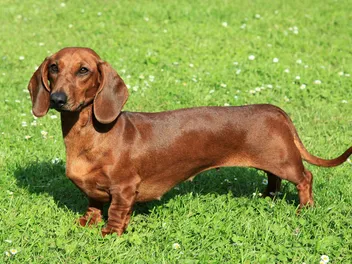
As these dogs became popular as pets rather than workers, breeders started focusing on dogs with a more petite frame, shorter legs, and longer backs, as these features were considered to be more aesthetically desirable. Further selective breeding resulted in the varieties of Dachshunds today, like the standard, miniature, wirehaired and longhaired.
The Health Considerations of a Dachshund’s Length

Dachshunds may not have much opportunity to hunt badgers today, but they still have the long back and short legs distinctive to them. As cute as this shape makes the breed, though, it does result in several health issues one should be aware of before adopting one of these canines.
These dogs are considered chondrodystrophic, which means the characteristics of the breed that were selectively bred, such as the short legs, have resulted in these dog’s bones developing deformities over time. Dachshunds ended up with curved bones in their front legs, which is what gives them their bow-legged appearance. ometimes, the breed’s bone deformities are more extreme, leading to arthritis, pain, trouble walking, or issues in the joints.
This breed’s length also causes issues. Despite their extreme length, a Dachshund has the same number of vertebrae as any other mammal, just grown longer. As a result, the Dachshund is prone to intervertebral disc disease (IVDD), a spinal issue caused by slipped or bulging discs. Up to 25% of this breed will experience IVDD, but how it affects them depends on the severity. In the most severe cases, a dog could become paralyzed in all four limbs.
The length of the Dachshund also requires the dog parent to always be careful to protect the back. This means that when a Dachshund is held, the back paws should be supported to help keep the back in proper alignment. Dachshunds also shouldn’t jump up and down onto things, as even a short jump (or fall) could cause issues with the spine. Even running up and down stairs can put unnecessary strain on the spine. This breed should also be watched for obesity; if a dog becomes overweight, it causes the muscles of the back to experience more strain.
So, as cute as the Dachshund's long body shape is, it can cause serious health issues. One must be careful with these dogs and teach them to be careful with themselves!

Final Thoughts
Dachshunds are adorable pups with a unique shape, but there’s a reason they look the way they do. The breed’s body length and short legs are due to selective breeding, which began when the breeders needed a dog that would fit into badger burrows.
Unfortunately, the length of these canines means they often have back problems, specifically IVDD, which can be severe. If you have a Dachshund, it’s vital that you always protect their back and teach your pup how to be careful with things, such as jumping on and off objects!
Featured Image Credit: Olga Aniven, Shutterstock
Expert dog care, straight to your inbox
News, insights, expert advice, and everything dog.

No spam — unsubscribe anytime.
By signing up, you agree to our Terms & Conditions and Privacy & Cookies Policy.
How useful was this post?
Click a star to rate. You can leave written feedback afterwards. (We read all feedback.)
Misty Layne lives out in the woods in small-town Alabama with her two Siamese - Serafina & Jasper. She also has an array of stray cats, raccoons, and opossums who like to call her front porch home. When she’s not writing about animals, you’ll find her writing poetry, stories, and film reviews (the animals are, by far, her favorite writing topic, though!). In her free time, Misty enjoys chilling with her cats, playing piano, watching indie and foreign films, photographing abandoned places, and catching up on her never-ending TBR list.