What Were American Bulldogs Bred For? Vet-Reviewed History & Facts


In this article
View 4 More +The American Bulldog we know and love today is a great family dog with a powerful, stocky build. So, what were American Bulldogs bred for? This dog was originally bred to be a farm utility dog, family companion, and protector. The American Bulldog is a direct descendent of the English Bulldog that landed on American soil hundreds of years ago.
Whether you have an American Bulldog or are thinking of getting one, you may be interested in finding out more about this breed’s background. Therefore, we’ve put together this fascinating history of the breed so you can learn where this noble dog got its start.

American Bulldog History
The history of the American Bulldog starts when English working-class settlers brought their English Bulldogs to America in the 17th century. During these days, America was still a British colony and a young, struggling nation facing many obstacles.
The harsh, unforgiving living conditions farmers endured in the southern part of America demanded a working dog that could handle a wide range of tasks including herding cattle, warding off predators, and protecting the homestead. They found the English Bulldog to be the perfect solution as this sturdy, hard-working dog seemingly could do it all.
As time marched on, people started calling the hard-working English Bulldog the American Bulldog, even though there were no official national dog clubs at that time that set standards for breeds.
As feral pigs were introduced to the American ecosystem, their population quickly grew due to them having no natural predators. Farmers, therefore, had to rely on their Bulldogs to keep these animals away from their land.

The Breed Was Revived Following World War II
Even though this strong and muscular dog was relied on heavily for the hard work of herding, protecting, and killing vermin, the breed became threatened with time as nobody was looking after the breed to ensure it would thrive.
By the end of World War II, the American Bulldog was nearly non-existent, except for some in the southern part of America. But thanks to a fan of this breed and a returning war veteran named John D. Johnson, the American Bulldog breed was revived and appreciated once again for its tenacity, strong body, and loyal and protective nature.
Johnson went to great lengths to capture several breeding specimens of the American Bulldog in densely wooded areas of the South. He was soon joined by another fan of the breed, Alan Scott, who took some top American Bulldogs from farmers in the South and infused their genetics into Johnson’s dogs’ bloodlines.

Several Bloodlines Were Established With Two Prevailing Favorites
The hard work of Johnson and Scott helped resurrect the American Bulldog and save it from near extinction. However, because this breed was relied on to do so many things, several bloodlines were established, with each one focusing on the physical traits needed to perform that specific function.
The Johnson-type of American Bulldog was one of the best-known lines. This dog had a bulky body, heavy bones, and a large head. The Scott-type was another well-known line that became popular due to its more moderate and athletic build. Today's modern American Bulldog is considered a hybrid of the Johnson and Scott variants.
The Modern-Day American Bulldog
The American Kennel Club’s (AKC) Foundation Stock Service first recognized the American Bulldog as a purebred dog breed in late 2019. In case you’re not familiar with the Foundation Stock Service, this is an optional breed registry service the American Kennel Club provides for new purebred dog breeds yet to be recognized by the AKC.
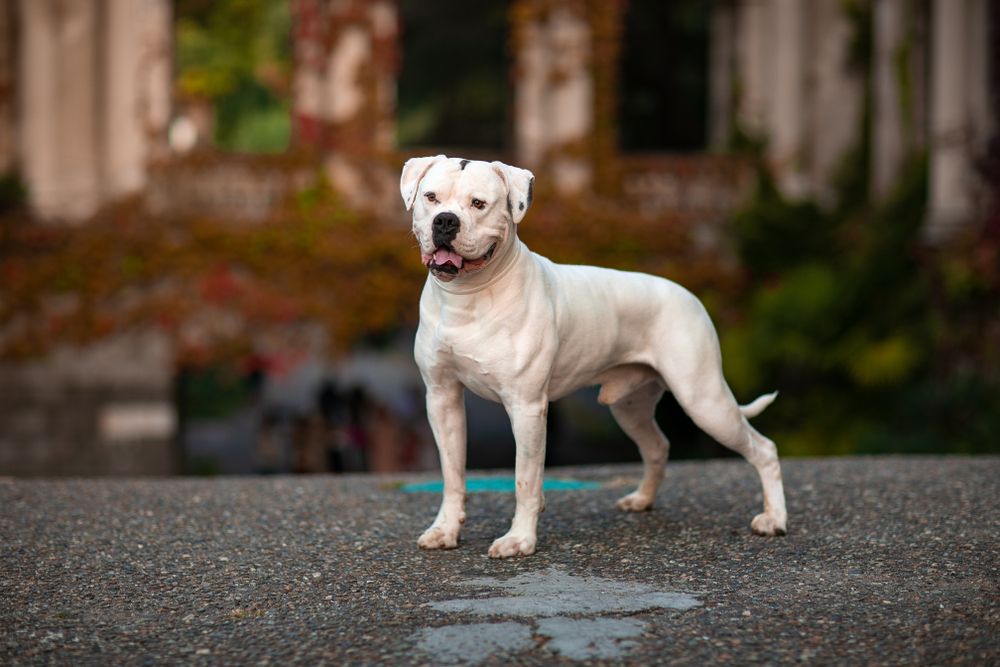
The American Bulldog we know and love today is a powerful, athletic, short-coated dog that’s muscular and big-boned. This dog ranges in height from 22–25 inches and can weigh between 60–100 pounds. The males are typically larger and stockier than the females. Both males and females have large, broad heads with ears that are small to medium in size that can be high-set, droopy, or semi-erect.
While most American Bulldogs are mainly white, they come in many other coat colors, including white and black, white and brindle, and white and tan. Acceptable coat markings include tan, black, red, brown, and brindle.

A Great Temperament in a Powerful Body
As far as temperament goes, the American Bulldog is friendly, energetic, loyal, confident, dominant, and gentle. The typical American Bulldog is very family-oriented and especially fond of children.
This dog loves being involved in family activities and always enjoys being part of the gang. This breed is part watchdog, part lap dog, and part gentle giant.
Without a doubt, the American Bulldog has come a long way from its early hard-working days as it’s made its way into the hearts and homes of many American families.
Conclusion
Originally, the American Bulldog was bred for the purpose of being a farm utility dog and a trusted companion and protector. Over the years, this dog breed has seen its share of ups and downs, and it nearly became extinct at one time.
Thanks to the work done by two American Bulldog lovers following the Second World War, this breed made a big comeback! Today, the American Bulldog is loved around the world for its beauty and pleasant temperament.
Related Read: EngAm Bulldog (English Bulldog & American Bulldog Mix)
Sources
Featured Image Credit: Golland, Shutterstock
Expert dog care, straight to your inbox
News, insights, expert advice, and everything dog.

No spam — unsubscribe anytime.
By signing up, you agree to our Terms & Conditions and Privacy & Cookies Policy.
How useful was this post?
Click a star to rate. You can leave written feedback afterwards. (We read all feedback.)

Nicole has loved animals of all sizes her whole life so it's no wonder she has dedicated her career to helping them through what she loves best: learning, writing, and sharing knowledge with others. She’s the proud mom of two dogs, a cat, and a human. With a degree in Education and 15+ years of writing experience, Nicole wants to help pet parents and pets around the planet to live happy, safe, and healthy lives.