In this article
We love our canine friends just like family. If there is one thing any pet owner would change about having a dog, it would probably be how long your dog’s lifespan is. But what if there was a way to take your dog’s DNA and recreate them after they have passed away?
No, we don’t mean Frankenweenie-style. Cloning is still a new concept to the general public, so people have a lot of questions about how it works. Yes, you can clone a dog. If you are considering cloning, or just want more information about the topic, we would love to explain on scientific, financial, and moral scales.

What Is Cloning?
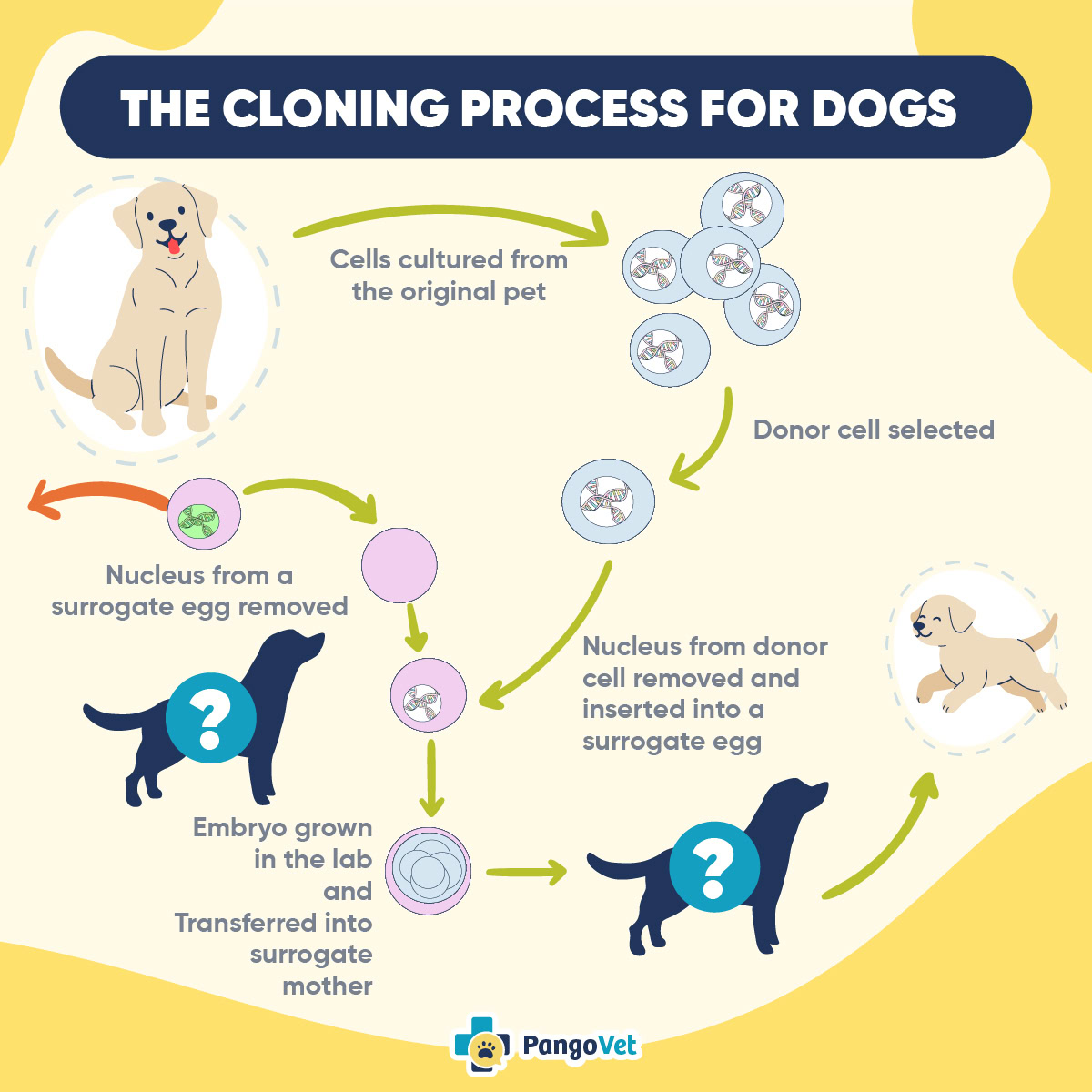
Cloning is the process by which DNA is extracted from an animal and replicated in a host egg.1 The process of cloning is simple in theory. However, much goes into it, and science is still far from perfect.
Essentially, scientists take a mature somatic cell and transfer it into another animal’s egg cell. First, they strip the egg cell of its nucleus to remove the host egg’s genetic information. The next step is to implant the somatic cells of the animal to be cloned into the empty host’s egg. An electrical current is used to fuse the egg and somatic cell resulting in a fertilized embryo.
When an embryo is still in its early stages, it stays in a test tube. Once it reaches a particular stage of development, the embryo is then placed into the womb of a healthy adult female dog. The dog acts as a surrogate, carrying the pregnancy to term and delivering naturally.
History of Cloning
Facilities have been trying to clone for many years successfully. The first successful clone presented to the public was Dolly the sheep in 1996. Once Dolly was successfully born, cloning really took off as the replica of a real sheep.
Since Dolly, there have been several species of animal cloned, some of which include:
- Cattle
- Swine
- Sheep
- Goats
- Rats
- Mice
- Cats
- Rabbits
- Mules
- Horses
One company that goes by the public name Clonaid claims they can clone human beings. On December 26, 2002, the company announced their first-ever cloned baby named Eve. Bur since they’ve never shown any proof of the cloned child, there can be no drawn conclusions on the success of human clones.
In 2006, Sooam Biotech Research Foundation was created in Seoul, South Korea, which is a biotechnology cloning headquarters. They have reportedly cloned 600 dogs according to numbers in 2015. Numbers have likely grown exponentially in the past 7 years.
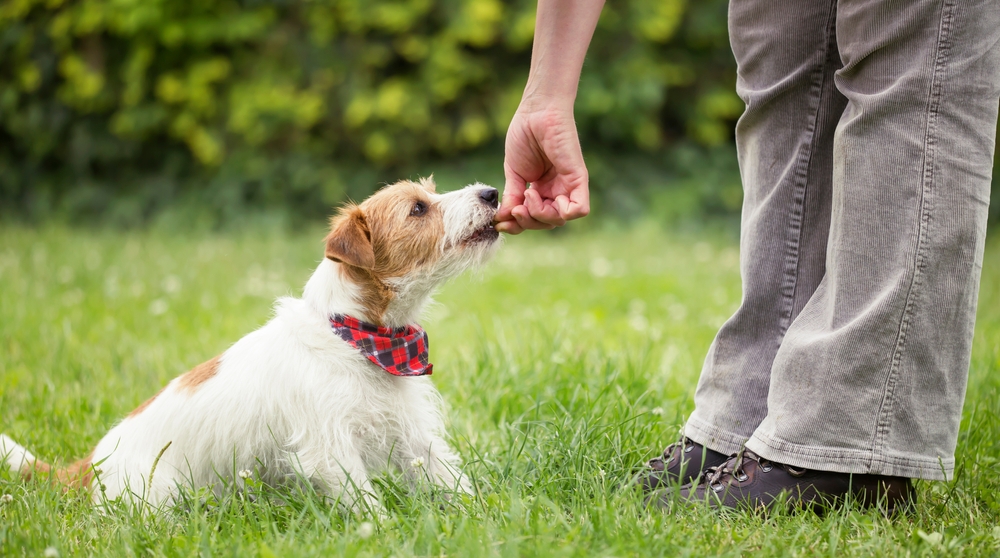
At a company named ViaGen Pets in Texas, the very first dog was cloned successfully. It was an adorable Jack Russell named Nubia. Nubia seemed to thrive like any other dog, having a peppy, happy-go-lucky approach to life. However, her character was very different from her original counterpart.
Since cloning began, there has been some serious debate about how it should be performed and concerns over the wellbeing of the clones. After all, it poses so many questions—especially when cloning humans.
Cloning is a foreign concept to most people. Lots of people understand the basic idea of cloning but don’t realize all the details that really go into it. When it comes to committing to having your pet cloned, there are some things you need to know.
Legalities About Cloning
When it comes to the legalities of cloning, it’s a whole other ball game. It seems there are still quite a few discrepancies on this reproduction method. Laws vary by state, and the FDA has an entire portion of the website dedicated to cloning information.
There are a few states where cloning is not welcome, while others have a “clone and kill” policy. Many of the reasons most scientists clone is to boost the agricultural aspect of life.
So, ultimately, the reasons we continue to clone animals have less to do with keeping our brilliant pets alive and much more to do with the economic upsides it offers for farming.
- Arizona
- Arkansas
- Oklahoma
- Michigan
- Indiana
- Virginia
- South Dakota
- North Dakota
That means you can’t clone for any purpose in those states.
Prices of Cloning
The prices of cloning can vary depending on the facility, but the general cost of the process is $50,000.
Are Clones Viable?

One worry is that cloning isn’t as successful as scientists would hope. Since cloning looked promising for mass farming industries, the process actually took much longer than anticipated. So, it poses the question of the effectiveness, time-friendliness, and additional upsides to cloning.
For instance, when Dolly the sheep was cloned in 1996, 277 tries created 29 viable embryos. Yet, even still, only one survived. So, it isn’t a very effective method to reproduce quickly.
There is no guarantee that the cloned entity will look identical. It could look very different due to environmental factors, yes. Suspicion leaves a doorway open to more health issues.
On top of paying the initial fees to have your dog cloned, you must consider any unexpected vet care and decreased lifespan that might be associated with cloning.
Cloning: Expectation vs. Reality
While cloning only has a 2%-3% chance of taking hold and uses several potential eggs to get a successful embryo, having a cloned animal might even be grimmer for some owners. The entire reason why you likely want to clone your pet is to have that exact same pet again.
What you might not realize is that even though they share the exact DNA with your beloved pet, they still will have their own quirks and personality. If you go the scientific route, one might say that different environmental influences can change personality development.
For example, the brain can develop differently due to epigenetics, environmental and social factors, and mere happenstance.
Other more metaphysical ideas might come from the idea that your animal’s existence is only partially their DNA. Another part comes from science that we don’t yet understand. You’re getting a carbon copy of your pet, yet their spirit is still not the same.
Regardless of what you believe, the fact remains that cloned pets just are never quite the same as their original selves. So, before you get a clone of your dog, you need to understand the emotional implications that it could have on you and the pet.
Sometimes psychologically, we can be expecting one result and get disappointed when that result doesn’t play out. It would be a real shame to spend such a large amount on something if you were just going to be let down by the reality.
However, we don’t know what happens behind the curtain. Only so much information is available to the public.
We might be far more advanced in cloning than we realize, which will only come to light once the science is solidified.
Personality
Many people assume that their clone will share the same personality that their original pup had. However, this isn’t the case. Several genetic and environmental factors play a role in developing character. So, no matter what scientific reason backs the outcome, the personality is just never quite the same.
Remember, a clone of your pet is comparable to your dog having an identical twin. It is not a total replica of your pal.
Lifespan
Lifespan is usually about the same between the clone and an organic pet, although studies have observed premature aging. Because of complications with developing clones long-term, they can suffer health issues more frequently and on a larger scale, potentially speaking.
However, there is not enough collectible data on the lives of cloned pets to have solid answers on the lifespan of any one animal.

Cloning Companies
There are several biotechnology companies across the globe that study cloning and its effects.
Clonaid
Clonaid is an American-based cloning company located in the Bahamas. They are the first company with claims of cloning human beings, saying that a little girl named Eve was born in December of 2022. There was never any proof to support these claims.
Clonaid turned into somewhat of a New Age cult, claiming to worship aliens and believe that cloning is one step toward immortality. Clonaid does not do private pet cloning for the public.
ViaGen Pets
ViaGen Pets is a company based in Cedar Park, Texas, that specializes in cloning pets. You can pay a whopping total of $50,000 (not including hidden or additional fees) to have your dog recreated. Also, they have other services, including freezing a DNA sample of your loving dog for the future.
The company offers tons of valuable information on its website. Plus, they have readily available associates to answer any questions you might have.
Should You Clone a Dog?

There is much speculation as to the implications of cloning. There is so much to consider regarding science, ethics, and financial viability. Only you can decide if cloning is the right solution to make your beloved pup’s memory live on.
- You can financially afford it
- You realize it is not going to have the same personality
- You understand that it is merely a copy of DNA
The truth is, that cloning your dog isn’t really bringing your original dog back to life. It’s simply creating an identical twin of your pooch that will have the same physical structure. While this might fill a void for some grieving owners, it might also set false expectations for the newcomer.
Final Thoughts
We have to remember that cloning is merely mirroring DNA. This pet will not share the memories, moments, and connection that you and your precious pup shared; they will only look the same. But if having a replica of your dog again will soothe a missing piece of you, that’s your call.
You can always choose to rescue a homeless dog at a local shelter that needs a home and love immediately. They might not be what your dog was, but they have something unique to offer all on their own. Plus, $300 is a lot less than $50,000—and you are giving a dog another chance at life.
Related Reads:
Featured Image Credit: Zuzule_Shutterstock