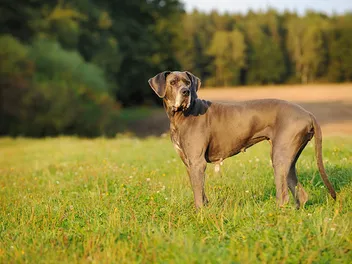
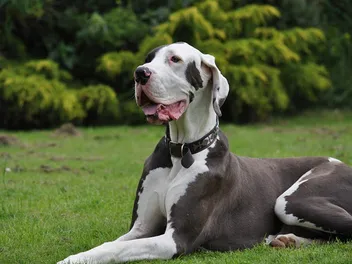
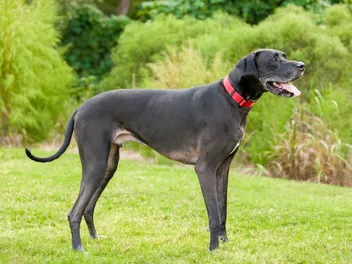
When Will My Great Dane Calm Down? Causes of High Energy & How To Counteract It

In this article
When introducing a new puppy to the family, a good degree of exuberant behavior is expected. This can be challenging for humans and other pets in the home, not to mention the furniture, the carpets, and your shoes!
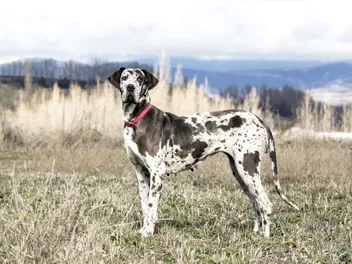
It’s even more challenging when your new doggie is a Great Dane pup roughly the size of a full-grown, medium-sized dog. A few months in, and you might wearily wonder when your bundle of joy will start mellowing out.
Well, there’s good news and somewhat bad news. The good news is that Great Danes don’t have a reputation for being a hyperactive breed, so your pup will calm down. The bad news is that this giant canine has a longer puppy phase than other breeds. As a result, the lively puppy behavior may continue until your doggie turns two.

The 6 Reasons Why So Your Great Dane Has So Much Energy
Your pup’s age is probably the main reason for their high energy levels, but there can be other reasons. If your colossal canine is beyond their puppy years and showing no signs of calming down, it’s time to consider other reasons. Let’s take a look at some possibilities.
1. Age
As mentioned, age is likely the most apparent reason for your gentle giant’s high spirits. With most animals, playfulness and high energy are key attributes of the pre-adult phase, and Great Danes are no exception. However, Great Danes mature more slowly than smaller breeds and are puppies until they are 2 years old.
They can reasonably be expected to begin to mellow as they ease into adulthood between the ages of 2 and 3 years.
2. Boredom
A lack of stimulation and engagement can exacerbate a puppy’s feisty behavior, but even a mature dog can display erratically hyperactive behavior under these conditions. If your adult dog is not settling down, has become excessively vocal, or has begun to exhibit destructive tendencies, it might be because they're bored.
Great Danes were originally bred as hunting dogs, so it is not in their genes to be content with lying around all day. However, as a generally mellow breed, many may be accepting of a relaxed lifestyle once they are fully grown.

3. Insufficient exercise
As a working dog bred to be active in the field, your Great Dane requires daily exercise as part of their care regime. Neglecting this may lead to behavioral issues, such as unmanageable hyperactivity, destructiveness, and obstinacy.
4. Not enough attention
You are the center of your dog’s universe, and if you don’t let them know that they’re loved, you could end up with a very unhappy canine. Each Great Dane is an individual, and their requirements for affirmation will differ. However, every Great Dane requires love and attention from their owner.
A lack thereof can result in manic, attention-seeking behavior or, on the other end of the scale, depression and lethargy.
5. Inherent Character
Even if you are the model pet parent who dotes on your Dane with regular game-playing, love, cuddles, and walks, some Great Danes remain overly exuberant. Like any animal or human, some individuals are naturally lively. It's best to embrace your energetic pup's liveliness and channel their energy in appropriate ways.

6. Anxiety
If you are convinced that none of the previous reasons accounts for your Great Dane’s crazy behavior, you might want to consider anxiety as a possible cause. Anxiety doesn’t always show up as nervous or skittish behavior. Other signs can include hyperactivity, clinginess, decreased appetite, panting, and destructiveness.
Some causes of anxiety in Great Danes are separation from their beloved humans, noisy or busy environments, and a lack of routine. Depending on the dog, there could be any number of other triggers. The only way to get to the bottom of it is to be patient and observant, make slow, calculated changes in their environment, and see if there is an improvement.
If you are uncertain, check in with your veterinary practitioner or an animal behaviorist.

Are Female Great Danes Less Hyper Than Males?
Many dogs display marked sexual morphological and behavioral differences. Often, adult females tend to be calmer and more sensible than males. As an owner of a young female Great Dane, you may be wondering whether her sex will ultimately result in her being calmer.
The answer is no. There are no indications that high energy levels in Great Danes are more prevalent in one sex. Your female Dane is just as likely to be a boisterous damsel as your male.
Will Spaying Or Neutering Help Calm Them Down?
Many owners of unmanageable and hyperactive dogs have experienced great success with calming them down by spaying or neutering them. Often, the wayward behavior is hormonally driven, so removing the source of the behavior can have beneficial results.
Similarly, spaying and neutering could have a calming effect on hyperactive behavior, provided it is due to hormones. In males, neutering may assist in lessening any developing aggressive behavior, but it may not address hyperactivity unless it is hormone-driven. In females, spaying will halt any difficult behavior associated with the heat cycle, such as restlessness and roaming.
Current guidelines recommend spaying and neutering only once the dog has finished growing. For large dogs, this is suggested to be between 5 and 15 months old. However, we know that Great Danes only finish growing around the 20-month to 2-year-old mark, so it may be best to delay until then.


The 4 Methods on How To Calm Your Great Dane Down
Considering these key reasons why your big guy or gal has over-the-top energy, there are—fortunately—solutions at hand. Have a look at the following suggestions. One or more likely a combination of these may have a positive effect on your big dog’s behavior.
1. Exercise
The best solution for excess energy is to burn it off! Great Danes require daily exercise as part of their routine, and puppies need at least 90 minutes of age-appropriate exercise.
Care should be taken not to overstress their still-developing bones, joints, and muscles. Adults can get by with around an hour of daily exercise. Long leisurely walks interspersed with an off-lead gallop (if possible) are great. A short early morning run-around is a great idea to release all that post-sleep energy.
2. Routine
Great Danes benefit enormously by following a routine. Although they are a laid-back breed, a lack of routine can be unsettling. Try to instill structure into their daily lives by sticking to a routine.
Meal times, playtime, walks, and rest time are examples of daily activities that can be arranged into an easy-to-follow schedule. If your gentle giant knows what to expect and when, fear associated with uncertainty can be eliminated, resulting in a calmer, happier dog.
3. Mental Stimulation
Like us, Great Danes differ according to whether they are more physical or cerebral. Great Danes are intelligent, but if your Dane is incredibly smart, they may prefer games and training over simple physical activities like walking or running.
You can include training exercises in their daily routine. Encourage your Dane to think by teaching tasks like sitting, staying, and fetching. They’re capable of even more complex requests and training, and they are eager to please and respond well to rewards. Get them involved in problem-solving activities like doggie puzzles.
Even if your dog prefers mental stimulation over physical activity, the latter should not be neglected.
4. Environment
If your big dog is highly strung and prone to anxiety, careful consideration should be given to their environment. Creating a calm and quiet environment for a boisterous or anxious Great Dane goes a long way toward curbing mania.
Have a safe space to keep your dog's bed or a chill-out area away from noisy kids, bustling home activity, or other loud noises.
Set an example for your Great Dane by being quiet, calm, and deliberate around them. Work out when the best time is for exciting play and lively love and when it’s the right time for quiet cuddles and relaxation.


Conclusion
The most likely cause of your Great Dane’s liveliness is their young age. With patience, understanding, and applying some of the abovementioned suggestions, you can determine the best way to manage and enjoy your big pup.
With time, your Dane will mellow into the gentle giant typified by this majestic breed. If that proves not to be the case, then hopefully, some of the points discussed above will help you pinpoint the cause of their unsettled behavior.
See also:
Featured Image Credit: mtajmr_Pixabay
Expert dog care, straight to your inbox
News, insights, expert advice, and everything dog.

No spam — unsubscribe anytime.
By signing up, you agree to our Terms & Conditions and Privacy & Cookies Policy.
How useful was this post?
Click a star to rate. You can leave written feedback afterwards. (We read all feedback.)
Eleanor is a high school Science & Math teacher and freelance writer. She lives in the beautiful KwaZulu Natal Midlands of South Africa with her six-year-old son, cat, horse and three chickens. As an all-time animal lover, science graduate and life-long learner, she is overjoyed to be able to turn her passions into helpful and informative articles. Eleanor and her son love to explore their beautiful country in their spare time. Road-tripping to interesting camping destinations is a favorite hobby. They particularly enjoy relaxing near the ocean, in the mountains or surrounded by African wildlife.